High-Frequency Harvester
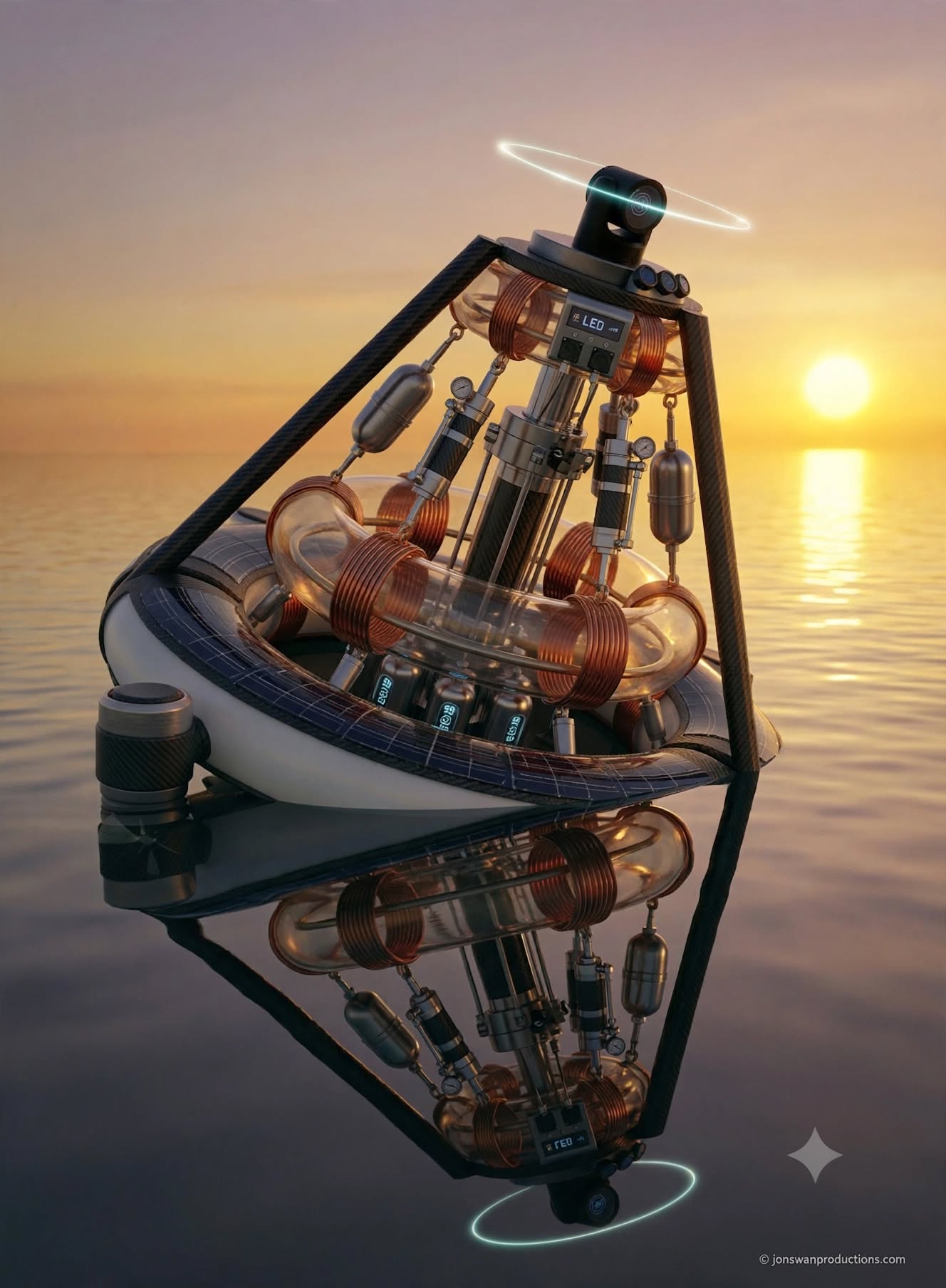
A wave energy harvester designed for fleet deployment. A heavy mass orbits inside a sealed toroidal chamber wrapped in copper coils — the motion of the sea becomes current directly, with the working parts never touching seawater. Solar and sensing on the same hull, so each unit returns ocean data as well as power. Larger vessels can deploy and link many of these across open water.
Read the Technical PaperThere is more than enough energy in water, waves, wind, and sun to power the entire planet. Our mission is to harvest it, deliver it as close to free as possible — and put it in the hands of the people who live beside it.
The ocean never stops moving. The wind never stops blowing. The sun never stops shining. These forces are abundant beyond measure, and they belong to no one — so the energy we draw from them should belong to everyone.
We are building wave energy to be owned and governed by communities — not controlled by a distant monopoly that raises the price whenever it pleases. Each coastal town can generate, own, and govern its own clean power. No one should control power. We the people should. That is what it means to democratize wave energy.
This is a mission of peace.
Throughout history, the root cause of conflict almost always comes down to resources. When resources are shared and abundant, the reason to fight disappears. Energy poverty is a choice humanity no longer needs to make — and neither is the conflict it breeds.
A fleet-ready autonomous energy vessel designed to harvest every force the ocean offers.
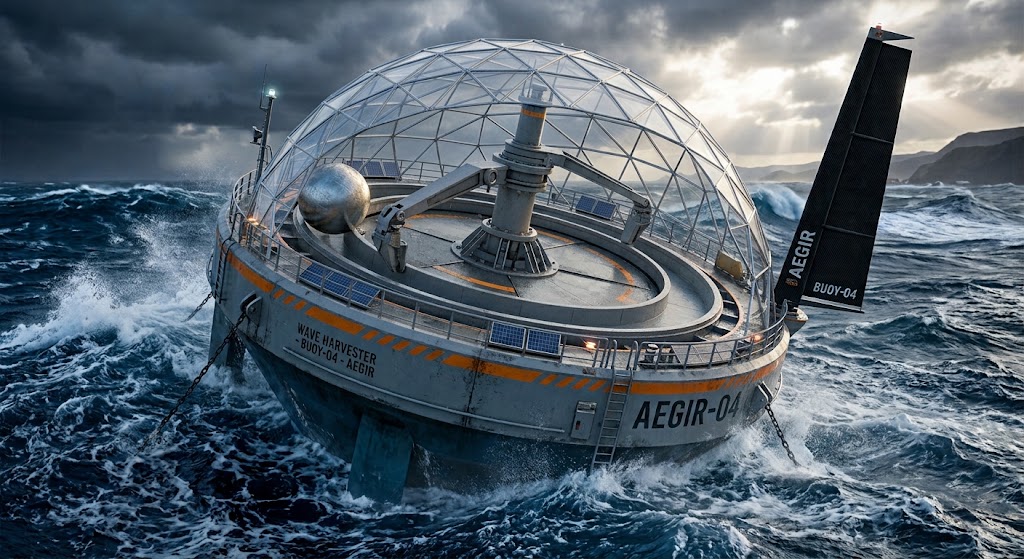
PHASE 1 — BUILT. A heavy sphere sweeping a banked circular track on a rotating arm, driving a shaft to the power take-off below. This configuration is assembled and running in a wave tank, from parts already on hand. Characterization — coast-down, output against load, output against wave input — is targeted for the end of November 2026.
Designed next, on the same hardware: three concentric tracks instead of one. The sphere runs the outer track in small seas — longest lever, most torque, most output from the least energy — and transfers to an inner track as conditions build, shortening the lever and de-rating the machine before the sea can overload it. The tilt of the wave supplies the energy for the transfer, so nothing has to actuate it, and the arm flexes at a joint like an elbow to guide the sphere across. It changes gear the way a bicycle does, but with no variable transmission to build or maintain. The transfer is a hatch, not a switch: the inner tracks sit lower, so opening a gate in the floor lets the sphere simply fall to the next one — which means no track has to blend its bank angle into another, and the gate defaults open, so a dead controller de-rates the machine by itself. The failed state is the survivable one, with nothing sprung and nothing powered.
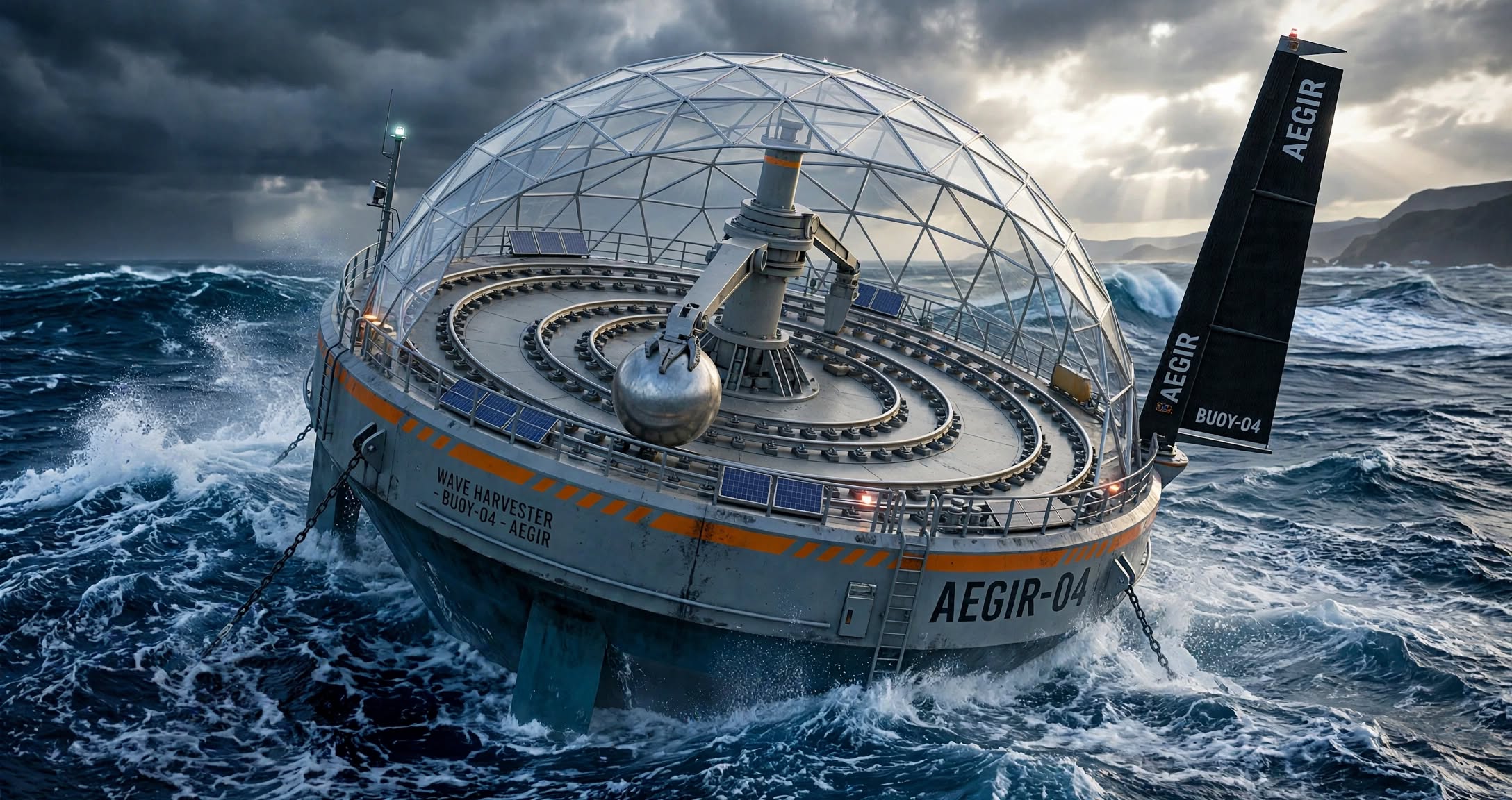
The three tracks and the elbow in the arm are both visible here. The tracks are a design, not a build — the demonstrator in the tank runs a single track today.
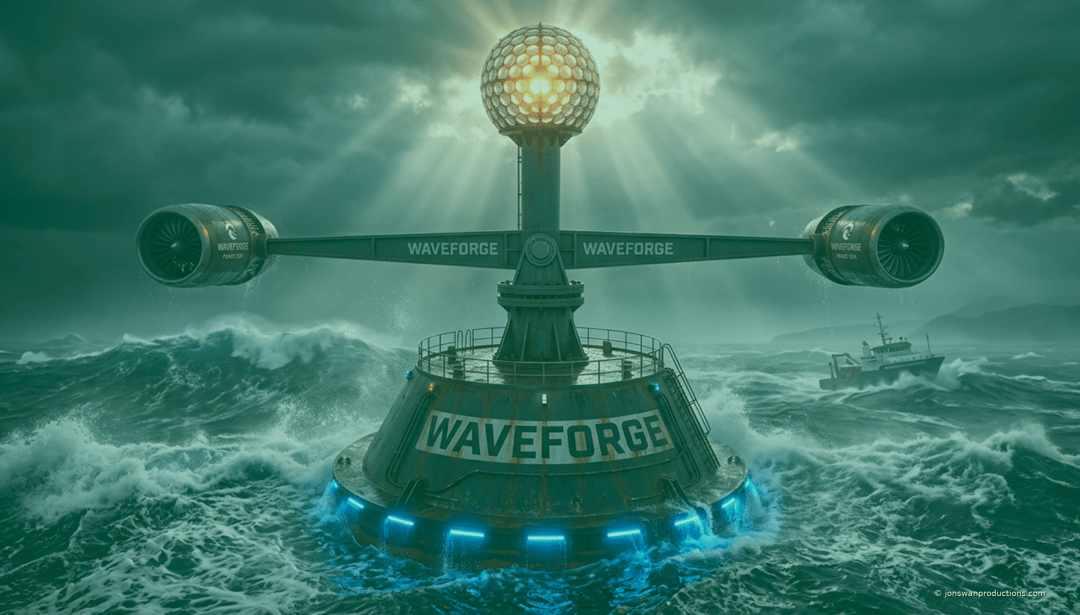
PHASE 2 — CONCEPTUAL. Substantially larger, with four systems the demonstrator does not have: teeter-totter generation through the central pivot, ballast carried in the arms rather than the hull base, hydraulic arm height adjustment, and propulsion by reversing the nacelles.
These interlock rather than simply accumulate — the arms hold the ballast, the height sets its lever arm, rotation aims it, and differential pivot sets its magnitude. One structure, four jobs. This vessel is a design, not a build, and is described as such deliberately.
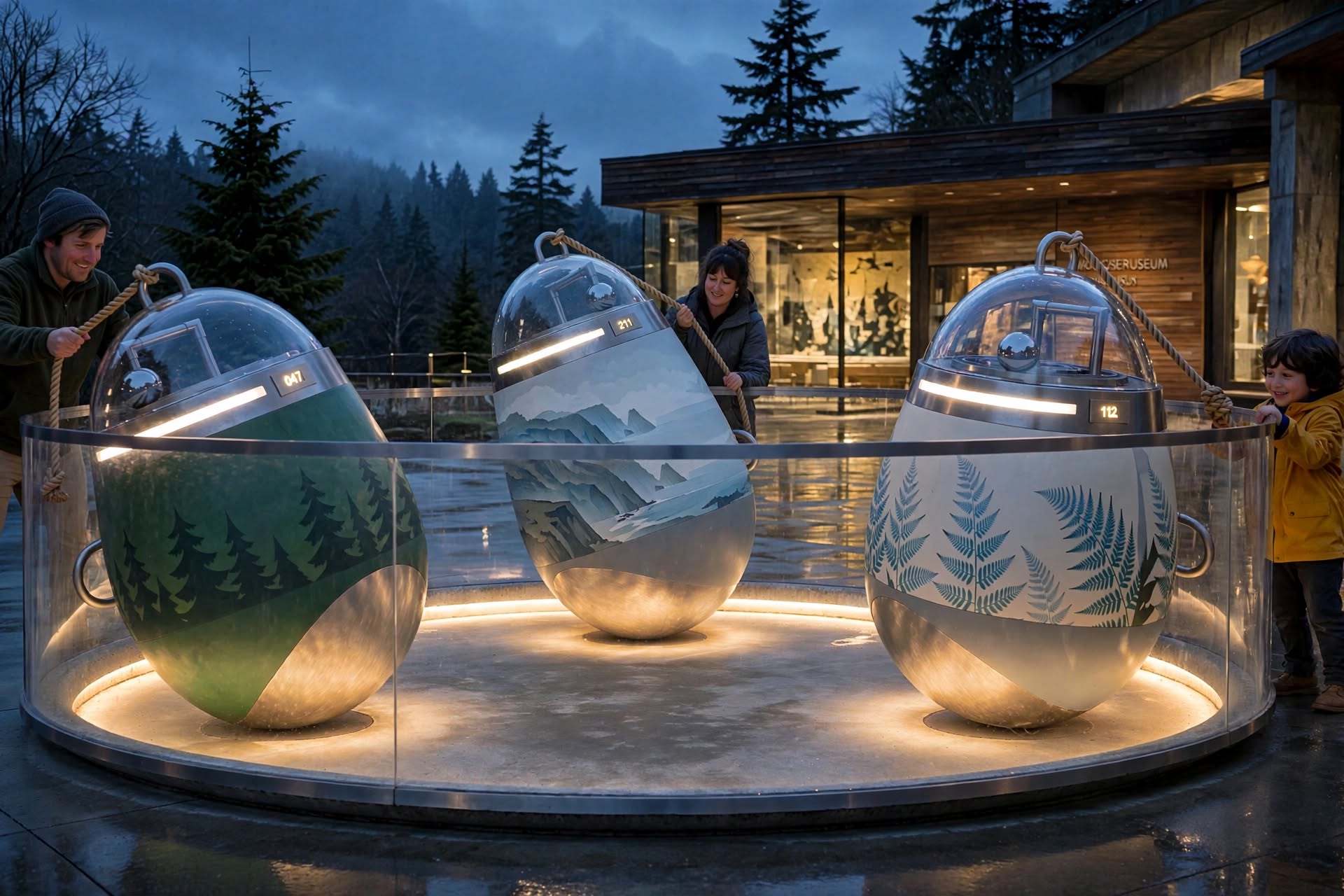
The same mechanism works on land. Three weighted sculptures, about five feet tall, each rocking and righting itself under a clear dome — concentric banked tracks, a heavy sphere on an arm, coils below, and a live readout of what each one is making.
PROPOSED EXHIBIT — CONCEPT. The three units share one shell and differ only in where the ballast sits. Period goes as the square root of the height of the center of gravity, so ballast height alone sets the rhythm — tuned about a fifth apart. Find one rhythm and only one of the three responds. That is the case for a mixed fleet, with no placard required.
They are worked by rope from outside a shared enclosure, so nobody is ever near the moving mass — and because a rope can only pull, the visitor has to find the natural period to get a response. The safest version of the exhibit turned out to be the one that teaches resonance.
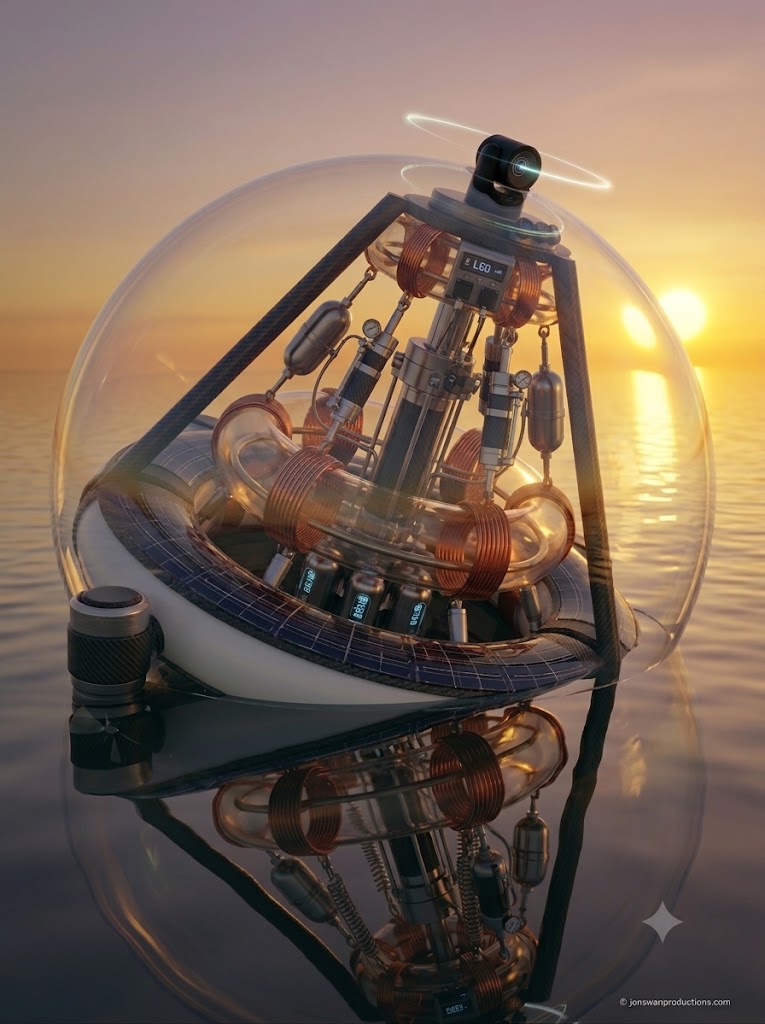
The cover is off in this view so the mechanism can be seen. In service it is closed — the working parts never meet seawater, and that is the whole point of the architecture rather than a detail of it.
The torus and the copper. A heavy mass travels inside the ring, and the coil bands around it turn that motion into current. There is no gearbox between the sea and the electricity, and nothing rotating passes through a wall into the water — the two things that most often end an offshore machine's life.
The central column. Fluid cylinders and small pressure vessels. They carry the load, store energy between waves, and let the machine be tuned to a sea state without anything being taken apart.
The ring and the mast. Solar on the collar, sensing on the mast. A buoy that is already moored in open water is a good place to measure the ocean, so each unit is intended to return data as well as power. That is a second product from hardware you were installing anyway.
The frame. Carbon fiber. Weight is the constraint that governs everything else in this design, because a unit that two people cannot handle is a unit that needs a vessel every time it is touched.
This is a concept rendering, not a photograph of a build. The benchtop demonstrator that exists today is the single-track machine further up this page.
Waves are abundant but variable. Tides are the opposite: smaller, steadier, and predictable years in advance — four times a day, on a schedule set by the moon rather than the weather. The two together are worth more than either alone.
TIDAL STATION — PATENT PENDING. A hollow caisson, ballasted with water, rides guide rails as the tide fills and empties the basin. It is lifted by buoyancy on the flood and lowered by gravity on the ebb, and both directions turn generators. Turbines in the inlet and outlet channels take a second share of the same water.
Why the pair matters more than the parts. A community cannot run on a source that stops. Wave energy is plentiful in a storm and thin in a calm; tidal is modest but arrives on a timetable you can print a year ahead. Their outputs are not correlated, so the combination is far steadier than either — and steadiness, not peak output, is what decides whether a place can actually depend on it.
They also sit in different water. The buoys work offshore, where the energy is. The tidal station works at the shoreline, where the grid connection already is. One network, two positions, and the cable that joins them is short.
Which is the point of all of it. Not a single machine and not a record output figure — a small network of unremarkable units, in ordinary water, producing enough hours of the day that a coastal town could stop burning diesel to keep its lights on.
Concept diagram. The tidal station is a design with a provisional filing behind it, not a built machine. The demonstrator that exists today is the single-track wave harvester further up this page.
A balanced horizontal arm with dual jet-engine nacelles swings through a flywheel-lazy susan as the vessel rocks in ocean swells. The same nacelles harvest wind at sea and reverse into thrusters for autonomous redeployment.
A Fresnel magnifying lens dome crowns the central mast, concentrating sunlight into fiber-optic bundles routed to a thermal core. Maximum exposure from the highest stationary point on the vessel.
The unified flywheel-lazy susan rotates the entire seesaw assembly to face incoming swells head-on. One component serves as energy storage, rotation platform, and pitch harvester simultaneously.
Nuclear plants melt down. Grids fail. Wind turbines shut down. WaveForge is the only major energy technology that gets more productive during the conditions that destroy other forms of energy infrastructure.
Earthquakes don't crack the foundation — there is no foundation. Tsunamis don't flood the system — the swells fuel it. Storms don't force a shutdown — the OIMH harvests harder.
Read the Full Case →No subsea cables. No grid connection. WaveForge produces green hydrogen at sea from seawater electrolysis — compressed, stored, and transferred to cargo vessels mid-ocean.
Grid connection is what has stopped wave energy, not the waves. For a small array the export cable costs more than the machines it serves. Make a storable product at sea instead and the cable problem disappears — along with the need for anyone's permission to connect.
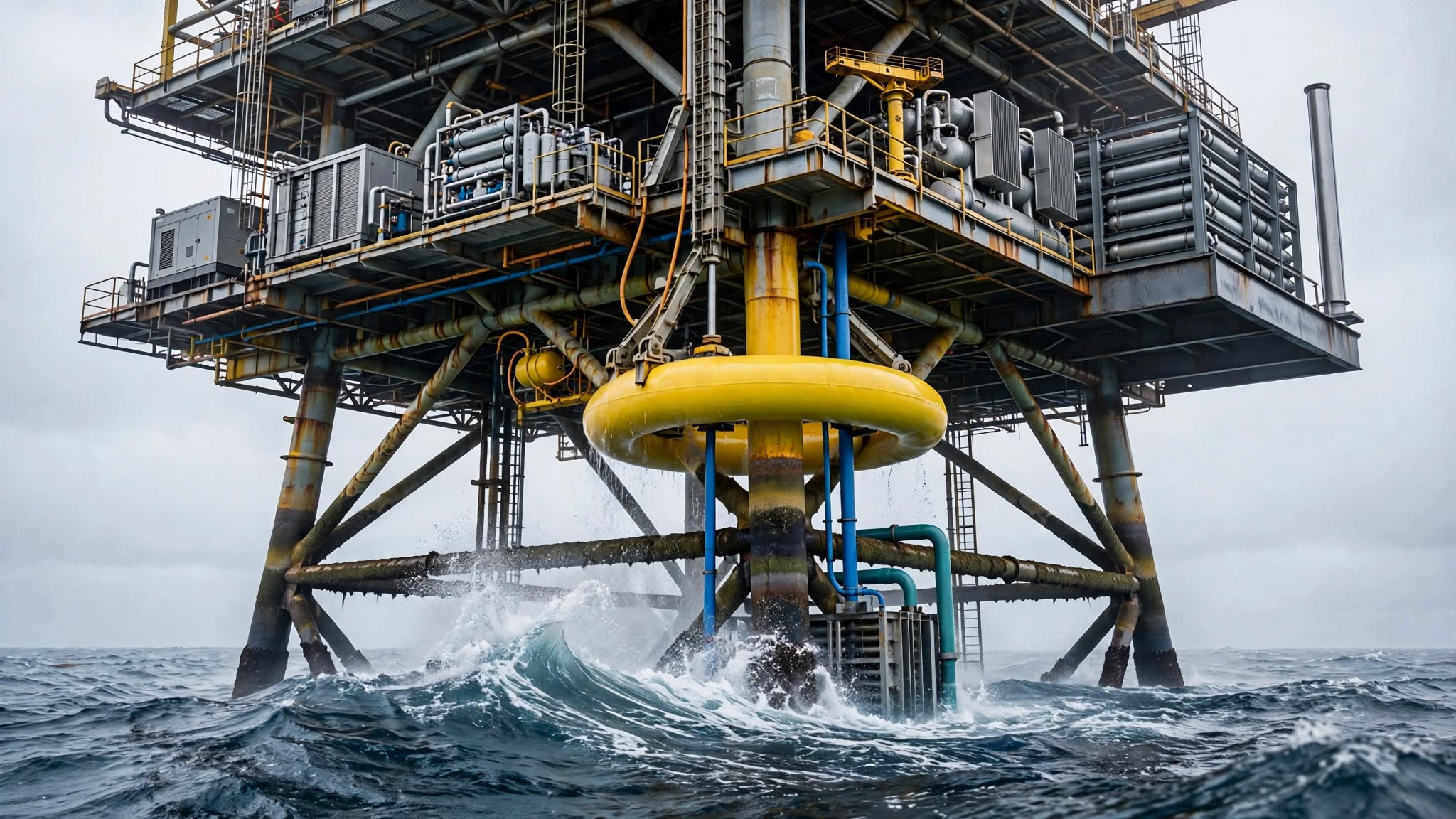
Learn MoreThere are thousands of offshore platforms approaching decommissioning. Removing one costs tens of millions of dollars. We think several of them are worth more standing.
Floating converters have to react against their own inertia or a mooring line — both ends of the machine are moving, which is why so many of them struggle. A platform is founded on the seabed. A machine mounted to it reacts against the planet.
Liquid hydrogen requires 20 kelvin — 253 degrees below zero — and liquefaction consumes 10 to 13 kilowatt-hours per kilogram against hydrogen's own 33. It burns a third of the energy you just made, then boils away in storage. Compression to pipeline pressure costs a fraction of that, and it is required either way.
Electrolysis rejects a fifth to a third of its input as heat. An offshore platform sits in an effectively unlimited eight-to-fifteen degree heat sink. That makes cooling a heat exchanger rather than a refrigeration plant — no compressor, no refrigerant, nothing to fail.
This is the entire reason we built a six-axis motion platform. Ocean testing means waiting for the right sea state, a vessel, a weather window and some luck — and no two sea trials are ever the same, so you can never isolate a variable. The ocean gives you validation but it never gives you comparison.
A simulator gives you the same wave a hundred times. We drive a reduced-scale power take-off with recorded Oregon sea state, on a bench, in January, and measure it repeatably — which is the only honest way to know whether one design beat another or the sea was simply different that day.
The conversion architecture is the subject of a pending application and is not described here.