WaveForge: Multi-Axis Ocean Wave Energy Harvesting Platform
Author: Jonathan Swanson (B.S. Chemistry, SPU; 2x OMSI Science Fair Featured Inventor)
Division: StabilityCore Energy
Status: Pre-Patent — Provisional Filing Pending
Date: March 2026
Our Mission
There is more than enough energy in water, waves, wind, and sun to power the entire planet for the foreseeable future. Our mission is to harvest it and deliver it as close to free as possible.
WaveForge exists to make clean energy affordable and accessible to everyone, everywhere. The ocean never stops moving. The wind never stops blowing. The sun never stops shining. These forces are not scarce — they are abundant beyond measure, and they belong to no one.
This is a mission of peace.
Throughout history, wars have been fought under many banners, but the root cause almost always comes down to resources. When resources are scarce — or hoarded — conflict follows. It’s human nature: give one child a toy and deny the others, and fights break out. But when resources are shared and abundant, the reason to fight disappears.
If a company does not have a moral code and compass, it will steer off track and become an uncontrollable train of destruction. This mission statement is our compass.
By building autonomous vessels that chase storms, ride waves, and convert seawater into hydrogen fuel, we aim to unlock the ocean’s limitless energy and bring it to shore at a fraction of the cost of fossil fuels. Energy poverty is a choice humanity no longer needs to make — and neither is the conflict it breeds.
1. Abstract
WaveForge transforms ocean wave energy into electricity through ingenious mechanical design — a floating platform with flywheel and sliding weight systems that harvest energy from both rotational and linear wave forces. It is powered entirely by natural celestial mechanics: the gravitational pull of the moon creates tides and swells, while the sun drives weather patterns that generate wind waves. No toxic manufacturing, no complex electronics — just pure physics creating unlimited clean power.
Ocean waves represent the sleeping giant of renewable energy. Wave power could theoretically meet all global electricity needs if fully harnessed, yet it remains largely untapped. Previous wave energy projects failed because they were expensive offshore platforms costing millions per megawatt, with complex electronics that corrode in saltwater. WaveForge solves wave power’s two biggest problems — cost and complexity — through a purely mechanical approach using basic components: flywheels, bearings, gears, and generators. The design is maintenance-friendly, saltwater-tolerant, and scalable from small buoys to large platforms.
Wave energy is projected to be a $50 billion market by 2035. WaveForge is positioned to capture this market by being the first mechanically simple, multi-axis wave harvester that actually works in real ocean conditions.
1B. Mission — Energy Equity, Not Disruption
WaveForge is not a disruptor. We are a force of positive change designed to level the playing field for energy access across the world — especially for nations that have been historically locked out of the energy economy by geography, geopolitics, or cost.
The goal of this technology is not to unseat the fossil fuel industry through market conflict, nor to displace the wind industry through aggressive competition. The goal is to eliminate the scarcity that makes energy a source of conflict in the first place. When every coastal nation has access to unlimited clean energy from the ocean outside its own door, the economic and political reasons to fight over fossil fuel reserves simply vanish.
1B.1 The Problem We Are Solving
Two of humanity’s largest crises are tightly interlinked:
- Climate change driven by atmospheric greenhouse gases, primarily from fossil fuel combustion. Coastal nations and island nations face the highest existential risk — rising seas, intensifying storms, saltwater intrusion into fresh water supplies. These are often the same nations with the least economic power to respond.
- Geopolitical conflict driven by competition for energy resources. Much of the last century of warfare — and most of the current century so far — has roots in who controls oil, natural gas, and the infrastructure to extract and transport them. When energy is scarce and centrally controlled, those who hold it dictate terms to those who need it.
These are not separate problems. They are the same problem viewed from different angles. Energy scarcity creates both the carbon emissions that damage the climate and the conflicts that damage human lives.
1B.2 Why Wave Energy Specifically Levels the Playing Field
The ocean is the one natural resource that is genuinely accessible to every coastal nation on Earth:
- 71% of the planet’s surface is ocean. No nation controls it. No embargo can block it.
- Every coastal nation has waves. From Bangladesh to Madagascar to Vanuatu to Haiti — the same ocean energy that powers California also powers every nation on any coast.
- Wave energy requires no fuel supply chain. No pipelines, no tanker routes, no foreign dependencies. The fuel delivers itself, forever.
- Local ownership is feasible. Unlike a nuclear plant or massive oil refinery, wave energy infrastructure can be owned by coastal communities, local cooperatives, or small nations — not just multinational corporations.
- Scales to need. One village can install one buoy. A nation can install a fleet. The technology works at any scale without requiring massive capital up front.
For the first time in human history, every coastal nation could produce unlimited clean energy using its own territorial waters, without needing to buy anything from anyone else. That is the foundation of energy independence — and energy independence is the foundation of peace.
1B.3 Why Positive Change, Not Disruption
The word “disruption” in tech usually means destroying incumbent industries and the livelihoods that depend on them. WaveForge rejects that framing. Instead:
- Fossil fuel workers have skills that are directly transferable — offshore platform operations, mechanical engineering, energy logistics. Their expertise becomes the foundation of the wave energy workforce.
- Oil platforms become hydrogen production hubs. The infrastructure stays. The workers stay. Only the fuel source changes — from extracted carbon to harvested waves.
- Wind industry components get recycled into WaveForge buoys (see Section 10). Wind manufacturers and technicians transition to wave energy production and maintenance. Nothing about the wind industry’s accumulated knowledge is wasted.
- Coastal communities that previously depended on fishing, shipping, or oil services can diversify into wave energy operations — often using the same ports, vessels, and skills they already have.
The transition from fossil fuels to wave energy can be gradual, planned, and inclusive. Workers retrain with their employers paying the cost of transition, because those employers transition alongside them. Communities that currently depend on extractive industries are not left behind — they are the first beneficiaries of the replacement industry.
1B.4 Peace Through Abundance
Conflict is not inevitable. Conflict is what happens when a resource is scarce and concentrated — when one party has what another party needs, and there is no alternative source. WaveForge changes that equation by making energy abundant and distributed:
- No single nation controls wave energy. Every coastal nation has its own.
- No cartel can form. You cannot monopolize what everyone already has access to.
- No pipeline can be weaponized. There is no pipeline. The fuel is delivered by physics.
- No tanker can be sunk to cut off supply. The energy is generated where it is used.
- No poor nation is dependent on a rich nation. Energy independence is literally a coastline away.
When every nation has enough, the reason to fight over energy disappears. When the fuel is physics itself, it cannot be controlled, hoarded, or used as leverage. Abundance is a peace strategy.
1B.5 The Climate Dimension
Every megawatt of wave energy displaces a megawatt of fossil fuel combustion. The climate benefits are measurable:
- Zero carbon emissions — wave energy produces no greenhouse gases in operation
- Zero toxic waste — no radioactive byproducts, no heavy metal tailings, no chemical spills
- Zero land use change — the ocean is already there; no forests cleared, no farmland converted
- Carbon-negative potential — surplus wave energy could power direct air capture of atmospheric CO2
- Ocean-friendly design — free-floating buoys, no seabed disturbance, no fishery displacement
Nations that are currently the lowest emitters per capita — typically poor coastal nations — stand to benefit most from wave energy, both because they avoid the economic lock-in of fossil fuel dependence, and because they are often the most vulnerable to climate change caused primarily by other nations’ emissions.
1B.6 Who This Technology Is For
WaveForge is designed to be accessible, not exclusive. The target beneficiaries include:
- Small Island Developing States (SIDS) — 52 nations including Maldives, Fiji, Barbados, Haiti, and many others. Most face existential climate threats and high energy costs. Wave energy is a direct solution.
- Coastal African nations — Senegal, Ghana, Kenya, Mozambique, Tanzania. Abundant coastline, growing populations, urgent need for reliable electricity.
- Southeast Asian archipelagos — Indonesia, Philippines, Vietnam. Thousands of inhabited islands requiring decentralized energy solutions.
- Latin American Pacific and Atlantic coasts — Peru, Chile, Brazil, Mexico. Long coastlines, developing grid capacity, strong wave resources.
- Developed coastal nations — Portugal, Ireland, Canada, New Zealand, Australia, Norway. Already investing in ocean energy, looking for reliable scalable solutions.
- Indigenous coastal communities worldwide — often grid-disconnected and paying premium prices for diesel generators. Wave energy provides independence and lower costs.
These communities are not afterthoughts. They are the central beneficiaries of the WaveForge mission. The technology is designed from the beginning to scale down affordably for small installations — not just up for grid-scale production. A 100 kW village-scale buoy is as much a part of the plan as a 100 MW fleet.
1B.7 What Success Looks Like
Success for WaveForge is not measured in market share, investor returns, or disruption metrics. Success is measured in:
- Number of coastal communities with new energy independence
- Tons of CO2 not emitted because wave energy displaced fossil fuels
- Number of geopolitical conflicts avoided or de-escalated because a disputed resource became abundant
- Number of workers who transitioned successfully from fossil fuel industries to clean energy
- Number of people lifted out of energy poverty
“The goal is not to build a successful company. The goal is to make energy so abundant and so distributed that no one has to fight over it. Peace through physics. Prosperity through abundance. Equality through access to the same ocean that every coast already has.”
The business success is the vehicle. The mission is the destination.
2. The Energy Source — Celestial Mechanics
Ocean waves are free energy. They are created by two perpetual forces:
- Lunar gravity: The moon’s gravitational pull drives tides and ocean swells — predictable, continuous, and eternal on human timescales
- Solar radiation: The sun heats the atmosphere unevenly, creating pressure differentials that drive winds, which transfer energy to the ocean surface as waves
Unlike solar power (daytime only) or wind (intermittent), ocean waves carry energy 24 hours a day, 7 days a week. The ocean acts as a massive energy storage buffer — sun and moon deposit energy continuously, and waves release it at a steady rate. Waves persist through the night, through storms, through overcast days.
WaveForge harvests energy deposited into the ocean by the two largest forces in Earth’s environment — solar radiation and lunar gravity — both perpetual and free.
3. Core Concept — Multi-Axis Mechanical Harvesting
Ocean waves produce motion in multiple axes simultaneously: lateral surge (horizontal push), vertical heave (up/down), and rotational rocking (angular tilting). Most existing wave energy devices capture only one axis. WaveForge captures all of them with a single nested mechanical structure.
3.1 Inertial Flywheel System (Rotational Rocking)
A heavy flywheel with gear teeth on its rim is mounted on a central axle inside the buoy hull. When waves rock the buoy, the flywheel resists rotation due to inertia — the buoy rocks around the flywheel. Meshing gear teeth drive a generator directly from this relative motion.
- Continuous rotation = smooth, steady power output
- Flywheel stores rotational energy through wave lulls (energy bank)
- Acts as gyroscopic stabilizer — spinning mass resists orientation changes, improving turbine performance on top
- Best performance in short choppy seas (rapid rocking = high angular velocity)
3.2 Inertial Lazy Susan Surge Harvester (Lateral Wave Surge)
A heavy weight rides on a circular rail track inside the buoy hull. Wave surge pushes the buoy laterally, but the weight stays put due to inertia. The relative motion between buoy and weight = rotation on the track.
- Worm gear drive: Converts slow lateral sliding into high-speed generator rotation. Self-locking (generator can’t back-drive the weight). Compact, marine-reliable, provides torque multiplication.
- Battery IS the weight: Lithium battery bank mounted on the inertial carriage — energy storage serves as harvester mass. Dual purpose, saves space and weight budget.
- Swell comes from one dominant direction for hours/days — track naturally aligns with wave direction
- Best performance in long ground swells (sustained lateral push)
3.3 Oscillating Water Column (Vertical Wave Heave)
Waves enter the buoy hull from below through an open bottom. Rising water compresses air upward through ducted turbines. Falling water creates suction pulling air back down. Wells turbines spin the same direction regardless of airflow direction — power on both inhale and exhale.
3.4 Ducted Wind Turbines (Perpendicular Wind Capture)
Two horizontal ducted turbines (Wells type) mounted on top of the buoy, resembling jet engine nacelles.
- Buys Ballot’s Law: Wind is usually perpendicular to swell direction — turbines capture crosswind energy that other wave devices ignore
- No external moving parts in water — zero marine life strike risk, blades fully enclosed
- Protective mesh screens: Wire mesh/grate on both duct ends keeps out kelp, driftwood, debris, sea birds
- Super blowout mode: Automated self-cleaning cycle — turbine reverses at high RPM to blast debris off screens
3.5 Solar Panel Array (Supplemental)
Deck-mounted solar panels provide supplemental power and charge the battery bank during calm seas.
3.6 Six Energy Sources on One Buoy (Buoy Scale)
| # | Source | Mechanism | Best Conditions |
|---|---|---|---|
| 1 | Wave heave (vertical) | OWC + Wells turbine | All wave conditions |
| 2 | Wind (perpendicular) | Ducted turbines | Windy conditions |
| 3 | Rotational rocking | Flywheel + gear drive | Short choppy seas |
| 4 | Lateral surge | Lazy susan + worm gear | Long ground swells |
| 5 | Rotational inertia | Circular track | Changing wave direction |
| 6 | Solar | Deck-mounted panels | Daylight hours |
No other wave energy device harvests from this many independent sources simultaneously. The full-scale Storm Chaser expands this to ten sources (see Section 10.4).
3.7 Multi-Frequency Sealed Induction Array
Ocean waves are not a single frequency. A real sea is a superposition — slow, deep ground swells beneath faster, shorter wind chop, with a continuous spread of periods in between. A converter tuned to one resonant frequency captures well only when the sea happens to match it, and falls nearly silent the rest of the time. The Multi-Frequency Sealed Induction Array addresses this directly by harvesting several frequency bands at once.
The array stacks three sealed tiers, each a transparent pressure tube wrapped in copper induction coils with a magnetic sphere rolling inside. The tiers are tuned to different registers of the sea — a large, heavy sphere and track for the slow bass swells at the base, progressively smaller and faster spheres for mid-period waves and surface chop above. As the hull rocks, each sphere oscillates through its coils and induces current by Faraday’s law. Because the tiers respond at independent frequencies, the buoy keeps generating across a far wider range of sea states than any single-resonance device.
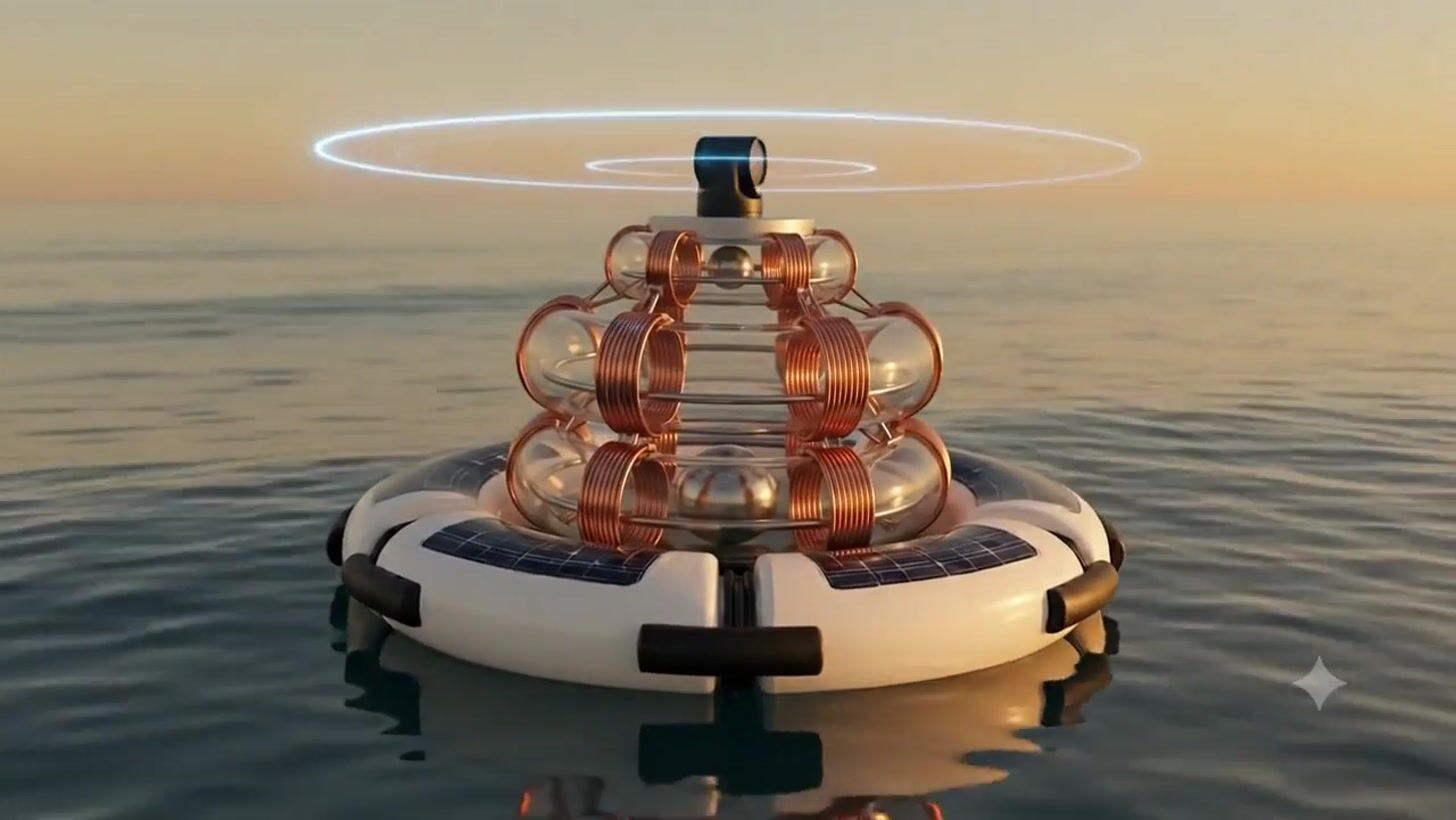
Why Sealed Induction
Most wave energy projects fail not from flawed physics but from the environment: saltwater corrosion, biofouling, and storm loading destroy exposed pistons, hydraulic seals, and articulated joints. The induction array places the entire generation mechanism — magnet and coil — inside sealed tubes, with no hydraulics, no external linkages, and nothing exposed to corrode or foul. Generation is reduced to a magnet moving past copper, lowering the maintenance burden and extending survivable service life at sea. In a severe storm, the spheres can be magnetically braked and held, immobilizing the moving mass to protect the housing from violent impact.
Engineering Challenges (Honestly Stated)
This is a design under active development, and three questions govern whether it succeeds — each to be resolved empirically on the bench, not asserted:
- Velocity and power. Induced power scales with the square of sphere velocity, while wave motion is slow. The architecture must up-convert slow hull motion into sufficient sphere speed (the rolling sphere gearing up against its track) to produce meaningful output — a measurement, not an assumption.
- Electromagnetic loading (Lenz’s law). The induction that generates power also brakes the sphere. Too heavy an electrical load stalls the sphere; too light a load leaves energy in the sea. There is a tuned operating point between the two, identified by direct input-versus-output current measurement.
- Structural survivability. Magnetically locking the spheres protects the spheres; the tower and sealed housings must independently survive wave impact and fatigue in extreme conditions. Hull survivability is treated as an open question to be validated, not presumed.
Each of these is directly testable on the StabilityCore shake table, which reproduces controlled, repeatable wave motion, with onboard current sensors measuring the energy balance — the same empirical method by which the active counterweight behavior (§4.3) was first characterized.
Single-extractor note: the multiple tiers do not violate the single-extractor principle, because each harvests a spectrally distinct band of the wave spectrum — they draw on separate frequency budgets rather than competing for the same one.
4. Hull Design — The Weeble Wobble Principle
The WaveForge buoy uses a spherical/ball-shaped hull with very rounded edges — the opposite of conventional ship design. Ships are designed for stability (resist rocking). WaveForge is designed for maximum instability — more rocking and swaying = more energy harvested.
- No preferred orientation — self-righting with low center of gravity (battery mass at bottom)
- Smooth flow reduces structural stress in storms
- Rounded hull amplifies response to wave motion across all axes
4.1 Passive Orientation System
- Weathervane fin (top): Rigid vertical fin at rear of buoy acts as passive wind vane — orients turbine intakes into the wind automatically. No motors, no electronics, no power needed. Can double as solar panel mount.
- Keel fin (bottom): Large stabilizing keel below waterline prevents unwanted spin from angled waves, counterbalances topside weight, lowers center of gravity. Works with weathervane fin as a paired system: top catches wind, bottom resists rotation → smooth directional tracking.
4.2 Wind-Wave Correlation — Retractable Turbine Fans for Simultaneous Alignment and Harvesting
In open ocean storm conditions, wind and swell are directly correlated — the wind blows in the same direction as the swell it creates. This fundamental oceanographic relationship enables a powerful dual-purpose design for WaveForge buoys: retractable turbine fans that simultaneously align the buoy perpendicular to the swell and harvest wind energy as a secondary power source.
How It Works
Small ducted turbine fans are mounted on retractable arms at the top of each buoy. In storm conditions:
- Wind catches the turbine fans — the asymmetric drag naturally rotates the buoy to face the fans into the wind, exactly like a wind vane or anemometer.
- Wind direction = swell direction — because the wind is creating the swell, aligning to wind automatically aligns the buoy perpendicular to the incoming waves.
- Optimal OIMH orientation achieved passively — the buoy rocks maximally in the direction that drives the offset eccentric weight into its orbital path. No active steering, no GPS waypoint tracking, no thruster fuel consumed.
- Wind energy harvested simultaneously — while the fans align the buoy, they are also generating electricity from the wind. Two energy sources from one set of hardware.
Why This Matters
| Factor | Without Wind Alignment | With Retractable Turbine Fans |
|---|---|---|
| Buoy orientation | Random — may not face optimal swell direction | Automatically perpendicular to swell — maximum OIMH energy capture |
| Wind energy | Wasted — not captured | Harvested — secondary power source, simultaneous with wave energy |
| Alignment method | Active thrusters (consumes energy) | Passive aerodynamic (generates energy) |
| Storm response | May need to disengage thrusters to conserve power | Stronger wind = better alignment AND more wind energy |
| Complexity | GPS + compass + thruster control software | No electronics needed — physics handles alignment |
| Failure mode | Software crash = loss of orientation | No software to crash — wind always blows, fans always align |
Retractable Design
- Extended position: Turbine fans deployed on arms extending above the buoy. Maximum wind capture and alignment torque. Used in moderate to storm conditions where wind-swell correlation is strong.
- Retracted position: Fans fold flat against the buoy hull. Reduces wind loading and protects the fans in extreme hurricane-force conditions where structural survival takes priority over energy capture.
- Automatic deployment: Wind speed sensor triggers extension when conditions are favorable. Spring-loaded retraction as failsafe — if the deployment motor fails, the fans retract automatically to protected position.
Why Perpendicular Alignment Is Critical for Circular Motion
The OIMH generates maximum power when the buoy rocks perpendicular to the incoming swell. This is not optional — it is fundamental to achieving the continuous circular orbital motion that makes the OIMH work:
- Perpendicular rocking tilts the platform back and forth across the wave direction. The offset eccentric weight falls toward the low side, and on the return rock it overshoots into the next quadrant — building circular orbit naturally.
- Parallel alignment (aligned WITH the swell) produces pitching motion only — the weight swings back and forth in a line instead of building circular orbit. The OIMH stalls or oscillates linearly without converting to rotation.
- Even 10–15° off perpendicular significantly reduces orbital efficiency. The lateral force component that drives the lazy susan drops as the misalignment increases.
This makes alignment the single most important operational parameter after the OIMH mechanism itself. Every other variable (mass, tilt angle, gear ratio, wave period) can be optimized through design — but without perpendicular alignment, none of them matter.
Multi-Layer Alignment System
WaveForge buoys use a layered alignment approach — multiple independent systems working together to maintain perpendicular orientation in all sea states. No single system is relied upon exclusively, and each layer adds redundancy:
| Layer | System | Mechanism | Conditions |
|---|---|---|---|
| 1 (passive) | Retractable turbine fans | Wind vane effect — fans catch wind, rotate buoy perpendicular to swell | Any wind conditions (strongest in storms) |
| 2 (passive) | Weathervane fin | Rigid vertical fin at rear catches wind asymmetrically | Moderate to strong wind |
| 3 (passive) | Retractable stabilizer fin | Deployable underwater fin increases directional stability and resists cross-wave rotation | All conditions — deploy for stability, retract for free rotation during calm |
| 4 (passive) | Keel fin | Fixed underwater keel resists unwanted spin, lowers center of gravity | Always active — structural baseline stability |
| 5 (active) | Rudder | Servo-driven underwater rudder for fine-tuning orientation. Wave-driven water flow provides the steering force — the rudder only needs to deflect the angle, not generate thrust | Active correction when passive systems are insufficient (cross-seas, shifting swell direction, confused seas) |
| 6 (active) | Turbine fan thrust | Reverse fans to produce asymmetric thrust for repositioning | Emergency realignment or repositioning to new swell direction |
Retractable Stabilizer Fin
- Function: A deployable underwater fin that increases the buoy’s resistance to cross-wave rotation. Like a sailboat centerboard — when deployed, it provides strong directional stability. When retracted, the buoy rotates freely.
- Deployment: Hinged or telescoping fin extends below the hull. Controlled by a simple linear actuator or mechanical latch.
- When deployed: Storm conditions, strong swell, any time perpendicular alignment must be locked in. The fin acts as an anchor against rotational drift.
- When retracted: Calm conditions where the buoy needs to rotate freely to find the next swell direction. Also retracted during extreme storms where the fin could be damaged by debris or extreme forces.
- No energy cost: The fin itself is passive — it uses the water’s resistance to rotation, not a motor. Only the deployment mechanism uses a small amount of energy.
Servo-Driven Rudder
- Function: Fine-tunes buoy orientation when passive alignment systems are insufficient. The rudder deflects wave-driven water flow to steer the buoy — the ocean provides the steering force, the servo just sets the angle.
- Power consumption: Minimal — a small servo holds a rudder angle. No propulsion, no thrust generation. The waves push water past the rudder, and the deflected flow turns the buoy.
- Control input: The generator encoder (generator-as-wave-sensor) detects orbital efficiency. If RPM drops below expected for the current sea state, the rudder adjusts until RPM recovers — closed-loop alignment optimization using the same sensor that monitors wave conditions.
- Failsafe: If the servo fails, the rudder returns to center (neutral) via spring return. The passive systems (fins, weathervane, turbine fans) continue to maintain approximate alignment.
The closed-loop alignment chain: Generator encoder detects low orbital RPM → onboard controller calculates swell misalignment → rudder adjusts angle → wave flow steers buoy toward perpendicular → RPM recovers → rudder returns to neutral. The generator is the sensor, the rudder is the actuator, the ocean is the power source. Zero additional sensors, zero thrust energy consumed.
The Deeper Insight
This design follows the same philosophy as every other WaveForge innovation: let nature do the work. The wind that creates the waves also aligns the buoy to harvest those waves optimally. The same force that drives the swell positions the harvester to capture it. Nothing is wasted, nothing fights the environment, and no energy is consumed for alignment — energy is produced by alignment.
In traditional wave energy systems, orientation is a problem to be solved with active thrusters and complex control software. In the WaveForge system, orientation is a free energy source that solves itself. The wind is not an obstacle — it is the alignment mechanism and the second fuel source, delivered to the same hardware at the same time.
“The wind creates the wave. The wind aligns the buoy. The wind powers the turbine. One force, three functions, zero energy consumed.”
4.3 Active Center-of-Mass Control — The Dual-Servo Counterweight
The passive weeble-wobble hull (above) gives the buoy no preferred orientation. The counterweight system gives it something the passive hull cannot: the ability to actively move its own center of mass, and therefore to tune how it responds to the sea in real time.
Sealed inside the spherical hull is an aluminum 2020-extrusion T-frame carrying a dense brass counterweight on a linear guide rail. A servo and timing belt slide the mass radially in and out along the rail; a second “360°” servo at the top of the frame rotates the entire assembly through a full circle. A slip ring routes power and signal across that continuous rotation without winding the wiring, and a coiled, compliant cable serves the moving carriage. Together the two axes can place the buoy’s center of mass anywhere within a horizontal disk — any radius, any bearing — and reposition it as sea conditions change.
Function
- Resonance tuning. Moving the mass changes the buoy’s rotational inertia and the position of its center of mass — and therefore its natural roll and pitch periods. Shifting these toward the period of the incoming swell drives the hull toward resonance, increasing the amplitude of its response and the energy presented to the harvesters.
- Trim and attitude. Biasing the mass off-axis re-trims the buoy, correcting list and setting a preferred lean into a dominant sea.
- Directional aim. The 360° rotation orients the off-axis mass — and thus the buoy’s tuned response — toward the dominant wave direction: the single-buoy analogue of the fleet positioning itself where the energy is.
- Driving the orbital motion. Aimed via the 360° rotation, the tilt can be set to lean the buoy into the incoming wave — using the sea’s own force to carry the hull past simple rocking and toward sustained rotation (half-turns, and in stronger seas full 360° orbits), the rotary motion the harvesters are built to convert. The top slip ring exists for precisely this reason: it lets the buoy turn without limit, never winding its own wiring.
Empirical origin. This mechanism was not derived on paper — it emerged from the water. In WaveForge wave-pool testing we tried many different ways to influence a buoy’s behavior, and controlling a movable mass at the base of the structure consistently performed best. The observed effect was direct and repeatable: shifting the base mass off-center set the buoy into a controlled, sustained tilt — a deliberate lean held against the water, rather than a hull sitting flat and neutral. That matters because tilt is not incidental to this architecture — the lean angle is one of the parameters that governs how strongly the hull rocks and drives the orbital harvesting. What had been a fixed design choice — the buoy’s tilt — becomes a live, commandable input. The governing insight is architectural: the base controls the structure — the same way a building’s foundation governs how the entire building responds to the ground moving beneath it. A buoy is a structure standing on a moving sea; command the mass at its base and you command the lean — and the response — of everything above it. The dual-servo counterweight is the engineered, actively-controlled form of that pool-discovered effect.
Scope. The counterweight is a control subsystem, not a generator — it tunes the catch; the harvesting is performed by the buoy’s separate magnetic generators. This cleanly decouples control from harvest: a single optimally-sized mass positions the hull, while the dedicated generators convert the resulting motion. The mechanism shown is at the design stage — rendered from a bench concept sketch — with the major components already in inventory.
The surfer, completed. The counterweight is one limb of a larger reflex. Paired with LIDAR to see the incoming wave and a thruster to take position, the buoy gains what a surfer has: vision, position, and the lean. It watches the swell approach, moves into its line, and shifts its weight to drop in — reading each wave and committing at the moment that matters, the same timing a surfer spends years learning. This is the organism the rest of this paper keeps pointing toward: not a machine that waits to be moved by the sea, but a body that sees the sea coming and decides how to meet it.
“A machine sits where it is bolted. This buoy moves its own weight to meet the sea — tuning itself toward resonance the way a body shifts its balance without being told.”
5. Buoyancy-Weight-Power Scaling Law
Since buoyancy is calculable, the limiting factor on power output is how much weight (flywheel mass) can be placed on the vessel. Weight creates torque — heavier flywheel + larger moment arm = more power from wave-induced rocking.
5.1 The Equation
P_max = η × m_flywheel × r_flywheel × ω_wave

where:
  m_flywheel ≤ B - m_hull - m_electronics    (weight budget)
  B = ρ_seawater × V_hull × g            (buoyancy budget)
  η = generator efficiency (~85-95%)
  r_flywheel = flywheel radius (moment arm)
  ω_wave = angular velocity from wave rocking
5.2 Cubic Scaling Advantage
Buoyancy scales with volume (r³). A vessel twice the diameter has 8x the buoyancy budget — meaning 8x the flywheel mass — meaning roughly 8x the power output. The physics rewards size, and the ocean has unlimited space.
Design implication: Favor large vessels with massive flywheels over many small buoys for maximum power per unit cost.
6. Power Delivery to Grid
6.1 Submarine Cable to Shore
Proven technology — offshore wind farms already run undersea power cables. Cost scales with distance from shore. Nearshore deployments (<10 miles) are economical; deep ocean gets expensive.
6.2 Wireless Power Transmission via Satellite Relay
Emerging technology — convert electricity to microwave or laser, beam to satellite, satellite relays to ground receiving station (rectenna). No cables, unlimited range.
- Partnership opportunity: Partner with a wireless power transmission company (Space Solar, Solaren, etc.) — WaveForge provides the ocean energy source, partner provides transmission infrastructure
- Path: Buoy → microwave/laser uplink → satellite → ground rectenna → grid
- Eliminates submarine cabling (the most expensive part of offshore energy)
- Makes deep-ocean deployment economically viable — the best waves are far from shore
- Multiple companies already demonstrating space-to-ground power beaming
6B. Power Take-Off — Fluid as the Intermediary
Ocean waves present a high-force, low-velocity resource. This single characteristic disqualifies most conventional machinery. A turbine is a dynamic machine requiring high fluid velocity; a mechanical gearbox requires a shaft already rotating at usable speed. Waves supply neither — they supply very large forces, very slowly, alternating in direction, with intervals of comparative quiescence between wave groups.
The architecture therefore places a hydraulic circuit between the ocean and the electrical machine.
6B.1 Fluid rectification and capture
The primary interface exploits relative motion between the toroidal float and a fixed reference — an offshore platform jacket, a taut mooring, or a suspended reaction mass. As the float traverses the wave profile it drives vertical hydraulic cylinders.
A manifold of four check valves rectifies bidirectional plunging motion into unidirectional flow, functioning precisely as a full-wave diode bridge functions in an electrical circuit. Both the buoyancy-driven up-stroke and the return down-stroke therefore contribute flow to the circuit.
It should be stated plainly that the down-stroke does not constitute an independent energy source. The return force originates in the gas spring described below, which was charged during the up-stroke. The rectifier's contribution is that both halves of the cycle pump, rather than that the incident wave is harvested twice.
6B.2 The hydro-pneumatic accumulator
High-pressure fluid is routed into spherical diaphragm accumulators, in which a flexible membrane separates compressed nitrogen from hydraulic oil. As fluid enters, the gas compresses. The component performs two distinct functions simultaneously.
As a spring, the stored gas pressure returns the float downward so that it continues to track the descending water surface, remaining loaded for the following crest. The spring rate is set by gas precharge and is therefore adjustable from the deck without mechanical intervention — a tuning parameter with no moving parts.
As storage, the accumulator absorbs the irregular pulses characteristic of wave groups and returns steady pressure, sustaining output through the intervals between sets. A converter that follows the wave produces output as irregular as the sea; a converter that stores before converting produces a conditioned output.
6B.3 Continuously variable conversion
Pressurised fluid drives a positive-displacement hydraulic motor, in which pressure acts upon pistons rather than velocity upon blades. This is the correct machine class for a high-pressure, modest-flow circuit.
Motor shaft speed is the quotient of flow and displacement. A variable-displacement motor therefore holds a constant, grid-compatible shaft speed while supply pressure varies — a continuously variable transmission with no gear teeth to fail.
This regulation holds within the accumulator's storage window rather than indefinitely. An undersized accumulator will permit shaft speed to decay between wave groups. Accumulator sizing is engineering work still outstanding and is directly measurable on a controlled-input test bench.
6B.4 Architectural consequences
Interposing fluid relocates the vulnerable components. The electrical generator is a conventional rotary machine housed within a sealed dry compartment. In the platform-mounted embodiment this compartment is situated above the splash zone on the deck; in the buoy embodiment it is placed low within the sealed hull, below the external water level but dry within, which additionally lowers the centre of gravity. In neither case is an electrical conductor exposed to seawater, and in neither case is a rotating seal in contact with the water column. Over-pressure protection is provided by standard hydraulic relief valves, which vent excess force rather than transmitting it to mechanical linkages — a fail-safe assembled from certified components.
The architecture does not, however, eliminate seals. The cylinders employ reciprocating rod seals, and these are located in the splash zone. Rod seal failure is a well-documented cause of marine hydraulic unreliability and is not discounted here. The trade is explicit: proven, certified, off-the-shelf components and dry electrics, in exchange for a sliding seal in the wetted region. Working fluid will be a biodegradable ester so that seal failure presents a maintenance rather than an environmental consequence.
In the buoy embodiment the critical component is consequently the rotational joint by which torque crosses from the exposed upper section into the sealed lower hull. That joint, rather than any electrical component, is where reliability is determined, and it is the subject of continuing bench work.
A second embodiment, in which generation occurs by direct induction within a sealed tube and no seal is present in any load path, is the subject of a pending application and is not described here.
7. Seismic Relay Network & Tsunami Early Warning
Most earthquakes originate under the ocean — WaveForge buoys are already there. The same IMU/accelerometer used for wave direction sensing doubles as a seismic sensor.
- Dual-purpose buoy: Energy harvesting + seismic monitoring on one platform
- Mesh network: Buoys relay seismic data via LoRa/satellite to shore stations → early warning system
- Revenue stream: Sell seismic data to USGS/NOAA/universities + generate power simultaneously
- Tsunami detection: IMU detects characteristic ultra-long-period signature (10–60 min period) — unmistakable vs. normal waves (5–20s). In deep water, tsunamis are only inches tall but the period signature is unique
- Replaces NOAA DART buoys: Current DART buoys cost ~$250K each, need battery replacements, sparse coverage. WaveForge buoys are self-powered, dense network, economically sustainable through energy revenue
- Warning time: Deep-ocean detection → minutes to hours of advance warning before coastal impact
8. Competitive Advantage
| Factor | Traditional Wave Energy | WaveForge |
|---|---|---|
| Complexity | Complex electronics, hydraulics | Simple mechanical: gears, bearings, flywheel |
| Saltwater tolerance | Electronics corrode, frequent failure | Mechanical components, sealed generators |
| Energy axes | Usually 1 (heave only) | 8 sources simultaneously |
| Maintenance | Expensive offshore service crews | Basic mechanical service, replaceable components |
| Cost per MW | Millions per megawatt | Fraction — standard industrial components |
| Scalability | Custom engineering per site | Cubic scaling law — bigger = exponentially more power |
| Secondary revenue | None | Seismic data + tsunami warning network |
8.1 Comparison with Existing Wave Energy Architectures
Every major wave energy converter (WEC) in development or deployment today captures energy from one or two axes of motion. The OIMH captures energy from all degrees of wave motion simultaneously — any direction the wave rocks the device feeds the same orbital path. This is the fundamental architectural difference.
Point Absorbers (Tethered Float)
Companies like Ocean Power Technologies (PowerBuoy) and others use a floating buoy anchored to the seabed by tethers connected to a linear generator or hydraulic piston. The float moves up and down with wave heave, pulling the tether to generate electricity.
| Factor | Tethered Point Absorber | WaveForge OIMH |
|---|---|---|
| Motion captured | Heave only (vertical pull on tether) | All axes — any rocking direction feeds orbital motion |
| Anchor requirement | Seabed anchor + mooring lines (major cost) | Free-floating or tethered — no seabed anchor required |
| Storm behavior | Must shut down or risk snapping mooring lines | Produces more power in storms — storms are fuel |
| Installation cost | Expensive subsea mooring + cable to shore | Deploy and harvest — produces hydrogen on-platform |
| Depth limitation | Nearshore only (mooring depth limits) | Any depth — open ocean capable |
| Lateral wave energy | Wasted — tether only captures vertical | Captured — lateral rocking drives orbital path |
| Energy accumulation | Resets each wave cycle | Resonant orbital pumping builds energy across cycles |
Oscillating Water Column (OWC)
Shore-mounted or nearshore chambers trap air above a water column. Waves push water in and out, compressing air through a turbine (e.g., Limpet, Mutriku).
| Factor | OWC | WaveForge OIMH |
|---|---|---|
| Location | Fixed to shore or breakwater | Deployable anywhere — open ocean, rivers, gorges |
| Motion captured | Heave only (water column rise/fall) | All axes simultaneously |
| Construction | Massive concrete chamber (millions) | Standard mechanical components (~$200 bench demo) |
| Scalability | Fixed structure — one site, one output | Fleet of 500+ buoys, relocatable to best conditions |
| Storm response | Can be damaged by extreme waves | Chases storms for maximum output |
Oscillating Surge Converters
Hinged flaps mounted to the seabed that swing back and forth with wave surge (e.g., Aquamarine Oyster, which went bankrupt in 2015).
| Factor | Surge Converter | WaveForge OIMH |
|---|---|---|
| Motion captured | Surge only (horizontal push/pull) | All axes simultaneously |
| Installation | Bolted to seabed — permanent, expensive | Free-floating, relocatable |
| Survivability | History of mechanical failure in storms | Mechanical simplicity — fewer failure points |
| Track record | Multiple bankruptcies (Aquamarine, Pelamis) | Validated Phase 0 — voltage confirmed April 4, 2026 |
Attenuators (Snake-Type)
Long floating structures oriented parallel to wave direction, with hinged segments that flex as waves pass along their length (e.g., Pelamis, which went bankrupt in 2014).
| Factor | Attenuator | WaveForge OIMH |
|---|---|---|
| Motion captured | Flex along one axis | All axes simultaneously |
| Complexity | Multiple hydraulic joints, high-pressure seals | Simple mechanical: bearings, gears, generator |
| Maintenance | Hydraulic seal replacement in open ocean | Basic mechanical service, modular slide-in generators |
| Wave direction | Must align with wave direction to function | Omnidirectional — self-orienting swivel |
| Track record | Pelamis bankruptcy after £100M+ invested | Working prototype from $200 in off-the-shelf parts |
“Every competing wave energy technology captures one axis and fights the rest. The OIMH captures all axes and fights nothing. The wave does the work.”
8.2 Why Previous Wave Energy Companies Failed
The wave energy industry has seen multiple high-profile failures — Pelamis (£100M+), Aquamarine (£40M+), Oceanlinx, and others. The common thread: they fought the ocean instead of working with it.
- Over-engineered for specific wave conditions — devices optimized for a narrow sea state band. Too calm = no power. Too rough = structural failure.
- Single-axis capture — wasting 70-80% of available wave energy by ignoring all but one motion component.
- Hydraulic complexity — high-pressure seals, hydraulic rams, and fluid systems that corrode and fail in saltwater.
- Fixed installations — bolted to the seabed or shore, unable to relocate to better conditions or avoid extreme weather.
- No secondary revenue — pure electricity generation with no fallback income stream.
WaveForge addresses every one of these failure modes: omnidirectional capture, mechanical simplicity, free-floating deployment, storm-chasing capability, and secondary revenue from seismic monitoring and hydrogen production.
9. Market Opportunity
- Wave energy projected to be a $50 billion market by 2035
- Wave power called the “sleeping giant of renewables” by energy experts
- Wave energy could theoretically meet all global electricity needs if fully harnessed
- While other technologies (e.g., Bill Gates’ nuclear reactors) navigate complex approval processes, WaveForge’s mechanical approach sidesteps regulatory complexity
- Three revenue streams per buoy: energy sales to grid, seismic data to NOAA/USGS, hardware/licensing
8B. Operations and Maintenance — Designing for a Machine Nobody Visits
The literature on wave energy failure is dominated by devices that worked and then could not be reached. Access, not conversion, is what usually ends a deployment: a fouled intake, a seized bearing or a parted mooring is a trivial repair, but a vessel, a crew and a weather window are not. On a machine ten miles offshore the repair is nearly free and the trip is the entire bill.
The economics are the same at any scale. A blocked downspout filter on a third storey costs almost nothing to clear and several hundred dollars to reach, and the whole cost lives in the gap between the operator and the blockage. Every problem the machine can resolve without being visited is therefore worth considerably more than the component it protects.
Three design commitments follow from that, and each is cheap to specify now and effectively impossible to retrofit onto a deployed fleet.
Self-clearing as a default behavior
Anything placed in the ocean will accumulate weed, plastic, silt and growth. This is a certainty rather than a risk, and a machine that cannot be reached must handle it unaided.
Reversing flow to clear an intake — backflushing — is long-established practice in marine sea chests, engine cooling intakes and industrial strainers. Where the platform already carries a reversible flow device, the capability to clear its own screens is present in the existing hardware at no additional cost, requiring only that it be invoked.
The scheduling question matters more than the mechanism. A cleaning cycle run on a timer, or triggered by a fouling sensor, requires a threshold, a decision and something to make the judgement. A short purge appended to every actuation requires none of those, and prevents accumulation rather than remediating it. The physics is also favorable: dislodging a filter cake is better served by a brief high-velocity pulse than by sustained reverse flow, so the low-cost implementation is also the more effective one.
Diagnosis by consequence rather than by cause
A domestic clothes dryer reports a blocked lint filter without any sensor in the duct. It observes that airflow has fallen and the cycle has lengthened, and infers the cause. The approach is cheap, robust, and requires no instrumentation near the problem.
The same inference is available here from instrumentation the platform already carries for other purposes. A commanded actuation that produces less response than expected indicates an obstruction, and the inertial sensor that measures platform motion for control purposes also measures that discrepancy. Current draw on the actuator provides a second, earlier signal, since load changes before performance loss becomes obvious.
The escalation policy is the part that matters for an unattended device, because there is no operator present to read an indicator. The system should clear itself, then attempt a more aggressive clearing cycle, and only then transmit. The single alert worth sending over a low-bandwidth satellite link from open ocean is that the machine can no longer resolve a condition on its own. Anything short of that is noise, and noise multiplied across a large array is worse than silence.
Modularity at the unit level rather than the component level
Replaceability is the standard answer to wear in unattended hardware, and it substantially relaxes the materials problem: a consumable does not need a twenty-year service life if it is inexpensive and quickly exchanged. Utility-scale wind applies this to gearboxes, which are exchanged rather than repaired in place.
However, modularity is in direct tension with sealing. Every module boundary introduces a joint, and every joint is a potential ingress path and corrosion site. An architecture whose central reliability claim is that no rotating element penetrates the pressure boundary is not well served by reintroducing connectors and gaskets in the name of serviceability.
The resolution is to place the module boundary at the unit rather than the component. In a distributed array of many low-cost devices, the device itself is the replaceable element: it is sealed permanently at manufacture, exchanged whole on station, and opened only ashore where the operation is trivial. Nothing is opened on the water. This also imposes a useful discipline on the design, since the approach is viable only if a unit is inexpensive enough to exchange rather than repair — which drives the design toward fewer parts, the same direction every other consideration in this architecture points.
The cost of vessel access should therefore be established early, because it determines the appropriate module size. Where access is expensive, the correct policy is to exchange the largest element that can be lifted and to open nothing on site.
Uncrewed aerial support
Uncrewed inspection is mature and commercially available; offshore wind uses aerial and subsea platforms for this routinely. Physical intervention is considerably less mature, as manipulating an object at sea requires holding station while applying force to a body that is itself moving. Inspection can be relied upon today; intervention should be treated as an emerging capability.
A single aerial platform serves three distinct functions for a distributed array:
Verification of non-reporting units. The most operationally significant failure is a device that has gone silent, and by definition it transmits nothing. Silence is ambiguous — a failed radio, a failed device, a dragged mooring and a lost unit are indistinguishable from shore — and that ambiguity is precisely what compels a vessel dispatch. A single overflight resolves it.
Data recovery. Satellite short-burst messaging is appropriate for status and alerts but is unsuited to continuous high-rate measurement, being both bandwidth-limited and priced per byte. An aerial platform passing within short-range radio coverage can recover complete logs from each unit in minutes. The architecture therefore splits cleanly: satellite for heartbeat and alerts, aerial pass for bulk data.
Wave field observation. An aerial platform at altitude observes the surface wave field directly, resolving wavelength, direction and group structure across the array. This is an established remote sensing technique and it substitutes for a dedicated marine radar installation, at lower cost and lower installed mass. Unlike the other two functions, this one contributes continuously rather than only on failure.
Launching from shore rather than from an attending vessel removes a substantial capital item from the deployment path. Typical nearshore test and deployment sites are within round-trip range of a fixed-wing VTOL platform, and shore basing places charging, storage and maintenance in an environment where they are straightforward. It also determines whether a small operator or a community can run the system independently, since operating an aircraft from a beach is achievable where operating a support vessel is not.
Contracting the flight operation to an established commercial operator is preferable to acquiring the capability. Such operators hold the beyond-visual-line-of-sight authorizations that represent the principal regulatory lead time, together with the associated insurance and trained personnel. This does not, however, relieve the platform designer of the corresponding obligations: standardized lifting points in consistent locations, fastening that requires no applied torque, self-aligning connections, and module masses within the lifting capability of an uncrewed platform. These are design decisions, not procurable services, and they cannot be added to a fleet already in the water.
Contracted support is also scheduled rather than responsive, which increases rather than reduces the importance of autonomous self-clearing. The device must remain serviceable until the next scheduled pass.
9B. Multi-Source Combined Output — The 24-Hour Reliability Advantage
A core strategic advantage of WaveForge over every other wave energy system is that multiple independent energy-capture sources operate simultaneously, each dominant under different conditions. No single source has to work all the time. The system as a whole always produces meaningful power because at any given moment, at least one energy source is at or near peak performance.
This multi-source architecture is the direct consequence of the “nothing is wasted” design philosophy — every natural force around the vessel becomes a fuel source.
9B.1 Energy Source Inventory
| Energy Source | Mechanism | Best Conditions | Present on Buoy | Present on Storm Chaser |
|---|---|---|---|---|
| OIMH orbital generator | Offset eccentric mass on lazy susan drives generator via gearing | Any wave motion | Yes | Yes (with maglev track) |
| Swivel linear generator | Pendulum swing of offset mass at swivel point | Moderate swell | Yes | Yes |
| Wells turbine (water column) | Hull-integrated air displacement from rising/falling water | Moderate to heavy swell | Yes | Yes |
| Retractable turbine fans | Wind harvesting + vessel alignment (passive) | Any wind | Yes (v2) | Yes |
| Ducted nacelle turbines | Seesaw arm dual-purpose wind generators | Wind | No | Yes |
| Flywheel-lazy susan generator | Hull-to-flywheel differential via self-locking worm gear | Hull rocking | No | Yes |
| Water ballast pendulum | Elevated flooded pontoons amplify rocking → OIMH | Any rocking | No | Yes |
| Fresnel lens concentrated solar | Mast-top solar collection dome with fiber optic routing | Daytime, any weather | Partial | Yes |
| Pontoon water-driven turbines | Transit mode water flow through hull | While moving | No | Yes |
| Thermal differentials (future) | Thermoelectric generators from waste heat + seawater cooling | Always | Future | Future |
Total independent energy sources per Storm Chaser: up to 10. Buoy variants use a subset (typically 4-6 sources).
9B.2 Source Activity by Condition
Different sources dominate under different conditions, ensuring continuous output:
| Condition | Active Sources | Dominant Source |
|---|---|---|
| Calm day, sunny | Fresnel solar, gentle OIMH, swivel pendulum | Solar (60% of total) |
| Calm day, overcast | Gentle OIMH, residual ocean motion | OIMH (low output) |
| Windy, moderate swell | Wind turbines, OIMH, swivel, Wells turbines | Wind + OIMH combined |
| Moderate sea | OIMH, swivel, Wells, wind turbines | OIMH (largest share) |
| Heavy sea / storm | OIMH (peak), wind turbines (peak), Wells (peak), water ballast pendulum amplification | All sources near maximum |
| Night, calm | Gentle OIMH, thermal (future) | OIMH continues |
| Transit mode | Pontoon water turbines, wind at elevated position | Turbines while moving |
Key insight: Every 24-hour period includes multiple condition transitions. At no point are all sources offline simultaneously. The vessel always produces measurable power.
9B.3 Combined Output Projection (25× Scale Production Buoy)
Estimated power output across conditions, combining all applicable sources, for a 25× scale production buoy equipped with the validated 5:1 gearbox architecture and 5-pound-equivalent scaled inertial mass:
| Source | Calm Day (sunny) | Moderate Sea | Active Seas | Storm Conditions |
|---|---|---|---|---|
| OIMH primary (5:1 gearbox + scaled mass) | 14-16 MW | 24-30 MW | 85-100 MW | 230-260 MW |
| Wind turbines (retractable) | 0.1 MW | 2-3 MW | 8-10 MW | 15-20 MW |
| Fresnel solar | 2-3 MW | 1-2 MW | ~0 MW (cloudy) | ~0 MW |
| Swivel linear generator | 0.4 MW | 1.5-2 MW | 4-6 MW | 6-10 MW |
| Wells turbines | 0.1 MW | 0.5-1 MW | 3-5 MW | 6-10 MW |
| Flywheel (Storm Chaser only) | 0.5 MW | 2-3 MW | 6-8 MW | 8-12 MW |
| Water ballast pendulum boost | — | Adds 10-15% to OIMH | Adds 15-20% to OIMH | Adds 20-25% to OIMH |
| Combined Total (Storm Chaser) | ~17-20 MW | ~32-42 MW | ~110-130 MW | ~265-310 MW |
Fleet of 500 Storm Chasers produces 8.5–155 GW depending on conditions. A typical nuclear power plant produces ~1 GW. A full WaveForge fleet in active storm conditions produces the equivalent of ~155 nuclear power plants, with zero fuel, zero emissions, and zero radioactive waste.
Projection Basis
These projections are derived from bench-measured data on a validated prototype, scaled via the fourth power law (power scales as L4 for linear dimensional scaling):
- Bench measurements (April 4, 2026): 2.5 lb inertial mass on 15” lazy susan, 1:1 direct drive, generator constant Kv = 0.13V per RPM validated across 30-100 RPM range.
- Gearbox upgrade (April 2026): STEPPERONLINE 5:1 planetary gearbox installed, multiplying generator RPM by 5× for the same orbital speed.
- Mass upgrade: 5 lb inertial mass replaces 2.5 lb, doubling torque at the orbital arm for same tilt angle.
- Scaling calculation: Bench power (V²/R on 10Ω load) × 254 × 0.9 efficiency factor.
- Safety factors applied: 90% efficiency accounts for gearbox friction, generator efficiency, and transmission losses.
Even at minimum gentle-tilt baseline, each 25× production buoy produces approximately 14 MW — more than most coal or gas peaker plants. The ocean never goes fully calm, so this is effectively the always-on minimum output. A 500-buoy fleet therefore guarantees at least ~7 GW of continuous baseload power from gentle motion alone — equivalent to seven nuclear reactors of minimum guaranteed output.
9B.4 Capacity Factor — The Metric That Actually Matters to the Grid
Grid planners and utility buyers don’t just care about peak power — they care about how reliably you deliver it. This is measured as “capacity factor”: actual energy produced over 24 hours, divided by theoretical maximum if running at peak continuously.
| Energy Source | Typical Capacity Factor | Notes |
|---|---|---|
| Solar (utility-scale PV) | 20-25% | Only works during daylight |
| Wind (onshore) | 35-40% | Depends on weather patterns |
| Wind (offshore) | 40-50% | More consistent than onshore |
| Traditional wave (single-source) | 15-30% | Shuts down in calm or storm |
| Natural gas (peaker plant) | 10-15% | Only runs during demand peaks |
| Natural gas (combined cycle) | 55-60% | Baseload operation |
| Nuclear | 90-95% | Gold standard for reliability |
| WaveForge Multi-Source (projected) | 85-95% | Multiple sources ensure always-on output |
WaveForge approaches nuclear-level reliability at a fraction of the cost, risk, and regulatory complexity. This is the single most important metric for utility buyers: reliable clean energy delivered 24/7.
9B.5 Why This Is the Strategy
- Every condition produces power — calm, moderate, stormy, day, night, transit. The system never goes idle.
- Redundancy through diversity — if one source fails mechanically, five others keep working. No single point of failure.
- Capital efficiency — one vessel, one installation, one maintenance operation harvests from up to 10 sources. Each source piggybacks on existing infrastructure.
- Grid value — high capacity factor means grid operators can actually build baseload capacity around WaveForge fleets, not just peak-shaving auxiliaries.
- Future-proof — new energy sources (thermal, ambient electromagnetic, bio-piezoelectric from marine growth) can be added without redesigning the vessel. The architecture accommodates growth.
- Jiu-jitsu in practice — no matter what nature throws at the vessel, some aspect of that force becomes usable energy. The vessel cannot be “beaten” by weather — it converts every weather condition into different revenue streams.
“The ocean is not one energy source. It is dozens. Every other wave energy company built devices to capture one of them. WaveForge captures them all — because nothing is wasted, nothing is overlooked, and every force the environment offers becomes fuel.”
10. WaveForge Storm Chaser — Full-Scale Vessel Architecture
The Storm Chaser is the full-scale evolution of the WaveForge buoy — a massive, self-propelled, eight-source energy harvesting ocean vessel designed to chase storms and convert extreme weather into grid-scale electricity. It combines proven marine engineering (steel hulls, flywheels, worm gears, bearings) with the multi-axis harvesting principles proven at buoy scale.
The WaveForge Storm Chaser turns the ocean’s most destructive force — storms — into humanity’s most abundant energy source.
10.1 Coupled Multi-Axis Harvesting System
The Storm Chaser uses multiple independent, orthogonal energy harvesting systems inside one hull:
Rotational Harvester — Flywheel-Lazy Susan + Seesaw Arm (Unified System)
- Flywheel-lazy susan (unified component): A massive steel flywheel (several tons) mounted inside the hull serves three functions simultaneously:
- Flywheel: Resists rotation due to gyroscopic inertia. As the hull rocks in waves, the relative rotation between hull and flywheel drives a generator via self-locking worm gear (50:1 ratio). Worm gear is self-locking — energy only flows out. The ocean cannot back-drive the generator.
- Lazy susan: The same flywheel disc acts as a free-rotating bearing surface for the seesaw arm assembly mounted on top. The arm naturally rotates on the flywheel to face the dominant wave direction — like a weather vane for waves. No motors, no electronics, no separate bearing system.
- Seesaw base: The seesaw arm is mounted directly on the flywheel. One component, three functions — fewer parts, fewer failure points, less weight.
- Horizontal seesaw arm with dual turbine nacelles: A long horizontal arm passes through a central wheel/gear mechanism at the top of a mast rising from the flywheel. The arm is balanced with identical ducted turbine nacelles on each end — like a jet engine on each side. As the buoy rocks in waves, the seesaw arm tilts back and forth, driving the central wheel and worm gear to generate electricity.
- Dual-purpose nacelles — wind turbines + electric thrust: Each ducted nacelle serves two roles:
- Harvesting mode: Nacelles face into the wind and generate electricity as air flows through the ducted turbine blades. Two turbines = double the wind energy capture.
- Electric thrust mode: Nacelles reverse direction as electric fans for gentle repositioning and slow cruising. Powered by harvested electricity stored in onboard batteries.
High-power hydrogen propulsion has been relocated to the seaplane-style pontoons (see Hull Design, Pontoon System), where hydrogen fuel cells drive electric motors connected to marine propellers. This simplifies the nacelle design — no hydrogen fuel lines running up the mast and along the seesaw arm — and places thrust at the waterline where it belongs for stability. No separate external fuel, no fossil fuels.
- Thrust mode sequence: When the vessel needs to reposition, the full thrust mode activates:
- Lock the seesaw arm in horizontal position
- Rotate pontoons to horizontal (seaplane float position) — trimaran configuration for maximum stability
- Fold the mast down 90° at its midpoint hinge — the mast and Fresnel dome lay flat and horizontal. Eliminates massive wind resistance from the tall mast and sphere, and dramatically lowers the center of gravity for stable high-speed transit.
- Lower the arm toward the waterline — reduces wind resistance and lowers center of gravity
- Deploy retractable stabilization fins beneath the pontoons
- Engage pontoon propellers — hydrogen fuel cells power electric motors driving marine propellers, vessel accelerates, fins provide directional stability and trim
- Vessel transits at cruising speed — low profile, stable trimaran configuration, maximum fuel efficiency
The pontoon angle becomes another throttle control:
- Pontoons vertical = harvesting mode (amplified rocking, maximum energy capture)
- Pontoons horizontal + propellers engaged = travel mode (stable trimaran transit)
- Pontoons at intermediate angle = harvest while cruising slowly on electric nacelle thrust
- Self-aligning on the flywheel: Wave force naturally pushes the seesaw assembly into alignment with the dominant swell direction. The flywheel’s gyroscopic resistance to rotation means the arm stays oriented while the hull moves around it — harvesting energy from both the flywheel’s rotational resistance and the seesaw’s rocking simultaneously.
- Lightweight nacelles + pontoon ballast: With hydrogen propulsion relocated to the pontoons, the nacelles are lighter and simpler — just ducted wind turbines and electric fans. Arm-tip mass is controlled by small trim weights for seesaw balance. The major ballast function has moved to the pontoon water ballast chambers, which provide far greater volume and more effective mass distribution:
- Harvesting mode (pontoons vertical, flooded): Pontoon ballast chambers filled with seawater add massive rocking momentum. Heavy vertical pontoons amplify wave-induced oscillation for peak energy output.
- Transit mode (pontoons horizontal, drained): Pontoon ballast released. Light pontoons = less drag, more efficient propeller transit.
- Spin mode (arm trim weights adjustable): Small adjustable weights at the arm tips tune the moment of inertia for optimal spin speed in wind-rotor mode.
This is the fifth throttle control — pontoon ballast level. Combined with flywheel height, dome height, hull ballast, and pontoon angle, the Storm Chaser has five independent tuning mechanisms.
- Sliding Vertical Track Pontoon System: An evolution of the rotating pontoon design — the pontoons travel vertically along rails on each side of the hull, serving fundamentally different functions at each position:
- Transport mode (pontoons low): Pontoons slide down to the waterline on vertical tracks. Seaplane float configuration — trimaran stability for safe, efficient transit. Low center of gravity, maximum hull stability, minimum rocking. Propellers engage for cruising.
- Active harvesting mode (pontoons high): Pontoons slide up to the top of the hull on the vertical tracks. At this elevated position they serve three simultaneous functions:
- Wind turbines: Higher elevation catches stronger, cleaner wind. Ducted fans generate electricity while simultaneously aligning the vessel perpendicular to the swell (wind vane effect).
- Perpendicular steering: Elevated position maximizes the aerodynamic lever arm for wind-driven steering. The higher the pontoons, the more effective the wind alignment force — longer lever arm from the waterline = more rotational authority.
- Pendulum ballast amplification: Heavy pontoons elevated on both sides of the hull create a longer pendulum arm. Like holding weights with arms outstretched — every wave tilts the vessel further. More rocking amplitude = more OIMH orbital energy. This is engineered instability — deliberately making the vessel less stable to capture more wave energy. The opposite of traditional naval architecture.
- Water ballast at elevation: Pontoons take on seawater when elevated, adding mass at the highest point. Adjustable ballast — fill for heavy swells (maximum pendulum effect), drain for calm seas (reduce unnecessary rocking). The same pontoon that was light for transit becomes a massive elevated counterweight for harvesting.
- Balanced pair: Identical pontoons on both sides, same height, same ballast level. Symmetrical mass distribution ensures the vessel rocks evenly without listing. The rocking is amplified but controlled — both sides experience the same forces.
- Continuously variable: The sliding mechanism allows any intermediate position between full-low (transit) and full-high (maximum harvesting). In moderate conditions, pontoons at mid-height provide a balance of stability and energy capture. The vertical position becomes a sixth throttle control — slide the pontoons up for more aggressive harvesting, slide them down for more stability.
- Reversible ducted fan motors — one system, two modes: The same ducted fan motors on each pontoon serve as both generators and thrusters simply by reversing current direction. No separate propulsion system. No separate generator. One set of hardware handles everything:
Pontoon Position Fan Direction Function High (harvesting) Forward (wind-driven) Wind generator + perpendicular steering High (harvesting) Reverse (powered) Emergency repositioning / fine steering Low (transit) Forward (water-driven) Water flow generator while cruising Low (transit) Reverse (powered) Transit propulsion — primary thrust Why build two systems when reversing one does both? The ducted fan is a generator when nature drives it and a thruster when the controller drives it. The only difference is the direction of current flow. Same bearings, same blades, same housing, same wiring — slight firmware change switches between harvest and thrust. This eliminates an entire propulsion subsystem’s worth of weight, cost, maintenance, and failure points.
The jiu-jitsu principle in action: Traditional vessels fight rocking with stabilizers and ballast placed low. The Storm Chaser embraces rocking by moving ballast high. The same wave energy that naval architects spend careers trying to cancel is deliberately amplified and harvested. The stronger the storm rocks the vessel, the more energy the elevated pontoon ballast feeds into the OIMH orbital system.
- Dual-purpose nacelles — wind turbines + electric thrust: Each ducted nacelle serves two roles:
- Perfectly balanced: Identical nacelles and matched ballast tanks on both sides of the pivot = equal mass distribution. No asymmetric loading on the hull. Smoother rocking, less stress on bearings and mast structure.
- Leverage multiplier: Torque = force × distance from pivot. The heavy water-filled tanks at the ends of a long arm generate far more torque through the worm gear than the same weight mounted close to the axle. Same physics that makes a long wrench easier to turn than a short one. And the weight is adjustable — pump in more water for bigger waves, release it for calm conditions.
Orbital Inertial Mass Harvester (OIMH) — 360° Omnidirectional Energy Capture
A fundamental design evolution that replaces the flywheel-lazy susan concept with a simpler, more powerful omnidirectional system. Instead of a flywheel that captures only pitch-axis rotation, the Orbital Inertial Mass Harvester (OIMH) captures wave energy from every direction simultaneously — 360 degrees of motion, all feeding a single central generator.
Architecture
- Circular maglev track: A ring-shaped track mounted inside the hull, using the same Halbach array permanent magnet levitation proven in the linear harvester system. The track forms a closed circular loop with near-zero friction. No lazy susan bearing required — the maglev track IS the bearing.
- OIMH inertial mass: A heavy spherical mass (several tons) mounted on top of a vertical rod — the “OIMH.” The rod’s base rides on the circular maglev track via a levitated carriage. The elevated mass raises the center of gravity high above the track, acting as a gravitational torque amplifier (see Section 12.6 — Elevated Mass Leverage Experiment). Small hull tilt angles create large lateral forces at the elevated mass, driving the carriage along the track with amplified force.
- Central generator with belt drive: A pulley wheel is attached to the OIMH vertical shaft at track level. A timing belt runs from this pulley to a generator shaft mounted at the center of the circular track. As the OIMH moves relative to the hull, the belt drives the central generator. The worm gear interface ensures energy flows only outward — self-locking, no back-drive.
How It Works
The vessel rocks in waves. The hull and track move with the waves. The heavy OIMH mass resists motion due to inertia — it stays relatively still while the circular track moves beneath it. This relative motion between the stationary OIMH and the moving track is captured by the belt drive and converted to generator rotation.
The breakthrough: direction doesn’t matter. A linear track only captures motion along one axis. The circular track captures motion from every direction:
- Primary swell from the north → OIMH stays, track shifts south → belt drives generator
- Cross seas from the east → OIMH stays, track shifts west → belt drives generator
- Confused storm seas from multiple directions simultaneously → OIMH stays centered, track oscillates chaotically beneath it → belt captures ALL of it
- Rogue waves from any angle → captured
No weathervaning needed. No alignment with wave direction. No wasted energy from off-axis waves. In storms — when seas are most chaotic, multi-directional, and energy-rich — the circular design captures the maximum possible energy precisely when the most energy is available.
Advantages Over Flywheel-Lazy Susan
| Property | Flywheel-Lazy Susan | Orbital Inertial Mass Harvester (OIMH) |
|---|---|---|
| Directional capture | Primarily pitch axis | 360° omnidirectional |
| Friction | Mechanical bearing friction | Near-zero (maglev) |
| Torque amplification | Mass at track level | Elevated mass = lever multiplier |
| Moving parts | Flywheel + lazy susan bearing + worm gear | Levitated carriage + belt + generator |
| Wave alignment needed | Yes (weathervane) | No — captures all directions equally |
| Storm performance | Good (single axis) | Optimal (confused seas = more capture) |
| Maintenance | Bearing wear, lubrication | No contact = no wear (permanent magnets) |
Scaling
The circular maglev track diameter scales with vessel size. Larger diameter = longer path = more relative motion captured per wave cycle. The OIMH rod height is tunable — taller rod in calm conditions (amplify small waves), shorter rod in storms (prevent structural overload). The same Halbach array magnet technology used in the linear harvester applies directly to the circular track — proven physics, different geometry.
Fourth-power scaling: Power output scales with the fourth power of linear dimensions (P ∝ L4) because torque scales as mass × arm length (m × L), mass scales as volume (L3), and angular velocity from ocean waves remains roughly constant regardless of buoy size. This means a 25× linear scale-up produces a theoretical ~390,000× increase in power output — small bench demonstrations translate directly to serious power plant potential at full scale.
Stacked Multi-Generator Array
A single OIMH on a central mast is the minimum viable configuration. Production-scale buoys deploy multiple OIMH units stacked vertically on the same central mast, with each unit independently driving its own generator:
- 3–4 OIMH units per mast: Each mounted at a different height, each with its own circular maglev track ring and belt-driven generator. All generators feed a common power bus.
- Rotational staggering: Each OIMH resting angle is offset by equal increments around the mast (e.g., 90° apart for 4 units, 120° apart for 3 units). This ensures the units are never all in the same phase of their swing simultaneously.
- Continuous power output: When one OIMH reaches the apex of its swing (momentary zero torque), the adjacent units are at mid-swing (peak torque). The staggered phases combine into smooth, near-constant power delivery — the same principle that makes multi-cylinder engines run smoother than single-cylinder engines.
- Frequency tuning: Units at different heights can carry different weights and rod lengths, tuning each to a different natural frequency. The array simultaneously harvests short choppy waves (low-mass, short-rod units) and long ocean swells (high-mass, tall-rod units) — extracting maximum energy across the full wave spectrum.
- Independent failure tolerance: Each unit operates independently. A single failed generator does not affect the others. The buoy continues producing power at reduced capacity until the next maintenance cycle.
- Scalable power density: Adding more stacked units to a taller mast directly increases power output without increasing the hull footprint. Buoy power scales vertically as well as with hull size.
The vertical stacking configuration is compact, mechanically simple, and inherently redundant — engineering qualities that matter especially for autonomous deep-ocean deployments with infrequent maintenance access.
Passive Self-Righting System — Adjustable Center of Gravity
Offset Eccentric OIMH — Self-Orienting Swivel Mass for Maximum Torque
A critical design evolution of the standard centered OIMH: the inertial mass is mounted off-center on the vertical shaft via a self-orienting swivel bearing with adjustable tension. Instead of the mass sitting symmetrically on top of the rod, it hangs from an offset pivot point — creating a compound pendulum that continuously self-orients toward gravity regardless of hull tilt direction.
- Offset mounting: The inertial mass is attached at its edge (not center) to the vertical shaft via a bearing or swivel joint. This creates an eccentric (off-center) weight distribution where the mass always hangs below the pivot point.
- Self-orienting swivel: A free-rotating swivel bearing (ball bearing, rubber bushing, or precision gimbal) allows the mass to rotate independently of the shaft. As the hull tilts in any direction, the mass rotates on its swivel to maintain the gravitationally lowest position — like a plumb bob.
- Adjustable tension: The swivel bearing friction is tunable, controlling how freely the mass swings. Higher tension = more damped pendulum response suited for long-period ocean swells. Lower tension = faster response for short choppy seas. The same hardware serves all sea states with a single adjustment.
- Continuous torque generation: Unlike a centered mass that only generates torque when tilted away from vertical, the offset eccentric mass creates constant differential motion between the shaft and the mass. The shaft tilts with the hull; the mass hangs toward gravity. This differential drives the generator continuously with no dead spots or zero-torque positions.
- Truly omnidirectional: The swivel self-orients to any tilt direction automatically. There is no preferred axis, no dead zone, no direction that fails to produce energy. North swell, east cross-sea, chaotic storm waves — the eccentric mass responds to all of them equally.
| Property | Centered OIMH | Offset Eccentric OIMH |
|---|---|---|
| Dead zones | Zero torque at vertical position | No dead zones — constant differential |
| Self-orienting | No — mass stays on shaft axis | Yes — swivel always finds gravity |
| Torque at small tilt angles | Low — sin(θ) near zero | High — offset creates torque even at small angles |
| Tunable response | Rod height only | Rod height + offset distance + swivel tension |
| Mechanical complexity | Simple — fixed mass on rod | Moderate — swivel bearing + offset mount |
| Energy capture efficiency | Good | Superior — captures energy from positions where centered mass produces zero output |
Integrated Swivel Linear Generator — Why Waste Movement?
The offset eccentric mass swings continuously on its swivel bearing — reciprocating pendulum motion that in a standard design is wasted as heat in the bearing friction. StabilityCore integrates a linear generator directly at the swivel pivot point, capturing this pendulum energy as a second independent electricity source from the same moving mass:
- Magnet ring on weight: A ring of permanent magnets is mounted on the swinging inertial mass, concentric with the swivel bearing axis.
- Coil fixed to shaft: A stationary coil winding is mounted on the vertical shaft at the swivel height. As the weight swings, the magnet ring oscillates through the coil, inducing current via Faraday’s law.
- Continuous generation: Every swing of the offset mass — in any direction — produces electricity. No dead zones, no preferred axis. The swivel self-orients and the linear generator captures energy from whatever direction the mass swings.
- Zero additional mechanical complexity: The swivel bearing already exists. The magnets and coil add only passive electromagnetic components — no moving parts beyond what already moves, no additional bearings, no belts, no gears.
- Complementary to rotational generator: The belt-driven rotational generator at the base captures orbital track motion. The swivel linear generator captures pendulum swing motion. Two independent electromagnetic harvesting mechanisms from one moving mass, capturing energy from two different motion axes simultaneously.
| Energy Source | Motion Type | Generator Type | Location |
|---|---|---|---|
| Hull tilt vs. OIMH inertia | Orbital (circular track) | Belt-driven rotational generator | Center of lazy susan / maglev track |
| Weight swing on swivel | Pendulum (reciprocating) | Magnet-coil linear generator | At swivel pivot point |
Why waste movement? The offset eccentric design creates pendulum motion that a centered mass never produces. A centered mass sits statically on its rod — no swing, no linear generation possible. The offset mass swings with every wave, and every swing is now harvested. The same design improvement that eliminated dead zones in rotational capture simultaneously created an entirely new energy source at the swivel point.
Bench-scale validation: The offset eccentric OIMH concept was validated using a tripod ball head with adjustable swivel tension mounted on an aluminum extension rod on a lazy susan. The difference in torque generation was immediately apparent — the offset swivel mass produced continuous rotational force during tilting that the centered mass configuration could not match. The self-orienting behavior was confirmed: the mass consistently found the gravitationally lowest position regardless of tilt direction.
45-degree vector force sweet spot: During bench testing, tilting the offset weight downward at approximately 45 degrees produced the most responsive behavior. This is consistent with the vector force physics — at 45°, sin(45°) = cos(45°) = 0.707, meaning the gravitational force splits equally into the lateral component (driving lazy susan rotation) and the vertical component (driving pendulum swing on the swivel). Both harvesting mechanisms — rotational and linear — peak simultaneously at this angle. Shallower angles favor one axis; steeper angles favor the other. 45° is the combined optimum. This informs full-scale vessel hull geometry and ballast configuration to target this tilt range in typical sea states.
Flat disc geometry vs. spherical mass: Bench-scale testing confirmed that a flat disc weight (cast iron plate) significantly outperforms a spherical mass of equivalent weight. When tilted to the 45° sweet spot, the flat disc’s asymmetric mass distribution creates a larger gravitational torque arm than a sphere. The disc’s flat face acts as a gravitational sail — at 45° tilt, the center of mass shifts further from the pivot axis than a sphere’s uniform distribution allows, producing stronger directional torque with each orbital cycle. The moment of inertia of a flat disc (I = ½mr² about the central axis) differs from a sphere (I = ⅖mr²), and when tilted, the disc’s higher moment of inertia about the orbital axis resists deceleration more effectively, maintaining orbital momentum through low-energy portions of each wave cycle. This was validated on the StabilityCore wave simulator — the flat disc maintained continuous orbital motion in conditions where an equivalent spherical mass stalled. Flat disc geometry is now the reference design for all OIMH configurations.
Active Wave-Adaptive Tuning — The OIMH as a Steered Energy Antenna
Ocean swells are periodic and predictable — wave sets arrive in repeating patterns with consistent frequency, amplitude, and direction over dozens of cycles. This periodicity enables predictive real-time tuning of the offset eccentric OIMH between wave cycles, optimizing energy capture for the specific sea state at every moment:
Adjustable Parameters
- Tilt angle of weight: Servo-controlled adjustment of the swivel mass tilt orientation, targeting the 45° vector force sweet spot for the current swell amplitude. Steep swells with large hull tilt angles may benefit from a shallower weight angle; gentle swells benefit from steeper angles that amplify small motions.
- Offset distance (telescoping/sliding orbital radius): Servo or linear actuator extends or retracts the eccentric mass along a radial arm or track, changing the orbital radius and moment arm length in real time. Longer offset = more torque per degree of tilt (amplifies weak swells into usable torque). Shorter offset = structural protection in storms (reduces mechanical stress on the inner ring). See dedicated section below.
- Height on shaft: Linear actuator raises or lowers the entire swivel assembly on the vertical shaft, changing the elevated mass leverage multiplier. Higher = more leverage for gentle seas. Lower = stability and protection in extreme conditions.
- Swivel tension: Motorized friction adjustment at the swivel bearing controls pendulum damping. Loose tension = fast response for short choppy seas. Tight tension = damped response for long-period ocean swells. Tunable to match wave period for maximum energy transfer.
Predictive Tuning Cycle
- Measure current wave set: Onboard IMU and pressure sensors detect swell frequency (period), amplitude (hull tilt range), and direction over 3–5 consecutive waves — sufficient to characterize the current sea state.
- Calculate optimal OIMH position: ESP32 or onboard processor computes the weight angle, offset distance, shaft height, and swivel tension that maximize combined rotational + pendulum energy capture for the measured wave parameters.
- Adjust between waves: During the wave trough (moment of minimum hull motion between successive crests), servos and actuators reposition the offset mass to the calculated optimum. Adjustment takes 1–3 seconds — well within a typical 5–15 second wave period.
- Harvest optimally positioned: Next wave arrives with the OIMH already configured for maximum capture of that specific wave’s energy profile.
- Continuous adaptation: As wind shifts, swell direction changes, or storm intensity varies, the system continuously re-measures and re-tunes. The OIMH tracks the optimal energy capture position the way a radar dish tracks a target — always pointing at the maximum.
Sea State Response Profiles
| Sea State | Tilt Angle | Offset Distance | Shaft Height | Swivel Tension |
|---|---|---|---|---|
| Calm (1–2 ft swell) | Steep (50–60°) | Maximum extension | Maximum height | Loose — fast response |
| Moderate (4–8 ft swell) | Optimal (40–50°) | Medium extension | Medium height | Medium tension |
| Heavy (10–20 ft swell) | Near optimal (35–45°) | Medium-short | Medium-low | Firm tension |
| Storm (20+ ft) | Shallow (20–30°) | Retracted | Lowered for stability | Tight — controlled damping |
| Cross seas (confused) | Auto-adjusting | Medium | Medium | Medium — responsive to rapid direction changes |
The OIMH becomes an actively steered energy antenna — always pointing at the maximum available energy, automatically adapting to changing conditions, harvesting more energy in every sea state than any fixed-geometry wave energy device. In calm seas it amplifies small motions for useful power output. In storms it protects itself while still harvesting. In confused cross-seas it self-orients and adapts faster than the waves change. No other wave energy architecture offers this degree of continuous real-time optimization from a single mechanism.
Resonant Orbital Pumping Mode — Maximum Energy Capture
The single most productive energy generation mode of the offset eccentric OIMH, discovered during bench-scale testing: when the vessel is oriented perpendicular to a consistent swell direction, small repetitive lateral rocking from wave action creates a fast continuous circular orbit of the offset mass around the vertical shaft. Each successive wave cycle pumps additional energy into the orbital motion, building RPM through resonant accumulation until the mass is orbiting at speeds far exceeding what any single wave could produce alone.
The Physics of Resonant Orbital Pumping
This is the same principle that allows a child to build enormous swing amplitude from small rhythmic pushes — resonant energy accumulation. Each wave cycle delivers a small lateral impulse to the hull. Because the vessel is perpendicular to the swell, this impulse rocks the hull side-to-side. The offset eccentric mass, already in slight orbital motion, receives this impulse as tangential force that accelerates its circular path. After 5–10 consecutive wave cycles of synchronized input, the orbital velocity has built to a level that would be impossible from a single wave event.
- Perpendicular vessel orientation is critical: The vessel must be oriented with its beam (widest point) facing the incoming swell. This produces maximum lateral rocking amplitude from each wave — the input that pumps the circular orbit. IMU sensors detect swell direction; the autopilot steers the vessel perpendicular using pontoon propellers and stabilization fins.
- Small perpendicular nudge initiates circular path: Pure side-to-side rocking would produce linear oscillation, not circular orbit. A slight secondary input perpendicular to the primary swell — from wind chop, cross-sea, or deliberate thruster pulse — converts the linear rocking into circular orbital motion. Once the circular path is established, each subsequent wave cycle reinforces it.
- Swivel tension synchronizes orbital period to wave period: The key to resonant pumping is timing — the orbital period of the mass must approximately match the wave period for constructive energy addition. Swivel bearing tension controls orbital speed: tighter tension for long-period swells (10–15 seconds), looser tension for short-period wind chop (3–5 seconds). The onboard processor continuously adjusts tension to maintain resonance lock.
- Orbital momentum acts as flywheel energy storage: The fast-orbiting mass stores kinetic energy between wave cycles. The generator extracts energy continuously from the sustained orbit while waves intermittently pump energy in. This smooths the inherently pulsed nature of wave energy into near-continuous generator output.
- RPM builds exponentially during pumping phase: Each wave cycle adds energy. If the orbital period is synchronized to the wave period, no energy is lost to destructive interference. After the initial build-up phase (5–10 cycles, typically 30–90 seconds), the orbit reaches a steady-state maximum where energy input from waves equals energy extraction by the generator plus friction losses.
Resonant Orbital Pumping Activation Sequence
- Swell detection: IMU and pressure sensors identify a consistent swell set — repeating wave period, stable direction, amplitude above minimum threshold. Minimum 3–5 consecutive waves of similar characteristics confirms a pumpable swell.
- Vessel reorientation: Autopilot engages pontoon propellers and stabilization fins to rotate the vessel perpendicular to the detected swell direction. Reorientation takes 15–60 seconds depending on vessel size and current heading.
- Swivel tension tuning: Processor sets swivel bearing tension to match the detected wave period. Target: orbital period = wave period ±10% for resonance lock.
- Circular initiation: A brief perpendicular thruster pulse or natural cross-chop converts the lateral rocking into initial circular motion. The offset eccentric mass begins a slow orbit.
- Resonant build-up: Each wave cycle pumps the orbit. RPM increases with every successive wave. Generator output climbs as orbital velocity builds. The system monitors RPM rate-of-change to confirm resonance is occurring.
- Steady-state maximum: Orbit reaches equilibrium speed where wave energy input = generator extraction + losses. This is the maximum sustained energy output state. The system maintains resonance lock by continuously fine-tuning swivel tension.
- Swell change detection: When wave period or direction shifts beyond the resonance lock threshold, the system detects decoupling (RPM declining despite wave input) and either re-tunes for the new swell parameters or exits pumping mode and returns to passive omnidirectional capture until a new consistent swell is detected.
Energy Output Comparison by Operating Mode
| Operating Mode | Vessel Orientation | OIMH Motion | Relative Energy Output | Best Conditions |
|---|---|---|---|---|
| Passive omnidirectional | Any | Random orbital + pendulum | 1x (baseline) | Confused seas, variable wind, no consistent swell |
| Wave-adaptive tuned | Any | Optimized orbital + pendulum | 2–3x baseline | Moderate consistent swells with predictable period |
| Resonant orbital pumping | Perpendicular to swell | Fast sustained circular orbit | 5–10x+ baseline | Consistent swell sets with stable period and direction |
5–10x energy output over passive mode from the same hardware, the same mass, the same generator — achieved purely through vessel orientation and resonant timing. No additional mechanical components. No structural modifications. Just intelligence applied to positioning.
This is potentially the single most valuable discovery in the WaveForge architecture. Consistent ocean swells — the most common sea condition on the open ocean — become the highest-energy operating mode rather than an average-energy background. The Storm Chaser fleet actively seeks consistent swell patterns the way a solar farm seeks clear skies, and resonant orbital pumping extracts maximum energy from every wave cycle.
Closed-Loop Orbital Feedback with Generator Position Sensing — Intelligent Nudge Assistance
The offset eccentric OIMH converts linear rocking into circular orbital motion automatically through asymmetric gravitational pull on the off-center mass. However, in marginal conditions — very gentle swells, calm spots between wave sets, or chaotic confused seas — the orbit may stall before completing a full revolution. A closed-loop control system using the generator itself as a position sensor detects these stall conditions and triggers an automated nudge to maintain continuous orbital motion.
Position Sensing Options
Two equivalent methods provide real-time orbital position feedback with no additional hardware cost:
Option A — Generator Hall Sensors
Standard 3-phase brushless generators contain built-in hall effect sensors for rotor position detection — the blue, yellow, and white wires typically present on industrial generators. These hall sensors provide real-time rotational position data that would normally require a separate encoder. The generator produces electrical power AND reports its exact position to the control microcontroller continuously.
Option B — Lazy Susan Hall Sensor with Magnets
Alternatively, a dedicated hall effect sensor mounted on the fixed frame reads magnetic markers placed on the rotating lazy susan ring. Small neodymium magnets spaced at known intervals (e.g., every 45°) pass the hall sensor during rotation, producing precise position pulses. This method offers:
- Independent of generator wiring — works with any generator regardless of hall sensor availability
- Direct orbital position — measures the OIMH track rotation itself, not the generator shaft (which is mediated by belt/gear ratios)
- Adjustable resolution — more magnets = finer position tracking
- Cheap and reliable — single hall sensor chip plus small magnets cost under $5
- Easy to add to existing designs — retrofittable on any OIMH lazy susan
Either option provides the position/velocity data needed for closed-loop nudge control. The lazy susan hall sensor is typically simpler to implement on the bench demo, while the generator hall sensor requires no additional components on production vessels that already have suitable generators.
- Position tracking: Hall sensor inputs to ESP32 GPIO pins, decoded into absolute rotational position (0°–360°) at high update rate
- Velocity calculation: Position delta over time yields orbital angular velocity in real time
- Stall detection: When angular velocity drops below a configurable threshold before the orbit reaches half-rotation, the system identifies a stall condition
- Direction detection: Position reversal indicates the weight is falling back instead of continuing — another stall signature
- No additional hardware: The generator is already present for power extraction; its hall sensors cost nothing extra
Automated Nudge Response
When a stall is detected, the ESP32 triggers a small servo or solenoid actuator that applies a brief lateral nudge to the OIMH assembly, restoring orbital momentum. The nudge is precisely timed and directed based on the detected stall characteristics:
- Nudge timing: Applied at the optimal orbital phase for maximum effect — when the weight is near bottom dead center and a lateral push will convert most efficiently into rotational velocity
- Nudge direction: Calculated from the current orbital phase and desired rotation direction
- Nudge strength: Proportional to the stall severity — gentle touch for near-threshold stalls, stronger push for severe stalls
- No wasted nudging: System only nudges when needed. During normal operation the orbit is self-sustaining and the nudge actuator remains idle, saving power
Control Algorithm (Pseudocode)
float position = readGeneratorHallSensors();
float velocity = calculateAngularVelocity(position);

if (velocity < STALL_THRESHOLD && position < HALF_ROTATION) {
    // Orbit stalling before completing half circle
    float nudgeDirection = computeOptimalNudgeAngle(position);
    float nudgeStrength = map(velocity, 0, STALL_THRESHOLD, MAX_NUDGE, MIN_NUDGE);
    triggerNudge(nudgeDirection, nudgeStrength);
}

if (position < previousPosition && previousPosition > 170) {
    // Position reversal detected — weight falling back
    triggerNudge(ORBIT_DIRECTION, RECOVERY_STRENGTH);
}
Why This Is Significant
Every other wave energy device either operates in a narrow sea state band (efficient only in specific conditions) or fails entirely outside its design envelope. The closed-loop nudge system extends the OIMH operating range to include:
- Very gentle swells that would otherwise be insufficient to sustain orbital motion
- Calm periods between wave sets where momentum would otherwise decay
- Confused seas where chaotic input disrupts the orbit rhythm
- Transition conditions where wave period shifts during operation
The result is continuous orbital motion across the full range of ocean conditions, from near-calm to storm, with the system intelligently compensating only when needed. Most of the time the orbit is self-sustaining and the nudge actuator is silent. When waves weaken or become chaotic, the system quietly keeps the rotation going.
Bench-Scale Validation
Resonant orbital pumping was discovered during bench testing of the offset eccentric OIMH on a lazy susan. When the assembly was rocked gently side-to-side with a small perpendicular input — simulating a vessel oriented perpendicular to a consistent swell — the offset mass rapidly built circular orbital velocity far exceeding the input rocking speed. The circular motion was self-sustaining once established, requiring only small periodic input to maintain. The effect was immediately dramatic and visually obvious: very little input motion produced very fast continuous circular output motion. This is the signature of resonant energy accumulation.
Shake table demonstration: The resonant orbital pumping mode is reproducible on the StabilityCore 6-DOF shake table by programming a consistent lateral rocking waveform on the X axis with a slight Y-axis perturbation. The OIMH demo placed on top with perpendicular orientation demonstrates the full pumping build-up sequence — visitors observe orbital velocity climbing with each successive wave cycle until the mass is orbiting at high sustained RPM from minimal input motion. This is the signature demo for the StabilityCore + WaveForge combo science kit.
Bicycle-Style Derailleur Gear System — Adaptive Drive Ratio for Variable Sea States
Bicycle transmissions solved the problem of matching human pedaling power to varying terrain decades ago: low gears for climbing hills (high torque, slow speed), high gears for flat roads (lower torque, faster speed), continuous shifting as conditions change. The same physics applies to wave energy harvesting — and WaveForge integrates a bicycle-style derailleur system into the OIMH drive train to match generator RPM and torque requirements to current wave conditions.
The Cycling Analogy
A cyclist climbing a steep hill shifts to a low gear — each pedal stroke produces less speed but more torque, preventing stalling. The same cyclist on a flat road shifts to a high gear — more speed per stroke, less torque needed. The transmission converts a constant physical effort into optimal output across widely varying conditions. This is exactly the problem wave energy harvesters face: small waves produce low-torque slow motion, storm waves produce high-torque fast motion, and a fixed gear ratio is suboptimal for either extreme.
OIMH Derailleur Operation
- Multiple drive sprockets on the OIMH output shaft — large sprockets for high gear ratios, small sprockets for low ratios. Same mechanism as a bicycle cassette.
- Chain or belt drive to the generator shaft — transfers torque from the selected sprocket.
- Electronic or mechanical derailleur shifts the chain/belt between sprockets based on current wave conditions.
- Wave sensor input — IMU and pressure sensors monitor swell amplitude, period, and direction. Onboard processor selects optimal gear for current conditions.
- Continuous or stepped shifting — continuously variable transmission (CVT) for smooth adaptation, or stepped gears for simpler mechanical reliability.
Gear Selection by Wave Condition
| Wave Condition | Gear Selection | Effect |
|---|---|---|
| Calm seas (1–2 ft swell) | Highest gear ratio (large output) | Multiply slow orbital motion into faster generator RPM. Prevents generator cogging from overwhelming weak waves. |
| Moderate seas (4–8 ft swell) | Middle gear ratio | Balanced torque and RPM. Maximum power output in typical ocean conditions. |
| Heavy seas (10–20 ft swell) | Lower gear ratio | Handle higher torque without stalling the generator. Convert powerful slow motion efficiently. |
| Storm conditions (20+ ft) | Lowest gear ratio | Maximum torque transfer. Prevents mechanical damage from excessive RPM while still harvesting extreme energy. |
| Changing conditions | Automatic shifting | Derailleur continuously adjusts as waves change, maintaining optimal power extraction. |
Three-Gear Prototype Derailleur for Bench Demo
The bench-scale OIMH demo will incorporate a simplified three-gear derailleur for demonstration and experimental validation:
- Gear 1 (low): 1:1 ratio for demonstrating baseline performance
- Gear 2 (medium): 3:1 ratio for moderate conditions
- Gear 3 (high): 5:1 ratio for low-energy conditions requiring RPM multiplication
Standard bicycle derailleur components — cassette, chain, derailleur, shift cable — are widely available, proven reliable over millions of cycling hours, and inexpensive. The demo uses bicycle parts directly, connecting the familiar mechanical system to wave energy harvesting in a way that is immediately understandable to visitors and science kit users.
Inventor Note
This design originated from the inventor’s cycling experience — recognizing that the variable conditions of wave energy capture are mechanically identical to the variable conditions of road cycling, and that the derailleur solution developed for bicycles applies directly. Cycling transmission technology is mature, manufactured at massive scale, and immediately transferable to wave energy applications. No new mechanical invention is required — simply repurposing a century of bicycle engineering.
Adjustable Orbital Radius — Telescoping/Sliding Arm for Real-Time Moment Arm Tuning
A second axis of adaptive tuning, independent from the gear ratio: the orbital radius itself is adjustable. The arm that carries the eccentric mass from the central shaft to the orbital track can be extended or retracted mechanically, changing the moment arm length — and therefore the torque per degree of hull tilt — in real time.
The Physics
Torque = Force × moment arm. Gravitational force on the eccentric mass is fixed by its weight, but the moment arm (the distance from the central pivot to the mass) can be mechanically varied. A longer arm multiplies torque for any given hull tilt, and because power output scales with torque × angular velocity, a longer arm amplifies the energy captured from weak swells. A shorter arm reduces mechanical stress during extreme seas and protects the system from fatigue damage.
Mechanical Implementation
- Telescoping arm: The radial arm extends and retracts like an antenna or hydraulic cylinder. Inner segment slides within outer segment, locked by motorized clamps or pin mechanisms.
- Sliding-track arm: Weight carriage rides on a motorized linear track along the radial arm. Ball-screw or belt-driven positioning. Position locked at optimal radius for current sea state.
- Compound mechanism: Both systems can be combined — coarse telescoping for major scale changes, fine sliding track for precise optimization.
- Bench demo version: The prototype implements a simplified manual version — 2020 aluminum extrusion with slotted hole and loosenable screw, allowing the pulley to slide inward or outward for live demonstration of the scaling law.
Sea State Response Table
| Sea State | Arm Length | Purpose |
|---|---|---|
| Calm (1–2 ft swell) | Maximum extension | Amplify weak input into usable torque. Long moment arm + gearing ensures generator still produces useful voltage. |
| Moderate (4–8 ft swell) | Mid extension | Balanced torque and structural load. Optimal power output with acceptable stress. |
| Heavy (10–20 ft swell) | Shorter extension | Input torque is already high — reducing arm length maintains generator RPM while protecting bearings and fasteners. |
| Storm (20+ ft swell) | Minimum extension | Structural protection takes priority. Shortest safe radius that still produces meaningful power. |
| Changing conditions | Continuous adjustment | Motorized positioning tracks the sea state in real time. Adjustment occurs during wave troughs (lowest load). |
Combined with Variable Gearing — Two-Axis Adaptive System
The adjustable arm works in concert with the bicycle-style derailleur gear system, giving the OIMH two independent axes of adaptive tuning:
- Gear ratio (Axis 1): Changes how fast the generator spins relative to the orbital motion. Multiplies RPM for low-energy conditions.
- Arm length (Axis 2): Changes how much torque is produced per degree of hull tilt. Multiplies input force for low-energy conditions.
Together, these two systems give the OIMH an adaptive envelope far wider than any fixed-geometry wave energy device. The system optimizes independently for torque (arm length) and speed (gear ratio), matching the current sea state the way a transmission matches engine output to road conditions.
Control Logic
- Generator encoder measures current orbital RPM and torque characteristics.
- ESP32 computes optimal arm length and gear ratio for current conditions.
- During wave trough (lowest mechanical load), motorized actuators adjust arm length and derailleur position.
- Next wave cycle arrives with the system pre-positioned for maximum energy capture.
- Continuous monitoring adjusts both parameters as sea state evolves.
Patent Claim: Adjustable Orbital Radius for Adaptive Wave Energy Capture
A wave energy harvesting system comprising: (a) an offset eccentric mass mounted on a radial arm extending from a rotating inner ring of a bearing assembly, wherein (b) the radial arm incorporates a mechanical length adjustment mechanism selected from the group consisting of telescoping sections, sliding carriages on motorized tracks, or combinations thereof, enabling real-time variation of the orbital radius and resulting moment arm length while the system is in operation; and (c) a control system that measures current sea state via the generator encoder and adjusts the arm length to optimize torque capture for current wave conditions; and (d) wherein the adjustable arm operates in conjunction with a variable gear ratio system (bicycle-derailleur-style or equivalent) to provide two independent axes of adaptive tuning for maximum power extraction across a wide range of sea states.
Inventor Note
The bench prototype validates this concept with the simplest possible mechanism: a slotted 2020 aluminum extrusion arm with a loosenable screw. Visitors at the OMSI exhibit can physically slide the arm in and out, watching the voltage on the connected voltmeter climb and fall in real time with each adjustment. This transforms the fourth-power scaling law from an abstract equation into a tangible, interactive experience — which in turn demonstrates why production-scale buoys with motorized arm extension will capture dramatically more energy than any fixed-geometry wave energy converter currently deployed.
Hybrid Bearing Architecture — Managing Friction at Scale
The bench prototype uses a standard aluminum lazy susan bearing, which is adequate for demonstration but becomes a critical limiting factor as the system scales. At production weights (multi-ton inertial masses on 50-foot buoys), friction losses in a conventional rolling-element bearing would consume a significant fraction of the harvested energy and cause rapid wear requiring costly maintenance in harsh marine environments.
This is a classic scaling problem: friction increases linearly with load while the harvested energy increases with load². In principle the ratio favors us as we scale up, but in practice bearing heat generation, lubrication failure, and fatigue wear set hard ceilings on scale unless the bearing architecture itself evolves.
Hybrid Magnetic / Mechanical Bearing Progression
WaveForge’s production roadmap includes a staged transition from simple mechanical bearings to full magnetic levitation, with intermediate hybrid configurations at each scale:
| Scale / Stage | Bearing Approach | Rationale |
|---|---|---|
| Bench V1 (current) | Standard aluminum lazy susan | Cheap, swap-friendly, proves the concept. Friction acceptable at 2.5-5 lb inertial mass. |
| Bench V2 | Passive permanent-magnet levitation + central thrust bearing | Demonstrates friction reduction without active control complexity. |
| OMSI linear maglev demo | Radial PM arrays with low-friction touchdown pads | Visible “floating weight” for visitors; graceful fallback on power loss. |
| Phase 1 Columbia Gorge demo | Passive PM + central thrust bearing | Robust, simple, no active control needed for field demo conditions. |
| Phase 2 nearshore buoy | Radial PM arrays + PTFE/titanium touchdown pads | Fault-tolerant design appropriate for unattended ocean deployment. |
| Production 25× Storm Chaser | Halbach array guidance + air bearing thrust | Efficiency at scale; compressed air available on repurposed oil platforms. |
| Grid-scale networked fleet | Segmental coil assist (compound PM + active control) | Continuous optimization, fault tolerance, adaptive response to wave conditions. |
Six Hybrid Bearing Options (Engineering Detail)
The six distinct approaches considered for production buoys, each with different trade-offs:
- Passive PM levitation + central thrust bearing (simplest). Permanent magnet arrays on the rotating rim repulse matching magnets or soft-iron on the stator to carry some vertical load. A central low-friction thrust bearing (thin roller, ball, or air bearing) carries the rest. Pros: Simple, no active control, low development risk. Cons: Limited gap and predictable stiffness; magnets must be mechanically secured. Some residual drag from magnetic hysteresis and eddy currents.
- Magnetic lateral guidance + central mechanical or air thrust. Magnets provide radial/lateral stiffness (centering) while a central bearing supports weight. Pros: Reduces sliding and brinelling at rim; keeps simple central support. Cons: Careful alignment needed to avoid binding.
- Radial PM arrays (repulsive) with low-friction backup pads. Multiple radial magnet modules around the circumference create a near-contactless guide; small PTFE or titanium pads provide touchdown on failure or overload. Pros: Very low friction at operating gaps; graceful touchdown on failure. Cons: Local stiffness depends strongly on gap; many modules required for uniform support.
- Halbach strips for low-drag guidance. Halbach magnet arrays on the rotor facing soft-iron stator segments concentrate flux on one side for lateral stiffness. Pros: Efficient use of magnet material; lower leakage fields. Cons: More complex to fabricate and align.
- Air bearings + magnetic guidance. Small aerostatic pads or thin air film provide thrust; magnets provide lateral guidance. Pros: Extremely low friction if compressed air is available. Cons: Requires pressure source and seals.
- Segmental coil assist (passive magnets + small active coils). Passive magnets provide the bulk of lift and guidance; small coils provide active fine control or damping at a few modules. Pros: Combines passive simplicity with active adaptability; small power budget for control. Cons: Requires power for coils, basic control electronics, and sensor feedback.
Why This Matters: The Friction Scaling Problem
Key engineering insight: A frictionless or near-frictionless bearing enables direct translation of scaling gains into usable energy output. When weight doubles in a high-friction system, part of the additional torque is consumed by the proportionally increased friction. In a magnetic bearing system, friction remains near zero regardless of load — so every increment of added mass or moment arm translates directly into additional generator output. This is the difference between theoretical scaling predictions and real-world production performance.
Addressing bearing friction proactively (rather than retrofitting later) is essential to making production-scale WaveForge buoys economically viable:
- Heat dissipation: Mechanical bearings generate heat proportional to load and rotational speed. At production scale with multi-ton inertial masses and continuous operation, heat management becomes a dominant design constraint.
- Maintenance cost: Offshore bearing replacement requires service vessels, crew, weather windows, and production downtime. Each replacement cycle costs tens of thousands to millions of dollars depending on vessel scale.
- Energy loss: Even 5% bearing friction translates to massive power loss at multi-megawatt scale. A 130 MW buoy losing 5% to friction wastes 6.5 MW continuously — enough to power 5,000 homes, gone to heat.
- Reliability: Magnetic bearings have no mechanical wear surfaces. Mean time between failures can be decades rather than years.
- Seawater tolerance: Sealed magnetic systems are inherently more corrosion-resistant than lubricated mechanical bearings.
Research Parts Already On Hand
Neodymium magnets and Halbach array experimental materials are already in inventory for bench-scale validation of magnetic bearing concepts. An OMSI linear maglev demonstration track is planned to show visitors the frictionless motion principle before the circular production implementation.
Self-Reinforcing Storm Efficiency — The Bearing That Gets Better in Bad Weather
A counterintuitive but critical property of electromagnetic bearing architectures: they become more efficient as storm intensity increases. This inverts the conventional wisdom that rougher conditions degrade performance.
The mechanisms responsible:
- Induced levitation scales with speed. In Halbach-array and eddy-current-based bearings, moving magnets induce currents in conductive stator material (Lenz’s Law). Faster rotation generates stronger induced fields, creating stronger repulsive levitation. At high orbital speeds (storm conditions), the rotor lifts farther from the stator, reducing any residual friction to near zero. At low speeds (calm conditions), touchdown pads gracefully engage.
- Power budget grows with energy harvest. Active-coil bearing systems (Option 6, segmental coil assist) require a small fraction of the harvested power to run control electronics. In storm conditions the system produces 5–10× more power than in calm seas, so the active bearing system has a proportionally larger power budget for fine control and active damping.
- Active damping improves with more signal. Feedback-controlled bearings stabilize by pushing against vibration. In calm seas, signals are subtle and damping is gentle. In storms, vibrations are larger and provide stronger feedback signals, allowing the active damping system to respond more precisely. The bearing becomes MORE stable under load, not less.
- Cooling improves with motion. The air gap between rotor and stator is continuously refreshed as rotation speed increases. In a storm, higher orbital speed means more airflow through the bearing assembly, better cooling, and further reduced thermal stress on magnets and coils.
- Self-regulating overload protection. If forces become truly extreme, passive magnetic repulsion peaks out naturally (magnets saturate in their useful range), and mechanical touchdown pads provide a graceful failure mode without destroying components.
Compare this to conventional mechanical bearings under the same conditions:
| Condition | Mechanical Bearing | Electromagnetic Bearing |
|---|---|---|
| Calm seas | Low friction, efficient | Touchdown engaged, modest friction |
| Moderate seas | Normal wear, moderate heat | Full levitation, minimal friction |
| Active seas | Increasing wear, heat rises | Stronger levitation, better cooling |
| Storm conditions | Maximum wear, overheating risk, potential failure | Peak levitation, peak active damping, peak efficiency |
| Extreme storm | High failure risk requiring shutdown | Self-regulates via magnetic saturation, safe touchdown pads |
This is the jiu-jitsu principle applied to the bearing itself. Every other wave energy bearing requires derating or shutdown in storm conditions to protect the mechanism. WaveForge’s electromagnetic bearing architecture does the opposite: it operates at peak efficiency precisely when the ocean is delivering peak energy. The same storm that would destroy a conventional mechanical system is what makes the electromagnetic system work best.
Combined with the OIMH’s storm-loving energy capture, the wind turbine system that aligns better in stronger wind, and the rudder system that steers more authoritatively in faster water flow, the bearing architecture completes a fully storm-optimized energy harvester. Nothing in the system gets worse in bad weather; multiple systems get better.
“The biggest storms produce the strongest orbital speeds. The strongest orbital speeds produce the strongest induced levitation. The strongest induced levitation produces the lowest friction. The lowest friction produces the most efficient energy conversion. The storm isn’t the enemy of the bearing — the storm is what makes the bearing work best.”
Cross-Technology Synergy with StabilityCore
This electromagnetic bearing architecture is not invented from scratch — it builds directly on StabilityCore’s hybrid passive/active magnetic isolation technology (Provisional Patent Application #63/986,480). StabilityCore addresses the same fundamental engineering challenge at building scale: using permanent magnets to carry static load while active electromagnets provide fine control and damping. Both technologies share the same organizing principle.
Key shared design elements:
- Permanent magnets for static lift. Free, always-on, no power required. StabilityCore uses this for building bases; WaveForge uses it for orbital bearings.
- Active coils for dynamic trim. Small, low-power, responsive. StabilityCore uses them for PID-controlled earthquake cancellation; WaveForge uses them for damping and fine bearing control.
- Orders of magnitude less power than full electromagnetic levitation. The hybrid approach is economically viable at scales pure maglev could not reach.
- Rotational and translational symmetry — StabilityCore’s symmetric load-bearing matches WaveForge’s circular orbital track with no preferred direction.
- Self-reinforcing under load. StabilityCore works harder when the earthquake is stronger. WaveForge works harder when the storm is bigger. Same jiu-jitsu principle, different natural force.
This cross-licensing opportunity is already described in the StabilityCore documentation and represents a significant portion of the combined IP portfolio value. One set of electromagnetic bearing research benefits both companies simultaneously.
Patent Claim: Hybrid Staged Bearing Architecture for Scalable Wave Energy Capture
A wave energy harvesting system comprising: (a) an orbital bearing assembly carrying an offset eccentric inertial mass, wherein (b) the bearing architecture progresses through staged configurations as the harvester scales from demonstration to production, each stage selected from the group consisting of: (i) conventional rolling-element bearings, (ii) passive permanent-magnet levitation with central thrust bearing, (iii) magnetic lateral guidance with mechanical or aerostatic thrust, (iv) radial permanent-magnet arrays with low-friction touchdown pads, (v) Halbach array guidance with soft-iron stator segments, (vi) aerostatic bearings with magnetic guidance, and (vii) segmental coil-assisted hybrid systems; and (c) wherein the staged progression enables economic scaling from bench prototype to multi-megawatt production buoys by addressing the friction-versus-scale limitation that has historically bounded the economic viability of mechanical wave energy converters; and (d) wherein the specific bearing architecture selected for each production configuration is matched to the operational scale, environmental conditions, and available infrastructure of the deployment.
“Friction is the single biggest limit on mechanical wave energy harvesters at production scale. WaveForge addresses it proactively with a staged bearing roadmap — not as an afterthought when production buoys overheat in the field, but as a fundamental design principle from the bench demo forward.”
Generator-as-Wave-Sensor — Zero-Hardware Ocean State Detection
The most reliable sensor is the one that’s already there. The OIMH generator encoder (hall effect sensors built into standard brushless generators) provides real-time data about ocean conditions without any additional hardware. The generator that harvests the energy simultaneously reads the waves — one component, two functions, zero additional failure points.
What the Generator Encoder Reveals
| Encoder Data | What It Tells You | Action |
|---|---|---|
| Average RPM | Wave energy intensity — how much power is in the current sea state | Select optimal gear ratio for conditions |
| RPM variation per revolution | Wave period and consistency — regular swells vs. confused seas | Predict next wave timing for resonant pumping |
| Acceleration patterns | Set detection — big sets approaching vs. lulls between sets | Gear up before sets arrive, gear down during lulls |
| Deceleration rate | Wave energy dropping — transition from active to calm | Shift to higher gear ratio to maintain generator RPM |
| Position per revolution | Which direction wave energy is pushing from | Optimize vessel orientation or OIMH tuning |
| Sustained high RPM | Storm conditions — heavy energy available | Shift to lowest gear ratio for maximum torque transfer |
Why This Matters
Every other wave energy system requires separate ocean sensors — accelerometers, pressure sensors, wave buoys, or LIDAR systems — all of which must be waterproofed, powered, maintained, and replaced when they fail. Each additional sensor is another point of failure in the harshest environment on Earth.
The WaveForge OIMH eliminates this entirely. The generator encoder is already inside the sealed generator housing, already powered by the rotation it measures, and already hardened for continuous operation. Less hardware means less failure. Less programming means less bugs. Less complexity means more uptime.
Ocean waves are not random — swells come in sets, periods are consistent over minutes to hours, and transitions between sea states are gradual. The generator RPM history over even 30 seconds provides enough data to characterize the current sea state and predict the next 30 seconds. This is sufficient for the derailleur gear system to shift proactively rather than reactively — like a cyclist who sees the hill coming and downshifts before the grade steepens, not after they’ve already stalled.
Closed-Loop Gear Optimization
- Measure: Generator encoder reports RPM, acceleration, and position continuously
- Analyze: Onboard microcontroller (ESP32) calculates wave period, intensity, and trend from RPM history
- Predict: Pattern recognition identifies set/lull cycles and anticipates sea state changes
- Shift: Derailleur adjusts gear ratio to keep generator in peak efficiency RPM range
- Verify: Post-shift RPM confirms the gear change was correct — if not, shift again
The entire feedback loop uses a single existing component. No additional sensors, no additional wiring, no additional waterproofing, no additional failure modes. The generator is the sensor. The ocean is the signal. Gravity is the algorithm.
River and Gorge Deployment — Phase 1 Near-Shore Energy Production
The highest-value near-term deployment of WaveForge technology is not the deep ocean — it is rivers, gorges, straits, and channels where wind-driven swells are consistent, predictable, and channeled by terrain into concentrated energy corridors. These environments combine the two conditions that maximize OIMH energy output: consistent swell direction (enabling permanent perpendicular vessel orientation) and simultaneous high wind (powering ducted turbines on the same vessel at the same time).
The Columbia River Gorge — Proof of Concept Deployment Site
The Columbia River Gorge, located 60 miles east of Portland, Oregon, is one of the most powerful and consistent wind corridors in North America. Thermal pressure differentials between the Pacific coast and the inland plateau channel wind through the narrow gorge at sustained speeds of 25–40+ knots during summer months, generating 10–20 foot wind-driven swells on the river surface. These conditions occur reliably almost every afternoon from May through September — not a rare weather event but a daily occurrence driven by predictable atmospheric physics.
The inventor has over hundreds of hours of direct experience windsurfing in the Columbia River Gorge, providing firsthand knowledge of wave patterns, swell timing, seasonal variations, and water conditions that inform the deployment strategy.
Why River/Gorge Environments Are Ideal for WaveForge
| Factor | Open Ocean | River/Gorge (e.g., Columbia Gorge) |
|---|---|---|
| Swell direction | Variable — changes hourly | Fixed — channeled by gorge walls, always aligned with wind |
| Wave period consistency | Changes with weather systems | Stable for hours — wind speed directly determines wave period |
| Resonant pumping uptime | 30–60% of operating hours | 80–90% of operating hours |
| Wind + wave correlation | Moderate — swell may arrive from distant storms | Perfect — wind causes the swell, both peak simultaneously |
| Maintenance access | Days by service vessel | Minutes by boat from shore |
| Power delivery | Subsea cable or hydrogen carrier | Short cable to shore — direct grid connection |
| Deployment cost | Millions — ocean-class vessel + deep mooring | Thousands — river-class vessel + anchor or tether |
| Permitting | Federal maritime + environmental review | State/county waterway permit |
| Revenue timeline | Years to first power delivery | Months — deploy, connect, generate |
Combined Wind + Wave Energy in the Gorge
When the Gorge fires up, wind and waves peak simultaneously — because the wind creates the waves. This means every energy source on the Storm Chaser reaches peak output at the same moment:
- OIMH resonant orbital pumping from 10–20 ft channeled swells — 5–10x baseline energy output
- Ducted turbines on seesaw arm from 30–40 knot channeled wind — near maximum rated turbine output
- Wind-driven spin mode — locked seesaw arm acts as wind rotor, additional rotational harvest
- All three sources peaking together — combined peak output 20–50x calm-condition baseline
This simultaneous multi-source peaking is unique to channeled environments where wind causes the waves. In open ocean, swell can arrive from distant storms independent of local wind — the sources don’t always correlate. In a gorge, when it’s windy, it’s always wavy, and both are always at maximum.
River-Class Storm Chaser Variant
A smaller, simpler variant of the ocean-going Storm Chaser optimized for river and gorge deployment:
- Smaller hull — river swells are shorter wavelength than ocean swells, requiring less hull volume for optimal rocking response
- Anchored or tethered rather than free-roaming — permanently positioned in the optimal energy zone of the gorge
- Permanently oriented perpendicular to current/swell — anchor geometry maintains orientation, autopilot fine-tunes
- Resonant orbital pumping as primary operating mode — consistent swells enable pumping mode for 80–90% of operating hours
- Short power cable to shore — direct grid connection, no hydrogen conversion needed for nearby demand
- Road-accessible deployment — transported by trailer, launched from existing boat ramps
- Lower cost, faster permitting, immediate revenue — ideal Phase 1 proof of commercial viability
Gorge Deployment Scaling Path
- Single prototype vessel — deployed in the Gorge, 60 miles from the inventor’s Portland lab. Real-world data collection, performance validation, iterate rapidly with same-day maintenance access.
- Small fleet (5–10 vessels) — positioned across the Gorge energy corridor at optimal spacing. Combined output feeds local grid or dedicated industrial customer.
- Expand to other river/gorge sites — Strait of Juan de Fuca, San Francisco Bay entrance, Cook Inlet Alaska, international sites.
- Scale to ocean deployment — proven river technology and operational experience informs the full-scale ocean Storm Chaser fleet design.
The Columbia River Gorge is not just a test site — it is a commercially viable energy production location in its own right. A fleet of river-class Storm Chasers in the Gorge could provide clean energy to Portland and the surrounding region while simultaneously validating the technology for global ocean deployment. Revenue from river operations funds the ocean fleet. The stepping-stone business model in action.
Other High-Energy River and Channel Sites
| Location | Energy Source | Characteristics |
|---|---|---|
| Columbia River Gorge, OR/WA | Wind + wave | 25–40+ knot thermal winds, 10–20 ft swells, daily summer occurrence, 60 miles from Portland |
| Strait of Juan de Fuca, WA/BC | Tidal + wind + wave | Strong tidal currents, Pacific swell exposure, consistent wind corridor |
| San Francisco Bay entrance | Tidal + wind + wave | Massive tidal flow, strong afternoon wind, heavy Pacific swell at the bar |
| Cook Inlet, Alaska | Extreme tidal | 30+ foot tidal range, enormous tidal current energy, existing Cook Inlet tidal energy projects |
| St. Lawrence Seaway | Current + wind | Strong river current, channeled wind, major shipping corridor with energy demand |
| Strait of Messina, Italy | Tidal + wind | Strong Mediterranean tidal currents, channeled wind between Sicily and mainland |
| Cook Strait, New Zealand | Wind + wave + tidal | One of the windiest waterways on Earth, massive energy potential |
| English Channel | Tidal + wind + wave | Strong tidal currents, consistent wind, high energy demand on both shores |
Networked Buoy Array with Repurposed Oil Platform — Industrial-Scale Hydrogen Production
The ultimate scaling configuration for static anchored OIMH buoys: a networked array of dozens to hundreds of wave energy buoys cabled to a central processing platform — a repurposed offshore oil rig converted from fossil fuel extraction to clean hydrogen production. The same infrastructure that caused the climate problem becomes the infrastructure that solves it.
Network Architecture
Static OIMH buoys are anchored in zones of consistent ocean swell, permanently oriented perpendicular to the prevailing swell direction for maximum resonant orbital pumping uptime. Each buoy generates electricity independently and transmits it via subsea power cable to a central hub platform:
- Parallel cabling: Each buoy sends power independently to the platform via its own cable. One buoy failure does not affect any other buoy. Maximum redundancy, slightly more cabling cost.
- Series cabling: Groups of buoys connected in series produce higher transmission voltage with fewer cables. More efficient over long distances but one failure in a series string interrupts that string.
- Hybrid topology (recommended): Groups of 5–10 buoys wired in series strings, with multiple strings connected in parallel to the platform. Balances transmission efficiency with fault tolerance. One buoy failure affects only its string; the remaining strings continue delivering power at full capacity.
Repurposed Oil Platform as Central Hub
Offshore oil platforms represent billions of dollars of existing infrastructure being decommissioned worldwide as fossil fuel operations decline. These platforms are ideally suited for conversion to WaveForge hydrogen production hubs:
| Existing Oil Platform Feature | WaveForge Hydrogen Hub Application |
|---|---|
| Deep water anchoring and structural foundation | Already solved — platform is permanently fixed in high-energy ocean zones |
| Crane systems and heavy lift capability | Deploy, service, and recover OIMH buoys from the platform |
| Crew quarters and life support | House maintenance crews and hydrogen processing technicians |
| Helipad | Crew rotation and emergency access |
| Storage tanks and loading infrastructure | Hydrogen carrier storage (MgH₂ pellets, liquid ammonia, methanol, LNG) and tanker loading |
| Pipeline connections (some platforms) | Potential direct hydrogen pipeline to shore — existing right-of-way |
| Permitted for ocean industrial operations | Regulatory framework already exists — conversion simpler than new construction permitting |
| Skilled workforce familiar with platform operations | Oil workers transition to hydrogen production — same skills, different product, same location |
Industrial-Scale Hydrogen Processing
The central platform receives megawatts of continuous electricity from the buoy network and operates industrial-scale chemical processing that would be impractical on individual small buoys:
- Industrial electrolyzers: Large PEM or alkaline electrolyzer stacks — far more efficient than small vessel-scale units. Continuous megawatt-class hydrogen production from desalinated seawater.
- Multi-carrier processing: Configurable production lines for all four hydrogen carriers (MgH₂ pellets, liquid ammonia, liquid methanol, LNG methane) — carrier selection matched to market demand and tanker scheduling.
- Bulk storage: Platform storage tanks hold days to weeks of hydrogen carrier production, buffering against weather variability and tanker scheduling.
- Tanker loading dock: Purpose-built loading infrastructure for hydrogen carrier tanker ships — same type of loading operations oil platforms already perform, different product.
- Waste heat integration: Exothermic carrier synthesis reactions (Haber-Bosch ammonia, Sabatier methanation) generate waste heat that preheats electrolyzer feedwater and powers thermal processes — the closed-loop thermodynamic network described in Section 10.14.
Scaling the Buoy Network
| Phase | Buoy Count | Estimated Output | Platform Requirements |
|---|---|---|---|
| Pilot | 10–20 buoys | 1–5 MW continuous | Small platform or anchored barge |
| Commercial | 50–100 buoys | 10–50 MW continuous | Single repurposed oil platform |
| Industrial | 200–500 buoys | 100–500 MW continuous | Multiple platforms or purpose-built hub |
| Grid-scale | 1000+ buoys | 1+ GW continuous | Multiple hubs networked to shore grid |
Workforce Transition
The global offshore oil workforce — hundreds of thousands of skilled workers facing industry decline — possesses exactly the skills needed for ocean hydrogen production: platform operations, heavy equipment maintenance, chemical processing, subsea cable management, marine logistics, and harsh-environment safety protocols. Converting oil platforms to WaveForge hydrogen hubs provides a direct employment pathway for these workers without relocation or fundamental retraining. Same platform, same skills, same paycheck — different product, different legacy.
Decommissioned Wind Turbine Component Recycling
First-generation offshore wind farms are approaching end of life in the 2030s — precisely when WaveForge scales to ocean deployment. These decommissioned wind turbines contain high-value components that are directly reusable in OIMH buoy construction, available at scrap prices rather than new manufacturing cost:
| Wind Turbine Component | New Cost | OIMH Buoy Application |
|---|---|---|
| Generator | $500K – $2M | Drop directly into OIMH buoy hull — already marinized, sealed, corrosion-resistant, 3–10 MW class. The single most expensive component in any energy system, available at scrap value. |
| Gearbox | $100K – $500K | Belt drive system coupling OIMH orbital motion to generator shaft |
| Tower steel | Tons of marine-grade steel | Hull fabrication — already rated for decades of ocean exposure |
| Nacelle housing | $50K – $200K | Weatherproof enclosure for buoy electronics and control systems |
| Main shaft bearings | $20K – $100K | OIMH track bearings or shaft support bearings |
| Power electronics | $100K – $300K | Rectifiers, inverters, grid connection — identical function in buoy application |
| Subsea power cables | $500K+ per km | Already ocean-rated — connect buoy array to central platform |
| Foundation steel | Hundreds of tons | Anchor systems for static OIMH buoys |
| Control PLCs | $10K – $50K | Adapt for OIMH PID control — same industrial controllers |
| Copper windings | Tons of high-grade copper | Rewind for OIMH linear generators at swivel pivot points |
The generator is the key. A single offshore wind turbine generator — marinized, sealed, rated for 20+ years of ocean operation, producing 3–10 MW — costs $500,000 to $2 million new. At decommission it is available for scrap value or less, since the wind farm operator must pay to remove and dispose of it. WaveForge offers to take the most expensive component off their hands for free or minimal cost, then drops it into an OIMH buoy hull where it produces clean energy for another 20+ years. Two decommissioned wind generators inside one 50-foot OIMH buoy — one per pendulum in a dual-OIMH stacked configuration — equals an instant multi-megawatt wave energy harvester built from recycled parts. A single decommissioned wind turbine provides both generators for one buoy. The 50-foot buoy hull accommodates these large generators easily, with the bulk of the hull submerged and nearly invisible from shore.
The scale of opportunity: Europe alone has over 6,000 offshore wind turbines installed, with thousands more planned. As first-generation units reach end of life, tens of thousands of generators, gearboxes, and associated components become available. One decommissioned wind turbine provides enough components for multiple OIMH buoys. The global wind decommissioning wave funds WaveForge’s ocean expansion with recycled industrial-grade hardware at a fraction of new cost.
Modular Slide-In Generator Bay Design
OIMH buoy hulls are designed with standardized generator bays — precision-machined slots that accept any compatible generator unit without custom fabrication. The mechanical interface is intentionally simple: a shaft coupler and gear mesh. The generator slides into the bay, the shaft engages the OIMH drive train via a standardized coupler, power cables connect through standard marine-grade plugs, and quick-release clamps lock the unit in place.
- Universal fit: The generator bay accepts generators from multiple wind turbine manufacturers — different brands, different power ratings, different vintages. As long as the shaft diameter and gear interface match the standardized coupler (with adapter sleeves for different shaft sizes), any generator drops in.
- Hot-swappable on site: A failed generator is unbolted, lifted out by the platform crane or service vessel, and a replacement slides in. Total swap time measured in hours, not weeks. No dry dock, no hull modification, no custom engineering per swap.
- Future upgradeable: As higher-efficiency generators become available from new wind farm decommissioning, they slide into the same bay. The buoy hull has a 50+ year service life — the generators inside it can be upgraded multiple times over that lifespan.
- Assembly line production: Every buoy hull is manufactured identically with empty generator bays. Generators are sourced separately — new or recycled — and installed at the final assembly stage. This decouples hull production from generator procurement, enabling parallel manufacturing and flexible sourcing.
- Dual bay configuration: Each 50-foot buoy hull has two generator bays — one per OIMH pendulum in the stacked dual configuration. Each bay operates independently, so one generator can be swapped while the other continues producing power. Zero downtime maintenance.
The design philosophy mirrors server rack computing: standardized bays, hot-swappable modules, any compatible unit fits, upgrade without replacing the chassis. Applied to ocean energy, this means a buoy hull built in 2030 is still accepting upgraded generators in 2060 — three decades of continuous improvement from the same physical structure.
Active Stabilized Generator Installation — StabilityCore-Assisted Open Ocean Maintenance
Generators operating 24/7 in ocean conditions will eventually require replacement. Open ocean generator swaps present a fundamental challenge: the platform crane sways with wave motion, the buoy generator bay sways independently, and aligning a multi-ton generator with a precision slot in heavy seas is dangerous or impossible with conventional rigging. WaveForge solves this by integrating StabilityCore active isolation technology into both the crane system and the generator bay:
- PID-stabilized crane cables: Four cables from the platform crane to the suspended generator are independently PID-controlled. IMU sensors on the generator measure its motion in real time; cable tension adjustments cancel platform sway, holding the multi-ton generator motionless in space regardless of wave conditions. The same cable winch PID architecture developed for StabilityCore building isolation, applied to crane load stabilization.
- Active generator bay floor: The floor of each generator bay incorporates a StabilityCore-derived multi-axis isolation platform — the same shake table technology proven at bench scale. As the buoy rocks in waves, the bay floor actively adjusts position to track the stabilized generator hanging above it, aligning the slot to meet the generator in real time.
- Wireless coordination between crane and bay: Both PID systems share real-time position data via wireless link. The crane stabilizes the generator in absolute space; the bay floor tracks the generator’s stabilized position relative to the rocking buoy hull. Both systems compensate for what the other cannot — the crane handles gross platform motion, the bay handles local buoy motion. Together they achieve precision alignment in conditions where either system alone would be insufficient.
- Installation in any sea state: 20-foot swells rolling the platform and buoy simultaneously — the generator hangs motionless, the bay slot tracks its position, they meet perfectly. Slide in, lock, connect power cables, done. No weather windows required, no calm-sea scheduling, no tow-to-port for maintenance. True open-ocean serviceability.
- Zero downtime dual-bay operation: One generator bay is serviced while the other continues producing power from its independent OIMH pendulum. The buoy never goes fully offline for maintenance — 50% output during swap, 100% output within hours of completion.
This capability exists only because the same inventor developed both the wave energy harvesting technology and the active seismic isolation technology. No competing wave energy company has access to PID-controlled multi-axis stabilization for ocean maintenance operations. StabilityCore’s building isolation patent and WaveForge’s energy harvesting patent create a combined competitive advantage that is impossible to replicate without licensing both technologies. The shake table that proves seismic isolation at bench scale simultaneously proves the feasibility of stabilized open-ocean generator installation at production scale.
Autonomous Self-Docking Buoy Fleet — Hybrid Anchored-Roaming Operations
OIMH buoys are not permanently fixed to their anchor points. Each buoy is equipped with hydrogen fuel cell propulsion (same pontoon-mounted propellers as the Storm Chaser architecture) enabling it to detach from its grid cable, navigate autonomously, and return to reconnect when the task is complete. A standardized quick-connect underwater docking system enables cable attachment and detachment in any sea state using StabilityCore PID-stabilized alignment:
Self-Service Maintenance
- Autonomous maintenance visits: Buoy onboard diagnostics detect generator wear, bearing degradation, or performance decline. The buoy autonomously schedules a maintenance visit — detaches from its anchor cable, motors to the central platform under its own power, and docks at the platform crane for service.
- No service vessel fleet required: Traditional ocean energy maintenance dispatches expensive crewed vessels to remote buoy locations. WaveForge buoys drive themselves to the platform — eliminating the service vessel fleet entirely. Saves millions in annual maintenance logistics.
- Platform-side maintenance: All service work happens at the central platform with crane access, spare parts, and technicians. Controlled environment, safe working conditions, efficient operations.
- Buoy returns after service: Generator swapped, diagnostics verified, buoy motors back to its anchor point, reconnects to the grid cable, resumes power production. Total downtime minimized to transit + service time.
Recharging and Repositioning
- Recharging: During extended calm periods with minimal wave energy, buoy battery banks may deplete below operating threshold. The buoy detaches and motors to the platform for fast charging from the grid, or relocates temporarily to a higher-energy zone to self-recharge from waves before returning to its assigned position.
- Seasonal repositioning: Ocean swell patterns shift seasonally. The fleet can autonomously redistribute — buoys detach from low-energy positions and reanchor in seasonal high-energy zones, maximizing annual energy capture across the entire array.
- Storm response: When exceptional storm energy is detected, select buoys detach from anchor positions and chase the storm for maximum hydrogen production, returning to their grid positions when conditions normalize.
Quick-Connect Underwater Docking System
- Standardized cable connector: Marine-grade power connector with magnetic or mechanical latch — designed for thousands of connect/disconnect cycles in saltwater.
- PID-stabilized alignment: StabilityCore active docking technology aligns the buoy connector with the anchor cable receptor in any sea state. Same PID + IMU + wireless coordination used for generator bay installation.
- Power flows immediately on connection: No manual hookup, no diver intervention. Buoy approaches dock point, PID aligns connector, latch engages, power flows. Fully autonomous.
- Emergency disconnect: If conditions exceed safe operating limits or the buoy detects a fault, it releases the cable connector instantly and motors to safe distance. Fail-safe — the buoy always prioritizes self-preservation over grid connection.
The buoy fleet becomes self-managing: each unit monitors its own health, schedules its own maintenance, navigates itself to and from service, and reconnects autonomously. The central platform crew manages the fleet from one location without dispatching service vessels to hundreds of remote ocean positions. This is the autonomous vehicle model applied to ocean energy infrastructure — self-driving, self-diagnosing, self-servicing power plants.
The Complete Circular Economy
Every transitioning energy industry provides the infrastructure, components, and workforce for the next:
- Oil platforms → hydrogen production hubs
- Wind turbine generators → OIMH buoy power systems
- Wind turbine gearboxes → OIMH variable-ratio drives (see detailed section below)
- Wind turbine steel (towers, hubs) → OIMH buoy hulls and anchors
- Wind turbine foundations → repurposed for offshore buoy anchoring or reef creation
- Wind turbine blades → ground into fiberglass aggregate for composite building materials
- Subsea cables → buoy array power network
- Oil workers → hydrogen production technicians
- Wind technicians → buoy maintenance crew
- Fossil fuel infrastructure → clean energy infrastructure
Nothing wasted. Everything repurposed. Every industry transition creates the parts and people for the next one.
Wind-to-Wave Transition Strategy — Why Recycling Becomes Essential
The core premise: if WaveForge technology proves to outperform wind turbines on capacity factor, reliability, and grid value, the wind industry will enter managed decommissioning within a decade. Rather than sending billions of dollars of infrastructure to landfills, WaveForge directly absorbs decommissioned wind components into its own production pipeline.
Recycled Wind Turbine Gearboxes for OIMH
Modern wind turbines use massive planetary gearboxes converting slow rotor rotation (12–20 RPM) into high-speed generator input (1,500–1,800 RPM). These gearboxes are:
- Heavily engineered — designed for 20–25 years in harsh outdoor conditions
- Rated for 1.5–10 MW loads — directly matching production OIMH scaling projections
- 80:1 to 100:1 ratios — ideal step-up for wave-rate-to-generator-rate conversion in the OIMH
- Weatherproofed and sealed — already built for marine-adjacent deployment
- Often retired with 50–70% life remaining — blades fail first, gearboxes survive
Integration path:
- Extraction: Decommissioned wind turbine is disassembled. Gearbox is removed with existing industry-standard equipment.
- Refurbishment: Bearings replaced, seals renewed, lubricants changed, gearbox inspected and recertified for 10+ more years of service.
- Integration: Refurbished gearbox becomes the primary drive between OIMH orbital output and generator input in a Storm Chaser buoy.
- Operation: Gearbox operates under similar load profile to original wind application — high torque, variable speed, continuous duty.
Cost impact: A new 3 MW industrial gearbox costs $400K–800K. A refurbished wind turbine gearbox delivers equivalent performance for $50K–100K — an 80–90% reduction on what would otherwise be one of the most expensive components in a production buoy.
Variable-Ratio Drives — Integration with Existing CVT Technology
Continuously Variable Transmission (CVT) technology is mature across multiple industries and directly applicable to OIMH production buoys:
| Source | Technology | Scale | OIMH Fit |
|---|---|---|---|
| Bicycle derailleur | Discrete-step gearing, chain+cassette | Consumer scale (tested on millions) | Bench demo and small buoys |
| Automotive CVT (Toyota, Subaru, Nissan) | Planetary or belt-drive CVT | Passenger vehicles | Mid-scale buoys (50–200 kW) |
| Wind turbine CVT (Voith WinDrive) | Hydrodynamic CVT | 1.5–10 MW | Production Storm Chaser buoys |
| Artemis Digital Displacement | Fluid-based digital CVT | Grid scale | Grid-scale production fleets — built specifically for wave energy |
WaveForge does not need to invent CVT technology. Instead, the WaveForge innovation integrates existing mature CVT technology with:
- The omnidirectional OIMH (WaveForge invention)
- Adjustable orbital arm radius (WaveForge invention)
- Generator-as-wave-sensor feedback (WaveForge invention)
- Multi-source harvesting architecture (WaveForge invention)
The combined system is patentable even though individual components are off-the-shelf. The innovation is the architecture, not the parts.
Wind Turbine Fleet Status — Why Now
The global wind industry is entering a predictable decommissioning wave:
- 2000–2010 turbines now reaching 20–25 year design life
- Estimated 14 GW of wind capacity decommissioning globally in 2025–2035
- ~60 million tons of wind turbine materials entering end-of-life in that window
- Only ~10% currently recycled — most goes to landfill or storage
- Industry actively seeking second-life applications
This is a massive opportunity. WaveForge production buoys could absorb the entire wind decommissioning stream over a 10-year transition period, while providing dramatically better energy output from the same components.
Transition Model — Wind to Wave
If WaveForge proves its performance advantages over wind at demonstration and production scale:
- Phase 1 (2026–2028): WaveForge bench validation, Phase 1 Columbia Gorge demo, Phase 2 nearshore buoy. Wind industry continues normal operations.
- Phase 2 (2028–2032): Production buoys demonstrate 85–95% capacity factor vs. wind’s 35–45%. Grid operators begin preferential contracting of wave energy.
- Phase 3 (2032–2040): Wind turbines reach end-of-life. Rather than replacement with new wind, components are harvested for WaveForge production buoys. Wind fleet gradually shrinks as wave fleet grows.
- Phase 4 (2040–2050): Wave energy dominant, wind energy in maintenance mode for specific applications only. Decommissioning industry pivots entirely to wind-to-wave component transfer.
This is not displacement — it is evolution. The wind industry’s workers, knowledge, supply chain, and infrastructure all transfer directly to wave energy. The transition is frictionless because WaveForge was designed from day one to accept wind industry outputs as inputs.
“If wave energy outperforms wind, the question becomes: what happens to all those wind turbines? The answer: they become the foundation of the wave energy fleet that replaces them. Nothing wasted. Nothing overlooked. Every piece of infrastructure finds its highest use.”
Environmental Justice
Decommissioning an oil platform typically costs $10–100 million and leaves behind environmental liability. Converting it to a hydrogen production hub eliminates decommissioning cost, creates ongoing economic value, employs the same workforce, and produces zero-emission energy. Decommissioning a wind farm sends thousands of tons of high-grade components to landfill. Recycling those components into OIMH buoys gives them a second productive life. The platform that once extracted carbon from beneath the ocean floor now produces clean hydrogen from the waves above it. The wind turbine that reached its design life now powers wave energy harvesting for another generation. The infrastructure that caused the problem becomes the infrastructure that solves it.
In extreme storm conditions a buoy can list severely or capsize. The stacked OIMH mast doubles as a passive self-righting mechanism by allowing the inertial weights to be lowered along the central shaft:
- Normal operating position: Weights elevated on OIMH rods for maximum torque amplification and energy harvest. Center of gravity is intentionally elevated to respond to wave motion.
- Self-righting mode: If tilt sensors detect a dangerous list angle, the OIMH weights are lowered along the shaft toward the keel. Dropping the center of gravity below the center of buoyancy creates a strong righting moment — the same physics that makes a weighted keel sailboat self-right after knockdown.
- Righting moment: GZ = GM × sin(θ), where GM (metacentric height) increases sharply as mass moves downward. Even a moderate weight lowered 1–2 meters generates substantial righting force on a large buoy hull.
- Automatic or commanded: The weight-lowering mechanism can be triggered autonomously by onboard tilt sensors, or commanded remotely via satellite link. Once the buoy rights itself and stabilizes, weights return to operating position and harvesting resumes.
- No external intervention needed: The buoy recovers from knockdown without a service vessel. Critical for autonomous deep-ocean deployments hundreds of miles from shore.
This transforms a vulnerability — elevated mass that could destabilize the buoy in extreme conditions — into a feature. The same mechanism that amplifies energy harvest in normal operation actively protects vessel integrity when conditions exceed safe operating limits.
Linear Harvester — Maglev Dual-Rail Inertial Weight
- Locomotive-scale mass (50–100+ tons) rides dual rails inside the hull, levitated by passive permanent magnets in a Halbach array configuration. A Halbach array is a special arrangement of neodymium permanent magnets that concentrates the magnetic field on one side (the levitation side) while nearly cancelling it on the other — achieving stronger lift from fewer, smaller magnets with zero power input.
- Lateral wave surge pushes the vessel sideways; the weight stays put due to inertia
- Weight slides back and forth along the track — separate generator coils wound along the rail length harvest electricity as the mass passes through them (linear generator). The levitation (permanent magnets) and power generation (coils) are independent systems — levitation requires zero electricity, and the coils are pure energy producers. The entire maglev system is a net energy producer with zero power input.
- Zero friction: Passive magnetic levitation eliminates all contact friction. Energy that would be lost as heat in conventional bearings/rails is captured as electricity instead. Heavier weight = more energy, with no friction penalty at any scale.
- Zero cooling required: Unlike electromagnetic maglev trains that use superconducting coils cooled by liquid helium (-269°C), the Halbach permanent magnet array generates no heat whatsoever. Neodymium magnets maintain their field strength for decades with zero degradation. No cryogenic systems, no coolant loops, no power draw. The generator coils do produce some resistive heat during power generation — this is passively dissipated through the steel hull into the surrounding ocean, which acts as an infinite heat sink. In storm conditions when the coils work hardest, the water is coldest and most turbulent — maximizing natural convective cooling. The system is self-regulating.
- Dual-rail stability: Two parallel tracks distribute load across 4+ contact points, provide lateral stability, and offer redundancy (vs. single monorail)
- Gravity-aligned: Weight naturally settles to the lowest point (wave trough side) — no active steering needed
- Dual-layer braking — magnetic + air compression:
- Primary — magnetic bumpers: Same-pole permanent magnets at both ends of the track act as contactless bumpers — the weight and track ends both present the same magnetic pole face, so they repel. As the mass approaches the end of travel, the repulsive magnetic field increases exponentially, decelerating and rebounding the mass back through the generator coils. Zero contact, zero wear, zero power (permanent magnets), infinite lifespan.
- Secondary — air piston linear generators: Sealed air pistons sit behind the magnetic bumpers, closer to the hull wall. The piston cylinders are wrapped in generator coils, turning each air piston into a linear generator. In extreme wave events that push the mass past the magnetic field, the air piston compresses — absorbing remaining kinetic energy like a spring — while the piston stroke generates electricity. The compressed air then releases as a rebound, and the return stroke generates electricity again. Every braking event produces power on both the compression and expansion strokes.
- Triple regenerative braking: The same principle as regenerative braking in hybrid and electric vehicles — instead of wasting kinetic energy as heat, convert it to electricity. The Storm Chaser does it three ways simultaneously: (1) maglev coils harvest continuously along the track, (2) magnetic repulsion rebounds the mass back through those coils, (3) air piston linear generators harvest the braking and rebound strokes. Zero energy wasted. Every joule of kinetic energy that would be a destructive hull impact is recycled into electricity.
- Hull protection: Together, the two layers ensure the mass can never physically strike the hull structure, even in rogue wave conditions. Graceful deceleration under all sea states.
- Zero dead zone: Conventional rail systems have static friction that must be overcome before the weight moves — small swells produce zero power. Maglev eliminates this threshold entirely. Even the gentlest ocean swell moves the levitated mass and generates electricity. This makes maglev most valuable in calm conditions — precisely when waves are too small for other harvesting systems.
- Always on, always harvesting: Permanent magnet levitation requires no startup power, no bootstrap electricity, and no minimum operating threshold. From the moment the vessel is deployed, the mass is levitated and ready to harvest. Even after weeks of dead calm, the first wave that hits the hull moves the mass and generates electricity instantly. No warmup, no activation sequence — just physics, always ready.
Unifying Principle: Let Heavy Things Move Freely, Harvest the Relative Motion
Every harvesting system in the WaveForge & StabilityCore portfolio is built on one core insight: suspend a heavy mass so it can move with minimal resistance, then capture the relative motion between the mass and its housing. The pendulum swings freely while the base harvests angular displacement. The flywheel resists angular change while the hull rocks around it. The lazy susan bearing lets the turntable rotate freely while the base stays fixed. The maglev rail weight floats on a magnetic field while the hull surges around it. Same physics, different geometry — and they all scale with mass. Heavier = more energy, with maglev ensuring zero friction penalty at any scale.
Orthogonal harvesting: Three flywheels capture rotational energy on two perpendicular axes (pitch and roll) plus precession wobble, the maglev rail captures linear energy (surge). Four massive energy systems operating on independent axes with zero interference — every direction of vessel motion is harvested.
10.2 Hull Design — Cone Shape, Buoyant, Tunable
- Cone-shaped hull with rounded corners: The hull is a cone with the wide base submerged and the narrow top above the waterline. The majority of the hull volume is underwater, providing massive buoyancy to counterbalance the heavy pendulum and flywheel systems mounted above. Rounded corners allow waves to flow smoothly around the hull rather than slamming flat surfaces — reducing structural stress and noise. The entire hull is sealed watertight like a submarine — welded steel pressure hull with sealed hatches, waterproof cable penetrations, and no open decks. Waves wash over it completely in heavy seas with zero water ingress. All mechanical and electrical systems are protected inside the sealed hull.
- Buoyancy counterbalance: The large submerged cone volume displaces enormous amounts of water, generating the upward buoyant force needed to support the heavy above-water harvesting systems (pendulum, Fresnel dome, flywheel, wind turbine). The wider the base, the more buoyancy. The cone shape means the vessel sits deep and stable while supporting significant topside weight.
- Natural self-righting: With the widest, heaviest section underwater and the narrow section above, the cone hull has an inherently low center of gravity. If the vessel over-tilts or flips in extreme conditions, the mass distribution automatically rights it — like a Weeble. The cone geometry is the self-righting mechanism.
- Seaplane-style dual pontoon system: Two pontoons flank the main cone hull — one port, one starboard — attached via heavy-duty slew bearings that allow each pontoon to rotate from horizontal (0°) to vertical (90°). The configuration resembles a seaplane’s floats, providing an immediately intuitive visual reference. Each pontoon is a sealed, multi-function module:
- Transit mode (pontoons horizontal): Pontoons deploy flat on the water surface like seaplane floats, creating a stable trimaran configuration. The wide stance provides exceptional stability for travel and rough-weather transit. Each pontoon houses a hydrogen fuel cell powering an electric motor that drives a marine propeller mounted at the stern of the pontoon. The trimaran footprint dramatically reduces roll and pitch during transit.
- Harvesting mode (pontoons vertical): Pontoons rotate upward to vertical position, acting as tall sail-like surfaces that catch wave energy and amplify the hull’s natural rocking motion. The vertical pontoons increase the vessel’s roll and pitch amplitude — more rocking = more energy from the flywheel, seesaw arm, and pendulum systems. Fillable ballast chambers in each pontoon add mass when vertical, increasing momentum in each rock cycle for greater power generation.
- Variable ballast: Each pontoon contains sealed water ballast chambers that can be flooded or emptied. Full pontoons in vertical mode = maximum rocking mass and energy output. Empty pontoons in horizontal mode = lighter, faster transit. Asymmetric fill (one pontoon heavier than the other) enables directional trim control.
- Hydrogen & fuel storage: The sealed pontoon interiors provide substantial volume for compressed hydrogen storage tanks, keeping volatile fuel separated from the main hull’s electrical and mechanical systems. Fuel lines route through the slew bearing junction to the main hull. Storing hydrogen in the pontoons also provides ballast weight during transit and keeps the fuel supply close to the fuel cells and propulsion motors that consume it.
- Retractable stabilization fins: Each pontoon has retractable fins mounted on its underside. In transit mode (pontoons horizontal), the fins extend below the pontoons to provide directional stability, steering control, and trim adjustment. Differential fin angle between port and starboard provides directional control without a traditional rudder. In harvesting mode (pontoons vertical), fins retract flush — the cone hull settles deep for maximum wave energy capture with no added drag.
- Hydrogen fuel cell propulsion in pontoons: Each pontoon houses a hydrogen fuel cell stack that powers an electric motor driving a marine propeller at the pontoon’s stern. This is proven, available technology — the same hydrogen-to-electric drivetrain used in vehicles like the Toyota Mirai and Hyundai Nexo, with wheels replaced by a propeller shaft. Advantages: thrust at water level eliminates tipping forces, pontoon housing protects the drivetrain from wave damage, propellers are ~70-80% efficient and easy to maintain at sea, and the trimaran configuration provides a stable platform for transit. The nacelles on the seesaw arm remain dedicated to wind harvesting and electric thrust — simplifying their design. Future upgrade path: hydrogen jet turbines could replace propellers for higher-speed storm chasing as marine hydrogen jet technology matures.
- Rotation mechanism: Heavy-duty slew bearings (same type used in crane booms and wind turbine yaw systems) at each pontoon’s hull attachment point. Motor-driven rotation with mechanical locks at 0° (horizontal) and 90° (vertical), plus any intermediate angle. The rotation motor is powered by the vessel’s own harvested electricity.
The seaplane pontoon system replaces the previous folding-wing ballast concept with a simpler, more versatile architecture. Two components (pontoons) replace three separate systems (wings, hull-mounted fins, and arm-tip ballast tanks for propulsion). Every function — stability, propulsion, ballast, fuel storage, directional control — is integrated into a single pair of rotating modules.
- Narrow waterline = easy rocking: The cone narrows at the waterline, giving a small cross-section where water meets hull. Less waterplane area means less resistance to rocking — waves tip the vessel more easily, generating more pendulum and flywheel motion for harvesting. The hull shape itself is tuned to maximize energy capture.
- Functional zones by depth:
- Base (deep underwater): Ballast, OWC chambers, maglev dual-rail track running through the widest section for maximum travel distance
- Middle (waterline): Generators, battery banks, hydrogen electrolysis systems, electric motors
- Top (above water): Horizontal flywheel, vertical lever-arm pendulum on lazy susan, wind turbine, Fresnel dome — all leveraging height for maximum torque and solar exposure
- Active water ballast system: Flood tanks in the cone base can take on or pump out seawater to dynamically adjust the vessel’s buoyancy and stability — proven submarine technology applied to energy harvesting:
- Flood tanks (take on water): Heavier base = more counterweight = supports heavier topside pendulum = more stable in extreme storms
- Blow tanks (pump water out): Lighter base = less stability = vessel rocks more freely = more energy harvesting from small swells
- Pumps powered by the vessel’s own harvested electricity — self-sustaining ballast control
- Passive rotary sleeve valve option (StabilityCore cross-technology): Coaxial nested hull tubes with matched aperture patterns act as a purely mechanical ballast valve — wave-induced roll/pitch causes relative rotation between inner and outer tubes, progressively aligning ports to allow seawater flow between ballast chambers. Rougher seas = more rotation = more ports open = faster ballast correction. Zero pumps, zero electronics, zero power required for basic trim correction. Eliminates an entire category of failure-prone active components in the harshest operating environment on Earth. Multiple aperture pattern layers at different heights can independently route ballast water, cooling fluid, and hydraulic damper fluid through a single passive mechanism.
- Four independent throttle controls: The Storm Chaser has four physics-based tuning mechanisms that work together to optimize harvesting for any sea state — no complex electronics, just adjustable mass and geometry:
- Flywheel height — slide up/down on central shaft to tune pitch rocking
- Pendulum dome height — slide up/down on lever arm to tune roll torque
- Ballast water level — pump in/out to tune overall stability and buoyancy
- Pontoon angle — rotate pontoons between horizontal (transit/stability) and vertical (amplified harvesting) to control vessel rocking behavior and energy capture
Storm mode: Flood ballast, lower flywheel, lower dome, pontoons vertical (maximum rocking amplitude) — hunker down, harvest at peak output.
Calm wind mode: Blow ballast, lock arm, deploy wings on arm, set flap angle — spin the arm for maximum wind-driven rotation. Pontoons vertical for ballast.
Transit mode: Pontoons horizontal, fins deployed, propellers engaged — stable trimaran cruising.
Calm sun mode: Blow ballast, raise flywheel, raise dome — maximize rocking from even the smallest swells + solar. - Hull shape defines the entire system: The cone geometry is the master variable — every other parameter cascades from it:
- Cone angle (steep vs. wide) determines the waterplane area at the surface — narrow angle = easy rocking, wide angle = more buoyancy but more resistance to tipping
- Cone depth (draft) determines how much volume is submerged — more depth = more displaced water = more buoyant force
- Cone base diameter determines the maximum buoyancy and internal volume for maglev track length, OWC chambers, and battery storage
- Buoyant force (weight of water displaced) defines the total topside weight budget — pendulum height, dome mass, flywheel weight, and wind turbine are all constrained by this number
- Optimal cone angle is the engineering sweet spot: enough buoyancy to support the pendulum weight, narrow enough at the waterline to rock freely, deep enough for self-righting stability
Size the cone first — everything else follows from the math. The hull shape IS the design.
10.3 Spin Mode — Wind-Driven Rotational Harvesting
The Storm Chaser has a critical operational gap: calm seas + high winds. No swells means the seesaw arm barely rocks and the flywheel generates little. But the wind is still blowing hard. Spin Mode solves this by converting the entire seesaw arm into a giant wind-driven rotor:
How It Works
- Lock the seesaw arm in horizontal position using mechanical locking pins at the pivot bearing. The arm becomes a rigid horizontal beam.
- Angle the nacelle thrust direction — instead of facing into the wind, each nacelle rotates to a tangential offset angle. Wind flowing through the ducted turbines now produces asymmetric thrust, creating torque around the central mast.
- Deploy wings along the arm: Hinged wing panels fold outward from the seesaw arm, transforming it into a full rotor blade with large swept area. In Seesaw Mode, wings stay retracted for minimal drag. In Spin Mode, they deploy to maximize wind catch — same reason wind turbine blades are wide, not just poles.
- Angle the wing flaps: Adjustable flaps on the deployed wings control the angle of attack — same principle as ailerons on an airplane. Both wings angle the same direction to create rotational torque around the mast. More flap angle = more wind catch = faster spin = more power. The flap angle becomes a fourth throttle control for the vessel — like a pilot controlling roll rate with aileron deflection.
- The locked arm spins the flywheel-lazy susan like a helicopter rotor — wind pushes the arm around and around.
- The flywheel-lazy susan harvests this rotational kinetic energy through the same worm gear generator used for wave-induced pitch. Same generator, different input force.
Operating Mode Table
| Condition | Mode | Arm State | Nacelle Role | Primary Harvest |
|---|---|---|---|---|
| Rough seas + wind | Seesaw Mode | Unlocked, rocking | Wind turbines (intake) | Wave oscillation + wind |
| Calm seas + high wind | Spin Mode | Locked, wings deployed | Angled + flaps set | Wind-driven rotation |
| Redeployment | Thruster Mode | Lowered | Electric fans (assist) | Transit (pontoon propellers) |
| Calm seas + sun | Solar Mode | Locked or idle | Idle | Fresnel dome solar |
Why This Is Brilliant
- Minimal new hardware: The nacelles, arm, flywheel, and generator already exist. Spin Mode adds locking pins, deployable wing panels, and adjustable flaps — all simple mechanical additions with no electronics. The wings fold flat against the arm when not in use.
- Eliminates the last dead zone: Previously, calm seas + high wind was an underperforming condition. Now it becomes a peak production mode. The vessel literally has no weather condition where it produces zero energy.
- Massive torque: The arm is long (10+ meters per side). Nacelles at the tips have enormous leverage. Even moderate wind creates substantial rotational force through the worm gear.
- Thrust-assisted startup: The nacelles may use a small amount of thruster power to initiate the spin. Once rotating, wind momentum takes over and the system becomes net-positive — generating far more energy than the startup cost. Like push-starting an engine.
- Continuous wind capture: As one nacelle swings through the windward side, the opposite nacelle rotates perpendicular to the wind on the leeward side — then they swap. Each nacelle alternates between maximum wind exposure and recovery, creating a smooth, continuous rotational force. The arm acts as a self-feeding wind rotor.
- Self-regulating: The worm gear is self-locking — wind cannot back-drive the generator. In extreme winds, the aerodynamic drag of the spinning arm naturally limits RPM. No electronic speed controls needed.
- Complementary to seesaw mode: High winds usually come with rough seas (Seesaw Mode). But sometimes high-pressure systems create strong thermal winds over calm water — Spin Mode captures this exact scenario.
The vessel is never idle.
Rough seas → Seesaw Mode. Calm seas + wind → Spin Mode. Calm seas + sun → Solar Mode. Storm approaching → Thruster Mode to reposition. Every weather condition on Earth is a production opportunity. The Storm Chaser adapts to nature the way plants do — always harvesting, always oriented toward the energy source.
10.4 Ten-Source Energy Harvesting
The Storm Chaser combines a Orbital Inertial Mass Harvester (OIMH), seesaw arm with dual turbine nacelles, wind-driven spin mode, maglev linear generation, oscillating water columns, mast-top DayLux solar, seaplane-style pontoon amplification, and elevated mass leverage into one vessel. Every weather condition is harvested:
| # | System | Energy Type | Best Conditions |
|---|---|---|---|
| 1 | Circular maglev OIMH | Omnidirectional rotational — 360° wave capture via elevated inertial mass on circular maglev track, belt-driven central generator | All wave conditions, especially confused storm seas |
| 2 | Seesaw arm + worm gear | Rotational — roll axis (seesaw rocking) | Storms, heavy seas |
| 3 | Dual ducted turbine nacelles | Wind (reversible — also serve as electric fans) | Windy conditions |
| 4 | Spin Mode (locked arm + angled nacelles) | Wind-driven rotation via flywheel | Calm seas + high wind |
| 5 | Maglev dual-rail inertial weight | Linear (wave surge) | All swells, even calm |
| 6 | OWC + Wells turbines | Vertical (wave heave) | All wave conditions |
| 7 | DayLux Fresnel dome (mast top) | Solar (concentrated light, 360°) | Calm seas, sunshine |
| 8 | Regenerative braking (magnetic + air piston) | Kinetic energy recovery | All conditions |
| 9 | Seaplane pontoons (vertical, ballasted) | Amplified rocking — increases output of systems 1, 2, 5, 6 | All wave conditions |
| 10 | Elevated mass leverage (integrated into OIMH) | Gravitational torque amplifier — the OIMH elevated mass raises the vessel’s center of gravity, increasing rocking amplitude across all axes. Gain multiplier for systems 1, 2, 5, 6, 9. | All wave conditions |
The dual ducted nacelles on the seesaw arm harvest wind and provide electric thrust, while the seaplane-style pontoons handle hydrogen fuel cell propulsion, ballast, fuel storage, and stabilization fins. In transit mode, pontoons rotate horizontal for a stable trimaran configuration with propellers driving and fins deployed. In harvesting mode, pontoons rotate vertical to amplify rocking and add ballast mass. No external fuel, no fossil fuels, no emissions.
The Fresnel lens dome sits at the top of the central mast — the highest point on the vessel — collecting and concentrating sunlight from 360 degrees into fiber optics routed down the mast into the hull for the DayLux system. Storms = massive mechanical output. Calm days = massive solar input. Energy production 24/7/365 in every weather condition.
10.5 Autonomous USV Fleet — Unmanned Surface Vessels
Each Storm Chaser is an autonomous USV (unmanned surface vessel) — the ocean equivalent of a UAV drone. No crew, no remote pilot, no tether. Each vessel reads its environment and makes independent decisions, just like a honeybee navigating to a flower field without instructions from the hive.
Storm Chasers use hydrogen fuel cell-powered propellers mounted on the seaplane-style pontoons for repositioning, or nacelle electric fans for gentle cruising. Hydrogen is produced by the vessel’s own electrolysis system and stored in compressed tanks within the pontoons — keeping fuel close to the fuel cells and separated from the main hull’s systems. The vessel makes its own fuel from seawater.
Swarm Intelligence
- Autonomous navigation: Each vessel reads weather data, wave sensors, and satellite feeds to independently decide where to harvest. No central controller required — distributed decision-making like a bee colony.
- Storm chasing: Weather sensors and satellite data detect incoming storm systems. Pontoons rotate horizontal, propellers engage, vessel transits to high-energy zones. On arrival, pontoons rotate vertical for maximum rocking and peak mechanical harvesting.
- Swarm communication: One vessel finds a storm, broadcasts location and intensity to the fleet. Others converge autonomously — like a scout bee performing a waggle dance to direct the swarm to nectar.
- Return to hive: When hydrogen tanks are full, the vessel autonomously navigates back to the nearest floating depot to offload. Then redeploys to the next energy-rich zone.
- Calm transit: Between storms, nacelle electric fans and low-power pontoon propellers reposition slowly while solar and spin mode keep batteries and hydrogen tanks topped off.
- Self-healing fleet: If one vessel goes offline for maintenance, the swarm redistributes coverage automatically. No single point of failure. The fleet degrades gracefully, never catastrophically.
- No fuel costs, no crew, no tugboats. The fleet follows the energy around the ocean like bees following the bloom.
10.6 Four Vessel Classes
| Class | Name | Description | Deployment |
|---|---|---|---|
| Sentinel | WaveForge Sentinel | Static offshore platform (~100 ft tall), anchored permanently. Vertical pendulum, maximum power output. Subsea cables to shore or on-site hydrogen depot. | Phase 1 — easiest investor sell, predictable revenue, proven location |
| Storm Chaser | WaveForge Storm Chaser | Autonomous roaming USV. Horizontal seesaw, hydrogen fuel cell propellers, retractable fins. Chases storms and returns to depot. | Phase 2 — after Sentinel proves the technology |
| Hive | WaveForge Hive | Floating hydrogen depot. Aggregates hydrogen from Storm Chaser fleet. Tanker ship pickup point along shipping lanes. | Phase 2 — deployed with Storm Chaser fleet |
| Explorer | WaveForge Explorer | Smaller research vessel variant. Crew quarters, onboard lab, instrument suite. Self-powered ocean research platform for NOAA, universities, oceanography. | Phase 2-3 — after Storm Chaser proves autonomous ocean capability |
WaveForge Explorer — Autonomous Research Vessel
A smaller, crewed variant of the Storm Chaser optimized for ocean research and exploration. Same core technology — seesaw arm, flywheel, hydrogen production, sealed hull — but scaled down and configured for science instead of maximum energy output.
| Feature | Storm Chaser | Explorer |
|---|---|---|
| Size | Large (maximum energy output) | Smaller (crew comfort + instrument space) |
| Primary mission | Hydrogen production | Ocean research + data collection |
| Crew | Unmanned (maintenance only) | 2-6 researchers, weeks-long missions |
| Interior | Machinery + hydrogen tanks | Lab space, bunks, galley, instrument bay |
| Hydrogen use | Export to Hive depot | Self-consumption (fuel + life support) |
| Range | Unlimited | Unlimited — never needs port |
- Self-powered, unlimited endurance: No diesel fuel, no refueling stops, no port calls for fuel. The Explorer can stay at sea for months, powered entirely by waves, wind, and sun. Research vessels currently spend $10,000-50,000/day on fuel alone.
- Closed-loop life support: Oxygen from electrolysis, fresh water from RO desalination, waste heat for cabin heating. The same Apollo-style life support system, powered by the ocean.
- Onboard lab: Interior space configured for sample collection, microscopy, water chemistry analysis, computing, and instrument storage. Self-powered means unlimited electricity for lab equipment.
- Integrated sensor suite: Hydrophones (whale/marine acoustic tracking), sonar, water temperature/salinity/pH sensors, weather station, bird species cameras — all powered continuously, all transmitting data via satellite uplink.
- Deep ocean access: Can position anywhere on Earth’s oceans without fuel logistics. Remote Southern Ocean, mid-Pacific, Arctic — locations that are prohibitively expensive for conventional research vessels become routine.
- Night operations: The vessel harvests wave and wind energy 24/7 — batteries and hydrogen tanks charge overnight while the crew sleeps. By morning, the vessel is fully powered for another day of research. No generator noise, no diesel fumes — silent ship at night.
- StabilityCore crew comfort: The crew quarters are mounted on WaveForge’s sister technology — StabilityCore seismic isolation bearings. The same bearing system designed to isolate buildings from earthquakes isolates the crew cabin from ocean wave motion. The hull rocks to harvest energy while the crew cabin stays level and stable. Researchers can sleep, work at microscopes, and eat meals without seasickness. The vessel is designed to rock — but the crew doesn’t have to.
- Target customers: NOAA, Scripps Institution of Oceanography, Woods Hole Oceanographic Institution, university marine science programs, environmental monitoring agencies, fisheries management.
WaveForge Sentinel — Static Offshore Platform
The Sentinel is the stationary workhorse of the WaveForge fleet — a permanently anchored, 100-foot-tall offshore energy platform designed for maximum power output in a fixed location. Unlike the roaming Storm Chaser, the Sentinel doesn’t need to travel, so every design decision optimizes for raw energy production.
Sentinel Specifications
| Component | Dimension | Notes |
|---|---|---|
| Total height | ~100 ft (keel to dome) | 10-story building equivalent |
| Hull (cone) | ~40 ft diameter base, ~60 ft draft | Deep cone, majority submerged, moored to seabed |
| Mast | ~60 ft above waterline | Fixed — no folding needed (no transit mode) |
| Vertical pendulum | ~50-60 ft arm length | Massive torque from long lever arm |
| Pendulum weight | 20-50 tons | Heavy sphere or cylinder at tip |
| Fresnel dome | ~8 ft diameter, top of mast | Stationary, 360° solar collection |
| Anchoring | Tension-leg or catenary mooring | Allows rocking while maintaining position |
Sentinel Design Differences
- Vertical pendulum (not horizontal seesaw): Since the Sentinel doesn’t travel, weight distribution for transit is irrelevant. A vertical pendulum on a 50-60 ft arm generates far more torque than a horizontal seesaw — gravity works with you instead of perpendicular to you. A 50-ton weight swinging on a 50-foot arm in 20-foot swells produces enormous power through the worm gear.
- No thruster mode: No propellers, no retractable fins, no folding mast, no travel configuration. Every component is optimized purely for harvesting. Simpler, cheaper, more reliable.
- Taller and heavier: Without the need to transit at speed, the Sentinel can be much taller and carry more weight. Taller mast = more pendulum leverage. Heavier flywheel = more rotational inertia. More hull volume = more hydrogen storage.
- Fixed mooring with rocking freedom: Tension-leg mooring keeps the Sentinel in position while allowing it to rock freely in waves — the mooring restrains drift but not pitch, roll, or heave. All three axes feed the harvesting systems.
- Subsea cable option: Stationary position makes subsea power cables practical for the Sentinel class. Electricity can be sold directly to coastal grids without hydrogen conversion losses. Dual revenue: sell electricity via cable AND produce hydrogen for tanker pickup.
- Wind turbine option: The fixed tall mast can support a traditional wind turbine at the top (below the Fresnel dome) since there’s no need to fold the mast. Adds a ninth energy source for the Sentinel class.
- Larger hydrogen production: More internal volume = larger electrolyzer stack, more storage tanks, higher daily output. The Sentinel is the hydrogen factory; the Storm Chasers are the scouts.
- Crew quarters: Permanent location allows scheduled maintenance crew rotation. Interior space for bunks, galley, workshop. The Sentinel can serve as a base station for Storm Chaser fleet maintenance.
Sentinel Deployment Locations
- North Atlantic: Consistent heavy swells year-round, proximity to European grid and shipping lanes
- Pacific Northwest: Powerful winter storms, close to US West Coast grid infrastructure
- North Sea: Existing offshore energy infrastructure (oil/gas platforms), well-understood wave climate
- Southern Ocean: Most powerful waves on Earth — the “Roaring Forties” and “Furious Fifties”
- Strait of Malacca / major shipping chokepoints: Hydrogen refueling stations at the world’s busiest shipping corridors
The Sentinel proves the technology. The Storm Chaser scales it. The Hive connects them. Three vessel classes, one integrated fleet, global coverage.
10.7 On-Vessel Hydrogen Production System
The Storm Chaser produces green hydrogen directly on the vessel via seawater electrolysis powered entirely by its own eight harvested energy sources. No external electricity, no fossil fuels, no grid connection. The ocean is both the energy source and the feedstock.
Production Pipeline
- Seawater intake: Raw seawater is drawn into the hull through filtered intakes in the cone base. The same intakes that feed the OWC chambers can supply the electrolysis system — dual-purpose plumbing.
- Desalination (reverse osmosis): Seawater passes through an onboard reverse osmosis (RO) unit to produce purified fresh water. RO is proven, compact, and energy-efficient — used on every modern submarine and naval vessel. Waste brine is returned to the ocean at ambient salinity levels (diluted by the massive surrounding volume). The vessel’s own harvested electricity powers the RO pumps.
- PEM electrolysis: Purified water feeds a Proton Exchange Membrane (PEM) electrolyzer stack inside the hull. PEM electrolyzers are ideal for the Storm Chaser because:
- Rapid response: PEM handles variable power input — perfect for a vessel where electricity fluctuates with wave intensity, wind speed, and solar conditions. Unlike alkaline electrolyzers that need steady power, PEM ramps up and down instantly.
- Compact footprint: Higher power density than alkaline systems — critical for fitting inside a cone hull where space is at a premium.
- High-pressure output: PEM can produce hydrogen at elevated pressure (30-80 bar) directly, reducing or eliminating the need for separate compression stages.
- Pure water input: The RO system provides the clean water PEM requires, avoiding the chlorine evolution, fouling, and corrosion problems of direct seawater electrolysis.
- Compression & storage: Hydrogen gas is compressed into high-pressure storage tanks (350-700 bar) mounted in the hull base. The tanks double as ballast weight — full tanks = heavier base = more stability. As hydrogen is offloaded, water ballast compensates to maintain trim. Tanks are rated for marine pressure vessel standards with hydrogen-compatible materials (no embrittlement).
- Offloading: At the floating depot (the “hive”), hydrogen is transferred via standardized quick-connect couplings to the depot’s bulk storage. The depot aggregates hydrogen from multiple Storm Chasers for pickup by tanker ships on scheduled routes.
Metal Hydride Storage — Solid-State Hydrogen
An advanced alternative to compressed gas tanks: metal hydride storage absorbs hydrogen directly into a metal alloy’s crystal lattice, storing it as a solid compound at low pressure. Applying modest heat releases the hydrogen on demand. This approach was identified by Dr. Lynwood Swanson (Ph.D. Physical Chemistry, University of Chicago; founder of FEI Company) as the optimal storage method for a marine energy vessel.
| Property | Compressed Gas (700 bar) | Metal Hydride |
|---|---|---|
| Storage pressure | 350–700 bar (extreme) | 1–30 bar (near ambient) |
| Volumetric density | ~40 g H₂/L | ~80–150 g H₂/L (up to 3× more compact) |
| Safety at sea | Catastrophic rupture risk under impact or hull breach | Solid block — no explosive decompression, no leak |
| Free surface effect / trim | Gas shifts in tanks during heavy seas | Solid — zero fluid agitation, fixed center of gravity |
| Energy to release | Pressure regulation only | Gentle heating (50–300°C depending on alloy) |
| Cycle life | Tank fatigue from pressure cycling | Thousands of absorb/release cycles |
| Weight | Light (but tank walls are thick/heavy) | Heavy per kg H₂ — but doubles as ballast |
Why metal hydrides are ideal for WaveForge:
- Waste heat drives release: The vessel’s generators, electrolysis system, and mechanical components all produce waste heat. Metal hydrides release stored hydrogen when heated — the vessel’s own thermal byproducts become the “key” that unlocks the fuel. Zero additional energy cost for hydrogen release.
- Weight is a feature, not a bug: Metal hydride beds are heavy — but the Storm Chaser already needs ballast mass in the hull base for stability. The hydride storage beds replace dead ballast weight with functional hydrogen storage. Same mass budget, dual purpose.
- Solid-state safety: No high-pressure vessels on an unmanned vessel in storm conditions. No catastrophic decompression if the hull is breached. No gas leak detection systems needed. The hydrogen is chemically bound inside a metal block — it only releases when you heat it intentionally.
- Fixed center of gravity: Unlike compressed gas or liquid hydrogen, solid hydride beds exhibit zero free surface effect in heavy seas. The vessel’s trim and stability calculations are constant regardless of hydrogen fill level.
- Compact storage: Metal hydrides can store more hydrogen per liter than compressed gas at 700 bar — critical inside the finite cone hull volume.
Candidate alloys for marine deployment:
| Alloy | Release Temp | Capacity (wt%) | Notes |
|---|---|---|---|
| LaNi₅ (lanthanum nickel) | ~25–50°C | ~1.4% | Near room temp release, fast kinetics. Best for on-demand delivery. |
| FeTiH₂ (iron titanium) | ~50°C | ~1.9% | Cheap, common materials. Excellent for marine use. |
| TiMn₂-based | Room temp | ~1.8% | Fast kinetics, proven in military/submarine applications. |
| MgH₂ (magnesium hydride) | ~300°C | ~7.6% | Highest capacity, cheapest metal. Needs more heat — viable with concentrated solar or exhaust heat recovery. |
| NaAlH₄ (sodium alanate) | ~150°C | ~5.6% | Mid-range. Ti-catalyzed versions are fully reversible. |
Integration with the Storm Chaser cycle: Electrolyzer produces H₂ at low pressure → hydrogen flows into metal hydride storage beds → alloy absorbs hydrogen exothermically (releases heat, which is dumped to seawater via hull cooling) → when fuel is needed or offloading to Hive depot, waste heat from onboard systems warms the hydride beds → hydrogen releases endothermically on demand → feeds fuel cell, thrusters, or transfer coupling. The entire cycle is thermally self-sustaining using the vessel’s own waste heat budget.
Hybrid approach: The optimal design may combine both storage methods — metal hydride beds for the bulk of long-term storage (safe, compact, stable ballast) with a small compressed gas buffer tank for immediate high-flow demands (thruster ignition, rapid fuel cell ramp-up). The hydride beds continuously replenish the buffer tank as hydrogen is consumed.
Why This Works on a WaveForge Vessel
Typical offshore hydrogen projects face high costs and harsh conditions. The Storm Chaser solves these problems through design:
| Offshore Challenge | Typical Problem | Storm Chaser Solution |
|---|---|---|
| Electricity cost | Offshore wind is expensive per kWh | Eight free energy sources — zero fuel cost, zero electricity purchase |
| Variable power | Wind/wave fluctuates, electrolyzers need steady input | PEM handles variable input natively; flywheel + battery buffer smooths peaks |
| Seawater corrosion | Direct seawater electrolysis causes chlorine, fouling | Onboard RO desalination — electrolyzer only sees pure water |
| Maintenance access | Expensive vessel trips to offshore platforms | Vessel autonomously returns to depot for maintenance; crew quarters available |
| Transport | H2 pipelines or conversion to ammonia needed | Metal hydride solid-state storage or compressed gas, offloaded at floating depot, tanker pickup |
| Heat rejection | Electrolyzers generate waste heat | Seawater cooling via hull — infinite heat sink surrounding the vessel |
| Space constraints | Offshore platforms have limited area | Cone hull interior is spacious; RO, electrolyzer, and tanks fit in functional zones |
Production Estimates
A single Storm Chaser producing 100+ kW continuous power could generate approximately:
- ~40-50 kg of hydrogen per day (at ~50 kWh per kg electrolysis efficiency)
- Equivalent to ~1,500 km of driving range for a hydrogen fuel cell vehicle — per day, per vessel
- A fleet of 100 vessels: ~4,000-5,000 kg/day — enough to refuel multiple cargo ships or supply a small hydrogen economy
- At green hydrogen market prices ($4-8/kg), a single vessel produces $160-400/day in hydrogen revenue with zero fuel cost
Autonomous Return Cycle
The Storm Chaser’s hydrogen tanks are the autonomous decision trigger — no human scheduling required:
- Harvest: Vessel produces hydrogen continuously. All excess electricity beyond onboard needs goes to electrolysis. Zero wasted energy.
- Tanks filling: Keep harvesting, keep producing. Tank pressure monitored by onboard sensors.
- Tanks at capacity: Pressure trigger activates transit mode automatically. Dump arm ballast water, fold mast, rotate pontoons horizontal, engage propellers, head to nearest Hive depot.
- Offload at Hive: Quick-connect hydrogen transfer to depot bulk storage. Like a bee depositing nectar in the honeycomb.
- Redeploy: Tanks empty, refill arm ballast, raise mast, navigate to next harvesting zone. Resume production.
The vessel is self-regulating — full tanks mean go home, empty tanks mean go harvest. Pure autonomous feedback loop, like a bee that flies home when it’s full of nectar.
Salt Ballast OIMH — Desalination Byproduct as Orbital Weight (Storm Chaser Mode)
A critical innovation for storm-chasing vessels: replace the fixed OIMH pendulum weight with a tank that fills with salt extracted during desalination. The ocean literally provides its own ballast. This requires additional engineering but would make the storm-chasing system incredibly efficient by maximizing energy production while minimizing transit weight.
How It Works
- Transit to storm: Salt tank is empty. Vessel travels light and fast with maximum fuel efficiency. No dead weight from a fixed pendulum mass.
- Arrive on station: Begin harvesting wave energy. Onboard RO desalination runs continuously, producing fresh water for electrolysis (hydrogen production).
- Salt accumulates: The desalination process extracts salt from seawater. Instead of dumping the brine overboard, the concentrated salt is routed into the OIMH orbital weight tank on the maglev track.
- Weight builds over time: The longer the vessel operates, the heavier the orbital weight becomes. Heavier weight = more gravitational torque = more orbital energy = more electricity. The system’s output increases over time as salt accumulates.
- Peak harvesting: Salt tank full. Maximum orbital weight. Maximum power output. The vessel is now operating at peak efficiency, with the full weight of extracted ocean salt driving the OIMH.
- Emergency departure: If the vessel needs to leave quickly (hurricane, rescue mission, mechanical emergency), the salt is dumped overboard instantly — like a jet aircraft releasing fuel. Weight drops, vessel becomes light and fast for transit.
Why Salt
| Property | Salt (NaCl) | Advantage |
|---|---|---|
| Density | 2.16 g/cm³ | More than twice the density of water — compact weight |
| Cost | Free | Byproduct of desalination that would otherwise be waste |
| Availability | Unlimited | The ocean contains ~35 g of salt per liter — infinite supply |
| Safety | Non-toxic, non-flammable | No hazardous material handling needed |
| Disposal | Return to ocean | Salt came from the ocean, goes back to the ocean — zero environmental impact |
| State | Solid (crystallized) | Doesn’t slosh like water ballast — more predictable mass distribution |
Operational Cycle
| Phase | Salt Tank | OIMH Weight | Vessel Speed | Power Output |
|---|---|---|---|---|
| Transit to storm | Empty | Light | Fast | Minimal (wind turbines only) |
| Arrive on station | Filling | Growing | Stationary | Increasing |
| Peak harvesting | Full | Maximum | Stationary | Maximum |
| Emergency departure | Dumping | Dropping | Accelerating | Decreasing |
| Return to port | Empty | Light | Fast | Minimal |
Compared to Fixed Pendulum Weight
| Factor | Fixed Weight (cast iron/steel) | Salt Ballast |
|---|---|---|
| Transit efficiency | Poor — carrying dead weight always | Excellent — travel light, fill on station |
| Maximum weight | Fixed by design | Variable — fill more for bigger storms |
| Emergency response | Cannot reduce weight | Dump salt instantly |
| Cost of weight material | Expensive (manufactured steel/iron) | Free (ocean provides it) |
| Scalability | Must manufacture larger weights | Just build bigger tanks |
| Environmental impact | Mining, smelting, transportation | Zero — salt from ocean, returns to ocean |
Three Products from One Process
The desalination system now produces three valuable outputs instead of one:
- Fresh water — feeds electrolysis for hydrogen production (primary revenue)
- Salt — becomes the OIMH orbital weight (increases power output over time)
- Electricity — from the salt-weighted OIMH driving the generator (powers everything)
The waste product of desalination becomes the fuel for energy production. Every output has a use. Zero waste. The system feeds itself.
Static Offshore Buoys vs Storm Chasers
The salt ballast system is optimized for storm-chasing vessels that need to travel light and fill heavy on station. For static offshore buoys that remain anchored permanently, a traditional solid steel or cast iron weight is simpler and more appropriate — no desalination system needed, no variable ballast complexity. The fixed weight is installed once and operates indefinitely.
| Configuration | Weight System | Reason |
|---|---|---|
| Storm Chaser (mobile) | Salt ballast from desalination | Travel light, fill heavy, dump for emergency departure |
| Static offshore buoy (anchored) | Solid steel/cast iron fixed weight | Simple, permanent, no moving parts, no desalination needed |
| River/gorge deployment (tethered) | Solid fixed weight | Short distances, no transit weight concerns |
“The ocean provides the wave. The ocean provides the wind. The ocean provides the weight. Everything the system needs to operate comes from the environment it operates in. Nothing is imported. Nothing is wasted.”
Byproducts — Closed-Loop Life Support
The electrolysis factory’s byproducts solve every crew life support requirement — the same principle as the Apollo command module and modern submarines. The vessel is a sealed, self-sustaining habitat:
- Oxygen (O2): Electrolysis produces pure oxygen as a byproduct. Stored in onboard tanks and fed into the sealed hull’s atmosphere for crew breathing air during maintenance operations. No external oxygen tanks needed — the hydrogen factory makes breathable air as a side effect. Same principle as submarine oxygen generators and the Apollo spacecraft’s fuel cell system, which produced electricity, water, and oxygen for the crew.
- Fresh water: RO desalination produces more fresh water than electrolysis needs. Excess supplies crew drinking water, cooking, hygiene, the bird nesting platform, and equipment cleaning. No water deliveries needed.
- Waste heat: Electrolyzer waste heat can be captured for crew cabin heating or additional thermoelectric generation. In a sealed hull surrounded by cold ocean water, waste heat is a resource, not a problem.
- CO2 scrubbing: Standard submarine CO2 scrubber technology (lithium hydroxide canisters or amine systems) removes exhaled CO2 from the cabin air. Proven, compact, low-power.
The factory’s waste keeps the crew alive. Hydrogen is the product. Oxygen, fresh water, and heat are the byproducts. Every output has a use. Zero waste, complete closed-loop system — just like a spacecraft.
10.8 Grid Delivery & Hydrogen Economy
Getting electricity from the middle of the ocean to the grid:
- Subsea power cables: Proven technology (offshore wind farms). Best for stationary nearshore fleet.
- On-vessel hydrogen electrolysis: Seawater → green hydrogen. Stored in tanks, collected by tanker ships or self-delivered to shore depots. No cables needed.
- Green ammonia synthesis: N₂ + H₂ → NH₃. Easier to store and transport than pure hydrogen. Already explored as shipping fuel.
- Battery barge relay: Charge massive battery containers on-site, swap with empty ones via autonomous cargo ships.
- Microwave/laser power beaming: Wireless transmission to relay stations or satellites (Japan and China actively researching).
10.9 Mid-Ocean Charging & Hydrogen Refueling for Cargo Ships
International shipping produces ~3% of global emissions and is desperate to decarbonize. Electric and hydrogen-powered cargo ships have one fatal problem: where do they refuel in the middle of the ocean?
- Storm Chaser fleet positions along major shipping lanes as floating charging and hydrogen refueling infrastructure
- Cargo ships pull alongside, fast-charge batteries or refuel with green hydrogen, continue their route
- Ships carry smaller fuel tanks and more freight — the Storm Chaser network eliminates the need for massive onboard energy storage
- Self-sustaining stations that generate their own power — never need fuel deliveries
- Premium pricing for mid-ocean energy access — no alternative exists
Complete zero-emission shipping ecosystem: Storm Chasers generate electricity → electrolyze seawater → produce green hydrogen → fuel hydrogen cargo ships. The entire global shipping supply chain runs on wave energy.
10.10 Developing Nation Energy Independence
Coastal underdeveloped nations — Africa, Southeast Asia, Pacific Islands, Caribbean — are surrounded by ocean energy but lack the infrastructure for nuclear plants or massive solar farms. These same regions sit in hurricane and typhoon alleys, receiving the most powerful storms on Earth.
What is currently their biggest threat becomes their biggest energy asset. A hurricane is no longer a disaster — it is the best production day of the year.
- A few Storm Chasers anchored offshore with a cable to shore can power entire communities
- Simple manufacturing requirements: Steel mill (flywheel, hull), machine shop (bearings, gears, shafts), basic electrical (generators, wiring), plastic molding (Fresnel lenses). No rare earth materials, no semiconductors, no specialized facilities.
- Any country with a shipyard can build one. Licensable design — local manufacturing creates jobs and energy independence simultaneously.
- No dependence on imported fuel, no billion-dollar loans, no waiting for multinationals. The energy is right there, crashing on their shores every single day.
- Nobody can sanction the ocean. Nobody can embargo waves.
10.11 Environmental Design — Wildlife-Positive Energy
The Storm Chaser is designed to be environmentally positive — not just carbon-neutral, but actively beneficial to marine and avian ecosystems. This is a deliberate engineering choice, not an afterthought.
Bird-Safe Ducted Turbines
- Enclosed blades: Unlike open wind turbine blades that kill hundreds of thousands of birds per year, the Storm Chaser’s turbines are fully enclosed inside ducted nacelle housings. Birds see a solid cylindrical object and avoid it — not invisible spinning blades.
- Intake screens: Protective mesh screens on nacelle intakes prevent any wildlife from entering the turbine duct. The same screens that block marine debris also protect birds.
- Zero bird kills: Open-blade offshore wind farms are one of the most controversial aspects of renewable energy. WaveForge eliminates this problem entirely through ducted design. No environmental opposition, no mitigation requirements, no seasonal shutdowns for migratory patterns.
Migratory Bird Nesting Platform
- Deck-mounted nesting area: A dedicated section of the vessel’s upper deck provides a safe, eco-friendly resting platform for migratory seabirds. Mid-ocean rest stops are critical for species that cross thousands of miles of open water — birds already land on ships, oil rigs, and buoys out of exhaustion.
- Purpose-built habitat: Textured landing surfaces, wind shelters, and fresh water collection points (from desalination waste) create a hospitable environment. Not just a flat deck, but a designed rest stop.
- Live camera feeds: Self-powered cameras stream wildlife activity to researchers, conservation organizations, and the public. Real-time footage of migratory birds resting on a clean energy vessel in the middle of the ocean — content that tells the WaveForge story better than any marketing campaign.
- Citizen science data: Automated species identification (image recognition) logs migratory patterns, population counts, and behavioral data. A fleet of Storm Chasers becomes a distributed ocean wildlife monitoring network — valuable data for ornithologists and marine biologists.
Marine Ecosystem Benefits
- Artificial reef effect: The submerged cone hull attracts marine life — barnacles, algae, fish, and invertebrates colonize the hull surface. Each vessel becomes a floating reef ecosystem.
- No seabed disruption: Unlike anchored offshore wind foundations that disturb the ocean floor, roaming Storm Chasers leave zero seabed footprint.
- No toxic runoff: No fuel, no oil, no hydraulic fluid. Pure mechanical systems with sealed bearings and generators. The only thing that leaves the vessel is hydrogen gas and electricity.
- Self-fueling on its own hydrogen: The vessel produces green hydrogen from seawater electrolysis — and burns a portion of that hydrogen to power its own onboard systems. A hydrogen fuel cell provides backup electricity for electronics, lighting, and crew systems when mechanical harvesting alone isn’t enough. The vessel creates its own fuel from the ocean it sits in. Zero external fuel, ever.
Floating Hydrogen vs. Subsea Cables — Protecting the Ocean Floor
The ocean is a delicate ecosystem. The floating hydrogen approach is fundamentally more ocean-friendly than massive underwater cables:
- No seafloor scarring: Subsea power cables require trenching, burial, and anchoring across hundreds of miles of ocean floor — disrupting seafloor habitats, coral systems, and benthic ecosystems. Each cable installation permanently alters the seabed. The Storm Chaser fleet requires zero seabed infrastructure. Nothing is anchored, trenched, or buried. The ocean floor is untouched.
- No electromagnetic interference: Subsea cables generate electromagnetic fields that interfere with marine navigation systems used by fish, whales, sea turtles, and other species that rely on Earth’s magnetic field for migration. Studies have shown cable EMF can disrupt feeding, breeding, and migration patterns in sensitive species. Floating hydrogen tankers produce zero electromagnetic disturbance to the water column.
- No disruption to marine migration routes: Cable installation and maintenance involves heavy machinery, dredging, and vessel traffic along fixed corridors that can cross critical marine migration routes. The Storm Chaser fleet moves with natural currents and weather patterns — working with the ocean’s rhythms instead of cutting across them.
- Massive cost advantage: Eliminating $2+ billion in cable infrastructure per installation isn’t just cheaper — it removes the most environmentally destructive component of offshore energy entirely. Floating hydrogen tankers transport the same energy without scarring a single meter of ocean floor.
- Energy is energy: Whether stored as hydrogen’s chemical bonds, a flywheel’s kinetic motion, or electricity in cables — it’s all the same fundamental energy in different packages. The Storm Chaser captures wave, wind, and solar energy, then packages it as hydrogen for clean transport to shore-based generators. Same energy delivered, zero ocean floor damage.
Wind farms kill birds. Oil rigs poison oceans. Subsea cables scar the seafloor and disrupt marine navigation. Nuclear plants heat rivers. WaveForge shelters wildlife, creates reef habitat, protects the ocean floor, and produces zero waste. The first energy platform that makes the environment better, not worse.
10.12 Fleet Power Projections
| Fleet Size | Estimated Continuous Output | Equivalent |
|---|---|---|
| 1 vessel | 100+ kW | Powers ~80 homes |
| 10 vessels | 1+ MW | Small town |
| 100 vessels | 10+ MW | Mid-size industrial district |
| 1,000 vessels | 100+ MW | Mid-size power plant |
| 10,000 vessels | 1+ GW | Nuclear power plant equivalent |
The ocean covers 71% of Earth’s surface. The energy is unlimited. The only constraint is how many Storm Chasers we build.
10.13 Development Roadmap — From Tabletop to Open Ocean
The Storm Chaser follows a realistic, phased development path. Each phase proves the core physics at increasing scale, builds investor confidence, and generates demonstrable data before committing to the next level of investment.
Phase 0 — Tabletop Proof of Concept (VALIDATED April 4, 2026)
| Parameter | Specification |
|---|---|
| Scale | Tabletop — 15” lazy susan, 2.5 lb offset eccentric mass, 14” shaft |
| Platform | StabilityCore 6-DOF shake table simulating ocean wave motion |
| Harvester | Offset eccentric OIMH with self-orienting tripod ball head swivel, GT2 belt drive to 3-phase brushless generator with built-in DC rectification |
| Proof | VALIDATED: Measurable DC voltage confirmed — 3V gentle tilt, 4V at 30 BPM (realistic swell), 5–6V at 40 BPM, 8V at 60 BPM, 13V at 100 BPM. Generator constant: 0.13V per RPM. Offset eccentric mass confirmed to self-convert linear rocking to circular orbital motion without perpendicular nudge input. |
| Cost | ~$200 in off-the-shelf components including photography tripod equipment |
| Purpose | Validate core physics: lateral wave motion → offset eccentric inertial mass orbital rotation → belt drive → generator → measurable electricity. COMPLETE. |
| Status | VALIDATED — First voltage measurement April 4, 2026. Data logged and documented. |
Phase 1 — Columbia River Gorge Field Demo (100 lb, 24” track)
| Parameter | Specification |
|---|---|
| Scale | Intermediate prototype — 24” heavy-duty turntable bearing (~60” effective track with extended arm), 100 lb offset eccentric mass |
| Location | Columbia River Gorge, Oregon — 60 miles from inventor’s Portland lab. Consistent 25–40+ knot thermal winds generating 10–20 ft swells daily May–September. |
| Platform | Portable floating raft or pontoon, anchored perpendicular to prevailing swell direction. Transportable by truck, launched from existing boat ramps. |
| Harvester | Scaled offset eccentric OIMH with 100 lb cast iron weight on industrial tripod/gimbal swivel, 3/4” or 1” steel shaft, 3:1 or higher gear ratio belt drive, industrial generator (500W–2kW class, potentially recycled wind turbine generator) |
| Bearing | 24” heavy-duty aluminum turntable bearing (500+ lb rated) or maglev ring with permanent magnets for near-zero friction operation |
| Frame | 2040 or 4040 aluminum extrusion base, tripod legs with adjustable feet, splash-resistant enclosure for generator and electronics |
| Electronics | ESP32 data logging, IMU for wave characterization, hall sensor orbital position tracking, SD card recording, voltage/current measurement, GPS |
| Power measurement | Continuous voltage and current logging at 50 Hz, orbital RPM tracking via hall sensors, wave period correlation, power output calculation |
| Projected output | 500W–2kW continuous in typical Gorge conditions (30–40 knot wind, 10–15 ft swell, resonant orbital pumping mode) |
| Proof | Video of real Columbia River Gorge waves driving the OIMH in resonant orbital pumping mode, producing measured electricity on-site. Voltage data correlated with wave sensor data. Scaling projections validated against bench-scale measurements. |
| Cost | ~$1,100–1,400 total — hardware ($800), floating platform ($200–500), deployment logistics ($100) |
| Purpose | First real-water validation using actual wind-driven swells. Prove bench-to-field scaling. Generate data for PNNL collaboration and DOE grant applications. Demonstrate combined wind + wave energy capture in a channeled environment. Film compelling demo video for investors, media, and TED presentation. |
| Inventor advantage | Hundreds of hours of direct windsurfing experience in the Gorge provides firsthand knowledge of wave patterns, swell timing, seasonal variations, and optimal deployment locations that no other wave energy researcher possesses. |
Phase 2 — Nearshore Buoy Deployment (~6–8 ft)
| Parameter | Specification |
|---|---|
| Scale | Buoy-sized vessel (~6–8 ft diameter hull) |
| Hull | Steel or aluminum cone hull, full sealed watertight design |
| Harvester | Full offset eccentric OIMH with multi-hundred-pound mass on maglev track, bicycle-style derailleur gear system, dual generators, integrated swivel linear generator |
| Propulsion | Hydrogen fuel cell + electric propeller for self-docking capability |
| Hydrogen | Small PEM electrolyzer to demonstrate on-vessel hydrogen production |
| Autonomy | GPS waypoint navigation, weather response, return-to-base, self-docking |
| Deployment | Open ocean nearshore test, tethered or anchored with quick-connect grid cable |
| Proof | Sustained autonomous energy harvesting + hydrogen production data over days/weeks |
| Cost | ~$10,000–30,000 — SBIR grant territory |
| Purpose | Prove multi-source harvesting, autonomous operation, hydrogen production, and self-docking at meaningful scale in real ocean conditions. |
Phase 3 — 50-Foot Production Buoy
| Parameter | Specification |
|---|---|
| Scale | 50-foot hull with multi-ton offset eccentric OIMH, dual recycled wind turbine generators in modular slide-in bays |
| Track | 15+ foot diameter maglev circular track with Halbach array permanent magnets |
| Output | 3.6 MW continuous (normal swells), 38+ MW peak (storm conditions) |
| Features | All ten energy sources, resonant orbital pumping, bicycle-style derailleur, closed-loop nudge control, active wave-adaptive tuning, self-docking, self-righting |
| Deployment | Networked array of 500+ buoys cabled to repurposed oil platform hydrogen production hub |
| Purpose | Commercial-scale clean energy production. Grid-scale power from ocean waves. |
Phase 4 — Full Storm Chaser Fleet
| Parameter | Specification |
|---|---|
| Scale | Full vessel fleet as described in this paper — four vessel classes (Sentinel, Storm Chaser, Hive, Explorer) |
| Systems | All ten energy sources, hydrogen fuel cell propellers, retractable fins, folding mast, spin mode, multi-carrier hydrogen export |
| Fleet | Multiple vessels + Hive depot, autonomous swarm intelligence, self-docking maintenance |
| Infrastructure | Repurposed oil platforms as hydrogen hubs, recycled wind turbine generators, workforce transition program |
| Funding | Investor capital, government contracts, defense partnerships, StabilityCore science kit revenue |
| Purpose | Commercial-scale green hydrogen production and autonomous fleet deployment. Replace fossil fuel infrastructure with ocean energy infrastructure. |
Each phase is self-validating. Phase 0 proved the physics (April 4, 2026). Phase 1 proves real-water performance. Phase 2 proves autonomous ocean operation. Phase 3 proves grid-scale production. Phase 4 proves the fleet. No investor is asked to fund a dream — they fund the next step with data from the last one.
10.14 Hydrogen-First Strategy — The Investment Case
The WaveForge Storm Chaser 1.0 is positioned for the global green hydrogen boom. Rather than selling electricity to coastal grids, the primary revenue model is mid-ocean green hydrogen production. This solves the three biggest barriers to ocean energy commercialization:
The Honeybee Model
The entire WaveForge fleet operates like a honeybee colony:
- The Hive: A massive floating hydrogen depot anchored along a major shipping lane. This is the central collection hub — the honeycomb.
- The Worker Bees: Storm Chaser vessels fan out across the ocean, harvesting energy from waves, wind, and solar radiation, converting it all into hydrogen. When their tanks are full, they return to the central depot to deposit their hydrogen payload — just like bees returning with nectar to fill the honeycomb.
- The Harvest: Hydrogen tanker ships dock at the depot on scheduled routes, collecting the stored energy and transporting it to shore-based power plants and industrial consumers.
It’s nature’s most efficient energy collection model scaled up for clean ocean power. The bees don’t build the flowers — they harvest what’s already there. The Storm Chasers don’t create waves — they harvest what the moon and sun already provide. Decentralized collection, centralized storage, scheduled distribution. A system perfected by nature over 100 million years of evolution.
Why Hydrogen, Not Grid Power
| Challenge | Grid Power (Cable to Shore) | Hydrogen (On-Vessel Production) |
|---|---|---|
| Infrastructure cost | ~$2 billion per 100 miles of subsea cable | $0 — no cable needed |
| Permitting | Coastal permits, environmental reviews, NIMBY opposition, years of delay | International waters — no coastal jurisdiction, no complaints |
| Grid interconnection | Complex grid tie-in, utility contracts, regulatory approval | None — hydrogen is self-contained, transport by tanker |
| Revenue model | Wholesale electricity rates (~$0.05/kWh), regulated pricing | Green hydrogen premium pricing, unregulated international market |
| Scalability | Each vessel needs its own cable | Unlimited — add vessels, add tanker routes |
Market Timing
- Green hydrogen is where solar was 15 years ago — massive government investment, rapidly falling costs, accelerating demand
- EU Green Hydrogen Strategy: €500B+ committed. Japan, South Korea, Germany, Australia all building hydrogen economies.
- International shipping (~3% of global emissions) is mandated to decarbonize — hydrogen fuel is the leading candidate
- No competing technology produces green hydrogen mid-ocean at scale. First mover advantage is wide open.
Revenue Streams
- Green hydrogen sales — produced on-vessel via seawater electrolysis, collected by tanker ships on scheduled routes
- Mid-ocean refueling — premium pricing for cargo ship hydrogen refueling (no alternative exists)
- Carbon credits — zero-emission production qualifies for international carbon offset markets
- Government contracts — naval/military applications for autonomous ocean energy stations
- Developing nation licensing — licensable vessel design for local manufacturing
- Emergency rescue & disaster response — self-powered vessels deployed to rough-water rescue zones and post-hurricane disaster areas (see Section 10.15)
Onshore Hydrogen-to-Grid Power Generation
The final link in the ocean-to-outlet energy chain: onshore hydrogen generators that convert delivered hydrogen back into grid electricity. The technology is proven and commercially available today:
- Hydrogen fuel cells: PEM fuel cells convert hydrogen directly to electricity at 50–60% efficiency with zero emissions — the only byproduct is pure water. Toyota, Ballard, and Plug Power already manufacture commercial fuel cell systems at MW scale.
- Hydrogen gas turbines: GE, Siemens, and Mitsubishi all have hydrogen-ready gas turbines that can burn green hydrogen in existing power plant infrastructure. Many natural gas plants can be retrofitted to run on hydrogen blends (up to 100%) with minimal modification.
- Grid integration: Onshore hydrogen generators connect to existing grid infrastructure — no new transmission lines, no coastal permitting, no subsea cables. The hydrogen arrives by tanker, feeds a generator, and electricity flows into the same grid that already exists.
- Dispatchable power: Unlike solar and wind, stored hydrogen can generate electricity on demand. The grid operator calls for power, the hydrogen generator fires up. This solves the intermittency problem that plagues other renewables — WaveForge hydrogen is baseload-capable.
The complete cycle: Ocean waves → Storm Chaser harvests energy → on-vessel electrolysis produces hydrogen → tanker delivers to shore → onshore generator converts to grid electricity. Every step uses proven, existing technology. The only missing piece was a cheap, abundant source of mid-ocean green hydrogen — and that’s what WaveForge provides.
Magnesium Hydride Inland Distribution — Solid-State Hydrogen Economy
A solution is not a solution if it only solves one part of the equation. Producing green hydrogen at sea is only half the challenge — the other half is getting that energy safely and efficiently to inland cities, factories, and power plants hundreds or thousands of miles from the coast. Compressed hydrogen gas requires expensive pressurized tanker trucks. Liquid hydrogen requires cryogenic infrastructure at −253°C. Both are dangerous, inefficient, and prohibitively expensive at continental scale.
Magnesium hydride (MgH₂) solves the inland distribution problem by converting hydrogen into a safe, stable solid that can be shipped like gravel:
The MgH₂ Cycle
- Ocean harvesting: WaveForge vessels harvest wave, wind, and solar energy → electrolyze seawater → produce green hydrogen gas on-vessel.
- Hydride conversion (on-vessel or at coastal depot): Hydrogen gas reacts with magnesium powder to form magnesium hydride (Mg + H₂ → MgH₂). This reaction is exothermic — it releases heat, which is captured for onboard use or dumped to seawater. The result is a stable solid powder or pellet at ambient pressure and temperature.
- Inland transport: MgH₂ pellets are loaded into standard shipping containers or hopper trucks — no pressurized tanks, no cryogenics, no hazmat placards beyond basic flammable solid classification. Ship by truck, rail, or barge to any inland destination. The same infrastructure that moves grain, gravel, or fertilizer can move hydrogen fuel.
- Hydrogen release at inland plant: At the destination, MgH₂ reacts with water to release hydrogen gas on demand: MgH₂ + 2H₂O → Mg(OH)₂ + 2H₂. This reaction is also exothermic — it generates both hydrogen gas AND heat, which can drive a turbine or supplement the power plant’s thermal cycle. The released hydrogen feeds fuel cells or gas turbines to generate grid electricity.
- Byproduct return: The spent byproduct is magnesium hydroxide (Mg(OH)₂) — commonly known as milk of magnesia. Non-toxic, non-hazardous, used in antacids and wastewater treatment. The spent Mg(OH)₂ is shipped back to the coast in the same trucks that delivered the MgH₂ (backhaul — trucks don’t return empty).
- Magnesium regeneration: At coastal processing facilities powered by WaveForge ocean energy, Mg(OH)₂ is reduced back to metallic magnesium through electrolysis or thermal decomposition. This is the most energy-intensive step in the cycle — and it’s powered entirely by surplus wave energy. The energy that’s too expensive on land is essentially unlimited on the ocean.
- Cycle repeats: Regenerated Mg is reacted with fresh hydrogen to form MgH₂ again. Closed loop, zero waste, infinite cycles.
Why MgH₂ Is Superior for Inland Distribution
| Property | Compressed H₂ Gas | Liquid H₂ | MgH₂ Solid |
|---|---|---|---|
| Storage pressure | 350–700 bar | Cryogenic (−253°C) | Ambient |
| H₂ density by weight | ~5% | ~100% (but heavy tank) | ~7.6% |
| H₂ density by volume | ~40 g/L | ~71 g/L | ~110 g/L |
| Transport infrastructure | Specialized pressure tankers | Cryogenic tankers, boil-off loss | Standard trucks, rail, barge |
| Safety | Explosive decompression risk | Extreme cold burn + boil-off venting | Stable solid, no leak/explosion risk |
| Boil-off / loss in transit | Leak through seals | ~1-3% per day evaporation | Zero — solid is indefinitely stable |
| Shelf life | Limited by tank maintenance | Days (continuous boil-off) | Years — store in a warehouse |
| Release method | Open valve | Warm up (energy cost) | Just add water (exothermic) |
Performance Enhancement — Nanostructured MgH₂
Standard bulk MgH₂ requires ~300°C to release hydrogen thermally. Modern materials science has dramatically improved this:
- Ball-milled nanoparticles: Mechanically reducing MgH₂ to nanoscale particles (~10-50 nm) lowers the hydrogen release temperature to ~200°C and dramatically accelerates absorption/release kinetics. Higher surface area = faster reaction.
- Catalytic doping: Adding small amounts of transition metal catalysts (titanium, nickel, iron, or vanadium) to the Mg powder reduces activation energy for both hydrogen absorption and release. Ti-doped MgH₂ can cycle thousands of times without capacity loss.
- Water-reactive pathway: The MgH₂ + 2H₂O reaction releases hydrogen at room temperature with no external heat input — the reaction itself is exothermic. This means inland plants don’t need furnaces or heat sources to extract the hydrogen. Just add water. The simplicity is the breakthrough.
The Economics
- Magnesium is abundant and cheap: 8th most common element in Earth’s crust. Extracted from seawater (1.3 g/L), dolomite, and magnesite. No rare earth dependency, no supply chain bottleneck.
- Transport cost collapses: Moving a solid powder in standard containers is orders of magnitude cheaper than pressurized gas tankers or cryogenic liquid hydrogen infrastructure. Existing trucking and rail networks work without modification.
- Storage cost near zero: MgH₂ pellets sit in a warehouse at room temperature indefinitely. No refrigeration, no pressure maintenance, no boil-off loss. Build strategic reserves like grain silos — energy security for months or years.
- Backhaul economics: The trucks delivering MgH₂ inland carry spent Mg(OH)₂ back to the coast. No empty return trips. The logistics loop is self-funding.
- Regeneration powered by free ocean energy: The traditionally prohibitive cost of regenerating metallic Mg from Mg(OH)₂ (~350 kJ/mol) is eliminated by WaveForge’s surplus wave energy. Storm energy that would otherwise be wasted during peak production periods is channeled into Mg regeneration. The ocean pays the energy bill that makes the entire cycle viable.
The Closed-Loop Vision
Ocean → Hydrogen → Solid → Truck → Inland Plant → Electricity + Water → Return Byproduct → Regenerate → Repeat
Every input is renewable. Every output is useful. Every byproduct is non-toxic. Every transport step uses existing infrastructure. The only energy source is the ocean. The only emission is water vapor. The cycle runs forever.
This is not just an energy technology — it is a complete energy distribution system from ocean wave to inland wall outlet. Generation, storage, transport, conversion, regeneration — every link in the chain, solved.
The Investor Pitch
We don’t sell electricity. We sell green hydrogen produced in the middle of the ocean with zero fuel cost, zero emissions, zero permitting, and zero grid infrastructure. The ocean is the fuel, the factory, and the highway. No subsea cables. No coastal politics. No competition. First to market in a trillion-dollar energy transition.
10.15 Hydrogen Carrier Comparison — Multi-Carrier Strategy
Magnesium hydride is WaveForge's primary solid-state carrier for inland distribution, but a full commercial deployment serves diverse markets with different infrastructure, regulations, and end-use requirements. WaveForge vessels are configurable for four practical hydrogen-derived carriers, each optimal for different destinations and applications.
Reference Platform — 10 MW Continuous Output
| Parameter | Value |
|---|---|
| Electric energy per day | 240 MWh/day (10 MW × 24h) |
| H₂ production (50 kWh/kg) | ~4,800 kg H₂/day |
| Water required | ~43,200 kg/day (~43 m³) desalinated seawater |
Carrier Comparison
| Carrier | Form | Production | Daily Output | Energy Content | LHV | Key Advantage | Key Challenge |
|---|---|---|---|---|---|---|---|
| MgH₂ | Solid powder/pellets | H₂ + Mg → MgH₂ | ~38,400 kg/day | ~346 MWh | 9.0 MJ/kg | Safe, stable, ambient pressure, ships like gravel | Requires Mg regeneration, energy intensive |
| NH₃ (Ammonia) | Liquid (-33°C or 10 bar) | N₂ + 3H₂ → 2NH₃ | ~27,200 kg/day | ~140 MWh | 18.6 MJ/kg | Existing global infrastructure, no CO₂ needed | Toxic, requires N₂ from air separation |
| CH₃OH (Methanol) | Liquid (ambient) | CO₂ + 3H₂ → CH₃OH | ~25,600 kg/day | ~140 MWh | 19.7 MJ/kg | Liquid at room temp, existing fuel infrastructure | Requires CO₂ capture source |
| CH₄ (Methane/LNG) | Gas or LNG (-162°C) | CO₂ + 4H₂ → CH₄ + 2H₂O | ~19,200 kg/day | ~294 MWh | 55.5 MJ/kg | Highest energy density, existing gas grid | Requires CO₂ capture, cryogenic storage as LNG |
Dual-Use Carriers — Energy AND Onboard Cooling
A unique WaveForge advantage: ammonia and methane/LNG are not only energy carriers — they are industrial refrigerants whose phase-change properties can provide onboard thermal management simultaneously with energy storage.
Ammonia (NH₃) as Coolant:
- NH₃ is the original industrial refrigerant (R-717) — still the standard for large-scale industrial refrigeration worldwide
- High latent heat of vaporization — excellent cooling capacity per kilogram
- WaveForge produces ammonia AND uses it for onboard cooling simultaneously from the same production stream
- Cools electrolysis equipment, hydrogen storage systems, crew quarters, and the StabilityCore-isolated onboard chemistry laboratory
- Vapor compression cycle driven by waste heat or small fraction of vessel power — net energy cost minimal
Methane/LNG Cold Energy:
- LNG stored at -162°C — the cold energy released during vaporization is a valuable resource
- Japanese and Korean LNG import terminals already harvest cold energy for district cooling, food freezing, and air separation
- WaveForge vessel stores LNG → vaporization cold cools all onboard cryogenic and electronic systems → warmed methane gas delivered to shore pipeline
- Cold energy reduces vessel air conditioning load — significant power saving in tropical operations
- Enables onboard liquefaction of other gases (O₂, N₂) as byproducts of electrolysis air separation
The Integrated Thermal-Energy System:
Wave energy → electrolysis → H₂ → carrier (NH₃ or LNG) → carrier cools onboard systems → carrier exported to shore → repeat
The energy carrier is simultaneously the cooling medium. Every kilogram of carrier produced serves double duty — energy storage for export AND thermal management for the vessel. StabilityCore isolates the chemistry lab from hull motion. Ammonia or LNG keeps it at the right temperature. WaveForge powers both systems from the ocean itself.
Market-Driven Carrier Selection
| Destination Market | Preferred Carrier | Reason |
|---|---|---|
| Inland cities (no pipeline) | MgH₂ | Ships by truck/rail, no infrastructure needed |
| Industrial ammonia users (fertilizer, chemicals) | NH₃ | Direct feedstock, existing terminals |
| Marine fuel market | NH₃ or CH₃OH | IMO 2050 compatible zero-emission ship fuels |
| Natural gas grid injection | CH₄ | Direct pipeline compatible, existing distribution |
| Chemical industry | CH₃OH | Universal chemical feedstock |
| Remote island / military base | MgH₂ or CH₃OH | Safe handling, no cryogenic infrastructure |
A WaveForge fleet operator selects the carrier configuration based on the destination market — the same vessel platform supports all four carriers with different onboard processing modules. This flexibility eliminates single-market dependency and allows the fleet to respond to price signals across multiple energy commodity markets simultaneously.
Cooling for Onboard Chemical Processes
Beyond crew comfort and equipment protection, cryogenic cooling from ammonia or LNG enables temperature-sensitive chemical synthesis processes onboard the vessel:
- Haber-Bosch ammonia synthesis — requires cooling to condense and separate ammonia from unreacted gases. LNG cold or ammonia refrigeration cycle provides this directly from the production stream
- Methanol synthesis — exothermic reaction requires heat removal for optimal yield. Ammonia refrigeration maintains reactor at ideal temperature
- Sabatier methanation — CO₂ + 4H₂ → CH₄ is highly exothermic. Cooling improves conversion efficiency and protects catalyst beds
- Air separation for nitrogen — cryogenic separation of N₂ from air for ammonia synthesis requires -196°C. LNG cold energy partially offsets the energy cost of nitrogen production
- Nanostructured MgH₂ production — ball milling and catalytic doping of magnesium hydride benefits from controlled temperature environment to prevent oxidation
- Electrolysis efficiency — PEM electrolyzer performance improves at lower operating temperatures. Ammonia or LNG cooling maintains optimal electrolysis conditions, increasing H₂ yield per kWh
The vessel's chemical production systems form an integrated thermodynamic network — waste heat from exothermic reactions feeds endothermic processes, cryogenic cold from carrier storage optimizes synthesis conditions, and WaveForge wave energy powers the entire system. Every BTU of thermal energy is put to work.
10.16 Environmental and Regulatory Advantage — Non-Toxic Carrier Portfolio
A critical and often overlooked advantage of the WaveForge carrier strategy is that all five hydrogen-derived carriers are relatively non-toxic, non-persistent, and non-carcinogenic — a stark contrast to the fossil fuel supply chain they replace. This is not merely an environmental talking point. It translates directly into regulatory speed, insurance cost, port access, and liability exposure.
Carrier Toxicity Profile
| Carrier | Toxicity | Environmental Persistence | Primary Hazard |
|---|---|---|---|
| H₂ (hydrogen) | Non-toxic | None — dissipates instantly | Flammable/explosive only |
| MgH₂ | Essentially non-toxic | None — reacts with water to Mg(OH)₂ | Water reactive — releases H₂ when wet |
| NH₃ (ammonia) | Irritant at low levels, toxic at high concentration | Rapidly absorbed by soil and water, biodegrades | Industrial standard — well understood protocols |
| CH₃OH (methanol) | Toxic if ingested, irritant | Biodegrades within days in water or soil | Common industrial solvent — standard handling |
| CH₄ (methane) | Non-toxic | Greenhouse gas if vented — don't vent it | Asphyxiant only — displaces oxygen |
What None of These Carriers Do:
- No carcinogens — none contain benzene, PAHs, or other carcinogenic compounds present in crude oil and coal
- No bioaccumulation — none persist in food chains or accumulate in marine organisms
- No Superfund liability — spills do not create persistent contamination requiring decades of remediation
- No heavy metals — no mercury, lead, arsenic, or cadmium as in coal combustion
- No radioactive trace elements — no thorium or uranium as in coal fly ash
- No ozone depleting compounds — all carriers are ozone-neutral
Commercial and Regulatory Implications:
- Port access — ammonia and methanol tankers already operate in virtually every major port worldwide. No new infrastructure negotiations required
- Insurance — non-toxic, non-persistent spill profile dramatically lowers environmental liability premiums compared to crude oil or LNG
- Environmental permitting — no oil spill response plan, no toxic release inventory, no hazardous waste designation for most carriers
- Community acceptance — coastal communities that oppose fossil fuel terminals accept ammonia fertilizer terminals and methanol chemical plants routinely
- IMO 2050 compliance — ammonia and methanol are the front-running zero-emission marine fuels under IMO's decarbonization roadmap. WaveForge carriers align perfectly with international shipping regulations already in motion
- Carbon credit eligibility — green hydrogen derived carriers qualify for carbon credits, carbon border adjustment mechanisms, and clean fuel incentives in the EU, US, and Asia
HVAC Engineering Perspective:
The WaveForge inventor holds EPA/R-410A HVAC/R certification with professional experience handling industrial refrigerants, compressed gases, and thermodynamic systems. Ammonia (R-717) is the original industrial refrigerant — its hazard profile, handling protocols, and thermodynamic properties are well understood and routinely managed in industrial settings worldwide. The dual-use ammonia carrier/refrigerant system described in Section 10.15 is grounded in established industrial refrigeration engineering, not theoretical speculation.
Every carrier WaveForge produces is cleaner, safer, and less environmentally damaging than the fossil fuel it replaces — not as a side benefit, but as a fundamental property of the chemistry. The ocean gives us energy. We give back water vapor and Mg(OH)₂. That's the entire emission profile.
10.17 Beyond Earth — NASA, Defense & Space Applications
The WaveForge core principle — harvest ambient environmental energy through configurable mechanical systems — is not limited to Earth’s oceans. The same technology translates directly to space, defense, and planetary exploration:
Space & Planetary
- Europa / Enceladus subsurface oceans: Jupiter’s and Saturn’s moons have liquid water oceans beneath ice shells, with tidal forces far more powerful than Earth’s. A WaveForge-derived buoy deployed through the ice could harvest tidal energy from planetary gravitational pull — powering autonomous science stations indefinitely without solar panels or nuclear RTGs.
- Asteroid mining stations: Asteroids tumble and rotate. A flywheel inertial harvester mounted on a mining station captures that rotational energy — same physics as the Storm Chaser flywheel capturing ocean rocking. Free power from the asteroid’s own angular momentum.
- Mars wind harvesting: Mars has thin atmosphere but powerful dust storms with sustained winds. Spin Mode with deployable wings could harvest Martian wind energy where solar panels fail — dust storms that blind solar arrays would be peak production events for a WaveForge wind rotor.
- Space hydrogen production: Water ice is abundant on the Moon, Mars, and asteroids. The same electrolysis system that produces hydrogen from seawater on Earth produces hydrogen from melted ice in space — rocket fuel manufactured on-site from local resources (ISRU).
- Orbital debris harvesting: Micro-vibrations and attitude adjustments on space stations waste kinetic energy. Inertial mass systems could recover this energy instead of dissipating it.
Defense & Naval
- Autonomous naval sentinels: Self-powered ocean platforms with no fuel supply chain. Indefinite deployment for surveillance, communications relay, or area denial. No crew, no resupply missions, no fuel convoys to protect.
- Submarine hydrogen refueling: Mid-ocean hydrogen production enables submarine fleets to refuel without returning to port — extending range and operational secrecy.
- Distributed sensor network: A fleet of Storm Chasers doubles as a distributed ocean surveillance grid — acoustic sensors, radar, satellite uplinks — all self-powered and self-repositioning.
- Anti-access/area denial (A2/AD): Autonomous vessels that can reposition, communicate, and sustain themselves indefinitely have obvious strategic value in contested waters.
- Global persistent reconnaissance: A WaveForge recon variant could circumnavigate the globe continuously with zero refueling stops — it produces its own hydrogen fuel from the ocean it travels through. Unlimited range, unlimited endurance. Hydrophones for submarine tracking, radar for surface surveillance, satellite uplinks for real-time intelligence relay. A fleet of autonomous recon vessels patrolling shipping lanes, chokepoints, and contested waters indefinitely — with zero logistical footprint. No tanker ships, no fuel convoys, no port access negotiations with foreign governments.
- Low-observable transit: In thrust mode with mast folded flat, arm lowered, and hydroplaning on foils, the vessel presents a minimal radar cross-section close to the water surface. In harvest mode it resembles a standard ocean buoy. Dual-profile capability — stealth when moving, camouflage when stationary. Impossible to distinguish recon vessels from commercial energy harvesters in a mixed fleet.
- Eliminates the Navy’s biggest logistical burden: Keeping ships fueled at sea requires a global network of tanker ships, fuel depots, and allied port agreements. WaveForge eliminates the entire fuel supply chain for autonomous ocean operations. Every dollar saved on fuel logistics is a dollar available for sensors and capability.
Emergency Rescue & Disaster Response
The Storm Chaser is uniquely suited for rough-water rescue and disaster response — it thrives in the exact conditions where people need saving most:
- Rough-water capable: Conventional rescue boats struggle in severe storms. The Storm Chaser is designed for extreme seas — higher waves mean more energy, not more danger. The vessel gets stronger as conditions worsen.
- Already on station: A fleet of Storm Chasers harvesting energy in storm zones is already positioned exactly where maritime emergencies occur. No dispatch delay, no transit through dangerous seas to reach the scene — they’re already there.
- Self-powered, unlimited endurance: No fuel to run out during extended search operations. Rescue missions can last days or weeks without returning to port. The vessel sustains itself from the ocean.
- Fresh water and oxygen: The onboard desalination and electrolysis systems produce fresh drinking water and breathable oxygen — critical life support for survivors in the water or adrift in life rafts.
- Communications relay: Satellite uplinks, radar, and sensor suites can coordinate multi-vessel rescue operations and relay survivor positions to Coast Guard and naval assets.
- Post-hurricane deployment: After a hurricane devastates a coastal area, a fleet of Storm Chasers can be dispatched to provide emergency power generation (via hydrogen fuel cells), fresh water production, and communications relay to disaster zones — all without relying on damaged shore infrastructure.
- Coast Guard partnership: The non-weaponized, rescue-capable profile makes WaveForge a natural partner for Coast Guard operations worldwide. Every nation with a coastline needs this capability.
Non-Weaponized Platform Policy
WaveForge vessels are designed exclusively for surveillance, protection, and intelligence gathering — never offensive operations. No weapons mounts, no hardpoints, no strike capability. This is an explicit, permanent design principle:
- Surveillance only: Sensors, cameras, hydrophones, radar, satellite uplinks — eyes and ears, not weapons
- Deterrence through presence: A persistent autonomous fleet in contested waters deters adversaries without escalation. Watching is not threatening.
- Avoids ITAR/export restrictions: Non-weaponized platforms face far fewer export controls, enabling sales and partnerships with allied nations worldwide without the regulatory burden of weapons systems
- Broader market access: Coast Guard, environmental agencies, fisheries enforcement, maritime safety, search and rescue, scientific research — all markets that close the moment you mount a weapon
- Public and political support: A clean energy wildlife sanctuary that also keeps the oceans safe is a platform everyone can support. A weaponized drone ship is controversial. WaveForge chooses the path that opens doors instead of closing them.
The technology works anywhere there is motion, gravity, or fluid flow. Earth’s ocean is the first market. Space, defense, and planetary exploration are the long game. NASA, DARPA, and defense contractors are actively seeking exactly this kind of dual-use energy harvesting technology. WaveForge will never carry weapons — it protects by watching, not by fighting.
“The only enemies are limited energy for the world and pollution. That’s what WaveForge was built to fight.”
— Jonathan Swanson, Founder
10B. WaveForge Storm Chaser — Land Variant (The Amphibious Platform)
Section added 2026-05-08 documenting architectural extensions developed May 6–8, 2026. New patent claims arising from this section are listed in Section 11B.
10B.1 The Architectural Insight
The Orbital Inertial Mass Harvester (OIMH) at the heart of the WaveForge Storm Chaser is a rocking-energy harvester. The form factor is a self-righting platform that rocks at its natural frequency. The energy input source is, from the harvester's perspective, irrelevant — rocking is rocking.
This insight decouples the form factor from the energy source. In the marine Storm Chaser, ocean waves provide the rocking input. Any periodic force at or near the platform's natural frequency can perform the same function on land. Wind, solar-thermal pressure cycles, geothermal pressure cycles, hydraulic flow, tidal surge, rainwater accumulation, even chemical reactions — all reduce to "things that can push the platform back and forth."
The result: WaveForge is amphibious. The same core OIMH mechanism deploys across marine and terrestrial environments via interchangeable input modules. This is the Modular Hybrid Platform architecture documented in this section.
10B.2 The Weeble-Wobble Form Factor (Land Deployment)
Yesterday's child's toy — the weeble-wobble — is a deceptively elegant engineering object. Bottom-heavy ballast and a curved base produce inherent self-righting from any tilt up to the critical capsize angle. The structure rocks naturally when perturbed, and returns to vertical when input ceases.
For terrestrial WaveForge deployment, this form factor is the right answer:
- Self-righting — storms, vandalism, animal contact, accidental impact: the platform pops back up. No service crew required.
- Inherently survivable — designed to rock; rocking is the input mechanism, not the failure mode.
- Visually intuitive — viewers immediately understand what the device does. Educational and aesthetic across all audiences.
- Scalable — identical form factor scales from tabletop (residential / consumer) through plaza-scale (institutional) to landmark scale (signature public art).
10B.3 The Frictionless Single-Point Pivot
The architectural detail that makes the entire modular platform efficient is the pivot mechanism. Standard bearings have distributed contact (many friction points along a race or surface). A single-point frictionless pivot has only one friction source — dramatically lower total drag, allowing resonance amplification to function as designed.
Three implementation options:
- Sapphire / ruby jewel bearing on hardened steel point — classic high-precision pivot from fine watchmaking and lab balances. Sub-millimeter contact area. Friction approaches that of bearing balls in oil. Centuries of track record in pendulum clocks and chronometers. Cost: $5–50 per bearing. Recommended for kinetic-art, residential, and consumer tiers.
- Magnetic levitation pivot — opposing permanent magnets levitate the platform with a small lateral-stabilization pin. Effectively zero rotational friction. Cross-licenses with DayLux maglev work and StabilityCore bearing technology. Cost: $100–500 per assembly. Recommended for industrial, commercial, and giant-landmark tiers.
- Air-bearing pivot — compressed air film, zero physical contact, requires power. Specialized research applications only.
The single-point pivot is the structural element that transforms the weeble-wobble from a child's toy into a precision energy-harvesting instrument.
10B.4 Modular Input Source Architecture
The land Storm Chaser supports interchangeable input source modules. Each is independently deployable based on local environmental conditions.
10B.4.1 Wind Input Module
A flapping or oscillating sail / vane mechanism converts wind force into periodic rocking. Two operational modes:
- Steady wind: oscillating-vane mechanism (pinwheel- or flag-like) translates continuous wind into periodic force via spring return.
- Gusty wind: simple sail with return spring captures gusts. The platform's resonant frequency filters random input — only frequencies matching resonance amplify into sustained rocking. Same Tacoma Narrows physics, inverted from destructive to constructive.
10B.4.2 Solar-Thermal Sterling Piston Module
A Fresnel lens concentrates sunlight to heat a working fluid (water, or low-boiling-point refrigerant). Phase change drives a Sterling-cycle piston. Piston cycling at the platform's natural frequency drives sustained rocking.
This eliminates the need for an intermediate turbine: phase change → volume increase → mechanical force → piston lift → platform rocking. Fewer moving parts, no precision turbine sized for specific RPM, lower cost, higher reliability.
10B.4.3 Geothermal Sterling Piston Module
The same Sterling-cycle architecture applied to subsurface temperature gradients. Working fluid circulates between a hot zone (geothermal heat source, typically 50–500m depth) and a cold zone (surface ambient or buried cold sink).
Phase change in the hot zone vaporizes the fluid, driving a piston up. Vapor cools and condenses, piston drops. Cycle repeats at a frequency tuned to the platform's natural rocking frequency via working-fluid mass and piston-travel design.
Strategic significance: this is the baseload variant. Unlike wind or solar, geothermal gradient is always present. 24/7 continuous operation. Particularly valuable for AI compute substrate, hospital backup, critical infrastructure, and any application requiring continuous renewable power.
10B.4.4 Hydraulic Flow Module
Flowing water (stream, river, tidal surge, rainwater accumulation, or stormwater channel flow) coupled to a paddle that drives the platform via cam linkage. Flow does not need to be powerful or strictly periodic — resonance filtering converts ambient flow into rocking at the platform's natural frequency.
Subvariants:
- Stream / river: small paddle wheel for rural homesteads, agricultural sites
- Tidal / surf: shoreline weeble rocked by incoming surf — simpler and cheaper than offshore Storm Chaser while still working at coastlines
- Rainwater tipping bucket cascade: collected rainwater fills tipping buckets that dump on the platform sequentially — pairs visually with the structure (you see the buckets tip), works during rain events when other renewables struggle
- Stormwater channel: urban drainage carries kinetic energy currently wasted; weeble in or beside the channel harvests it. Applications: urban park installations, stormwater-activated sculptures, building integration.
10B.5 Hybrid Configurations — Multiple Inputs, One Platform
A weeble-wobble does not need to choose one input source. Multiple input modules can run simultaneously, each contributing rocking force to the same resonant platform. This is the Hybrid Configuration architecture.
Single-source renewables all have duty-cycle gaps:
- Solar: dark at night
- Wind: quiet in calm
- Hydraulic: less in dry seasons
- Tidal: gaps between cycles
- Geothermal: continuous but low instantaneous power
A hybrid weeble-wobble with multiple modules has no gaps. When one source is quiet, another is providing input. When multiple sources are active simultaneously, contributions add — and because resonance amplification is non-linear, two half-strength sources combined at resonance can produce more output than one full-strength source at resonance.
10B.5.1 Recommended Hybrid Configurations
| Configuration | Input Modules | Best Application |
|---|---|---|
| Hybrid Coastal | Tidal + Wind + Solar | Pacific NW, Gulf coast |
| Hybrid Rural | Wind + Stream paddle + Solar | Off-grid farming, rural homesteads |
| Hybrid Desert | Solar + Wind + Geothermal | Arizona, Mojave, similar |
| Hybrid PNW Residential | Wind + Rainwater + Solar | Portland-area homes, gardens |
| Hybrid Urban | Stormwater + Wind + Solar | City parks, building integration |
| Hybrid Industrial | Geothermal + Solar + Wind | Hospitals, data centers, critical infrastructure |
10B.5.2 Self-Regulation Through Mechanical Resonance
An additional advantage of the resonant platform architecture: the platform's amplitude limit acts as inherent input regulation. When multiple sources produce input simultaneously above the platform's saturation threshold, the platform reaches its mechanical amplitude limit and the excess input is harmlessly absorbed by mechanical stops or returned by the restoring force.
Conventional hybrid renewable systems require complex inverter / controller electronics to manage variable input from multiple sources. The WaveForge modular hybrid platform achieves the same regulation function passively, through mechanical resonance properties. Significant cost and reliability advantage at deployment scale.
10B.6 Product Tier Hierarchy
The amphibious platform supports an unusually broad product hierarchy from a single core technology:
| Tier | Product | Price Range | Volume |
|---|---|---|---|
| 1 | Tabletop kinetic art / gift | $50–500 | High volume |
| 2 | Holiday seasonal variants (Santa, snowman, etc.) | $50–2,000 | High recurring |
| 3 | Yard / residential renewable | $500–5,000 | Medium |
| 4 | Plaza / institutional installations | $5,000–50,000 | Medium-low |
| 5 | Place-specific commissions (Seattle orca, salmon, etc.) | $50,000–500,000 | Low |
| 6 | Landmark sensation (giant kinetic art / signature pieces) | $500,000–2,000,000+ | Very low |
| 7 | Industrial off-grid / disaster-resilient | $5,000–50,000 | Medium |
| 8 | Marine WaveForge Storm Chaser | $millions/unit | Low |
Same core IP across all eight tiers. The volume tiers (1, 2, 3) fund the moat tiers (5, 6, 7, 8).
10B.7 Strategic Significance
The amphibious platform reframes WaveForge from "wave energy company" to tuned mechanical resonator that harvests any ambient kinetic energy via a precision frictionless pivot and modular input sources.
This description applies to ocean waves, wind, solar-thermal, geothermal, hydraulic, tidal, rainwater, stormwater, and hybrid combinations of all of the above. One company. One core IP. Eight or more product variants. Every renewable energy market simultaneously.
For grant applications: addressable market expands across multiple program offices (DOE Water Power for marine, DOE Geothermal Technologies Office for geothermal variant, ARPA-E for novel approaches, NSF SBIR for basic R&D). Same core technology, multiple distinct funding pathways.
For investor pitches: total addressable market grows by 1–2 orders of magnitude versus marine-only framing. Tied directly to the AI compute energy substrate trend that drove Panthalassa's $140M raise in May 2026.
For mission alignment: energy poverty affects 770 million people without electricity globally. A modular hybrid platform that thrives in disaster conditions, deploys at low capital cost, and works in remote / off-grid / disaster-prone regions is direct relief for the most vulnerable populations on Earth. This is the Bob Hope mission expressed at planetary infrastructure scale.
11. Patent Claims (Provisional Filing)
- Circular-track lateral energy harvester with directional alignment (seismic + ocean wave)
- Combined vertical pendulum + lateral rotational energy harvesting system
- Gear-reduced rotational generator with omnidirectional track positioning
- Multi-axis nested harvester: merry-go-round + pylon frame + pendulum (unified structure)
- Floating wave energy variant — same mechanism deployed on buoyant platform
- Dual ducted turbine (Wells type) on wave energy buoy with OWC air compression
- Passive weathervane fin for turbine wind orientation (no motors/power)
- Stabilizing keel fin paired with weathervane fin — anti-rotation directional tracking system
- Protective mesh intake screens with automated reverse-cycle debris ejection (super blowout mode)
- Perpendicular wind capture through ducted turbines (wind ⊥ swell, Buys Ballot’s Law)
- Ocean seismic relay network — dual-purpose energy + monitoring buoy
- Tsunami early warning via self-powered buoy network
- Inertial circular-track surge harvester inside buoy hull (lateral wave energy → rotational → generator)
- Battery bank as inertial carriage mass — dual-purpose energy storage + harvester weight
- Flywheel gear-drive harvester converting buoy rocking motion to generator output with gyroscopic stabilization
- Eight-source hybrid energy harvesting platform (pitch, seesaw roll, dual wind turbine/thrusters, wind-driven spin mode, linear surge, wave heave, solar, regenerative braking)
- Wind-driven spin mode: locked seesaw arm with angled nacelles and directional flaps converts wind into rotational energy through flywheel-lazy susan — eliminates calm-sea dead zones
- Rounded/spherical buoy hull designed to maximize wave-induced motion for energy harvesting (anti-stability design)
- Worm gear drive on circular inertial track for self-locking torque multiplication in marine energy harvester
- Integrated ocean wave energy harvester with wireless power transmission uplink via satellite relay
- Self-powered ocean buoy combining wave energy harvesting with tsunami/seismic early warning relay network
- Coupled flywheel + maglev dual-rail dual harvesting system in single ocean vessel (rotational + linear, orthogonal axes)
- Self-locking worm gear drive for flywheel-to-generator coupling (energy flows one direction only)
- Adjustable-height flywheel on central shaft for tunable vessel sway characteristics (buoyancy center-of-gravity control)
- Self-righting ballast system for autonomous vessel recovery from extreme conditions
- Rounded non-spherical hull optimized for maximum wave-induced rocking amplitude with directional stability
- Top-heavy vessel design with high-mounted flywheel to maximize moment arm and torque generation
- Integrated DayLux Fresnel lens solar collection on vessel hull exterior — eight-source harvesting platform (seesaw, dual turbine/thrusters, spin mode, linear, vertical, wind, solar, regenerative braking)
- Electromagnetic levitation (maglev) dual-rail system for zero-friction inertial weight linear energy harvester — levitation coils double as linear generator
- Dual-rail track system for distributed load bearing of heavy inertial mass in wave energy vessel (vs. monorail)
- Self-propelled autonomous energy harvesting vessel with storm-chasing navigation capability
- Networked fleet of self-propelled wave energy vessels with coordinated storm-tracking repositioning
- On-vessel seawater hydrogen electrolysis for green hydrogen production and storage
- Mid-ocean floating charging and hydrogen refueling station for electric/hydrogen cargo ships along shipping lanes
- Licensable modular wave energy vessel design for developing nation local manufacture using standard shipyard capabilities
- Retractable stabilization fin system for pontoon-equipped energy vessel — deploys during propeller transit for directional control and trim, retracts for deep-draft harvesting mode
- Hydrogen fuel cell-powered marine propellers mounted in seaplane-style pontoons — proven automotive hydrogen drivetrain technology (fuel cell → electric motor → propeller shaft) adapted for marine propulsion, with future upgrade path to hydrogen jet turbines as the technology matures
- Deployable wing panels on seesaw arm for wind-driven spin mode — transforms horizontal seesaw into rotary wind harvester with aileron-style flap control
- Migratory bird nesting platform on autonomous ocean energy vessel with live camera feeds and automated species identification
- Autonomous rough-water rescue and disaster response vessel — self-powered emergency platform providing fresh water, oxygen, power generation, and communications relay in storm and post-hurricane conditions
- Ocean-to-grid hydrogen energy chain — on-vessel hydrogen production delivered to onshore hydrogen generators (fuel cells or gas turbines) for dispatchable grid electricity without subsea cables
- Metal hydride solid-state hydrogen storage system for ocean energy vessel — alloy beds absorb electrolyzer output at low pressure, release hydrogen on demand via vessel waste heat, with hydride mass serving as functional hull ballast
- Rotary sleeve valve manifold for passive wave-actuated ballast distribution — coaxial nested hull tubes with matched aperture patterns that progressively align as wave-induced roll/pitch causes relative rotation, creating self-scaling seawater flow paths for ballast correction with no pumps, no electronics, no power, and no failure-prone active valve components; multiple aperture pattern layers at different axial heights enable independent control of ballast tanks, cooling fluid routing, and hydraulic damper circuits from a single passive geometric mechanism (cross-licensed from StabilityCore seismic isolation patent, Claim 55)
- Multi-carrier hydrogen export system for ocean wave energy vessel — configurable onboard chemical processing modules producing any of four practical hydrogen-derived energy carriers (magnesium hydride solid pellets, liquid ammonia, liquid methanol, or liquefied natural gas methane) from the same electrolysis hydrogen feedstock, with carrier selection determined by destination market infrastructure, enabling the same vessel platform to serve inland distribution networks, existing ammonia terminals, marine fuel markets, and natural gas grid injection points without hardware redesign
- Dual-use hydrogen carrier thermal management system — ammonia produced onboard serves simultaneously as energy export carrier and vapor-compression refrigerant for vessel cooling, and liquefied natural gas stored onboard provides cold energy during vaporization for cryogenic process cooling, such that each kilogram of energy carrier produced serves double duty as both exportable fuel and onboard thermal management medium, reducing vessel auxiliary power requirements and improving overall system efficiency
- River and gorge deployment variant of a multi-source wave energy vessel comprising a smaller hull anchored or tethered in a channeled wind-wave corridor, permanently oriented perpendicular to the prevailing swell direction, with offset eccentric OIMH operating in resonant orbital pumping mode as the primary energy capture mechanism and ducted wind turbines simultaneously harvesting channeled wind, wherein the wind that generates the swells also drives the turbines such that all energy sources peak simultaneously, and wherein short cable connection to the shore grid enables direct electricity delivery without hydrogen conversion
- Autonomous self-docking wave energy buoy with hybrid anchored-roaming capability comprising hydrogen fuel cell propulsion for independent navigation, a standardized quick-connect underwater power cable connector with PID-stabilized alignment for autonomous grid attachment and detachment in any sea state, onboard diagnostics that trigger self-scheduled maintenance visits to a central platform, and autonomous repositioning capability for seasonal energy optimization, storm chasing, and recharging operations, wherein the buoy fleet is self-managing with each unit independently monitoring health, navigating to service, and reconnecting to the grid without human intervention or service vessel dispatch
- Active stabilized open-ocean generator installation system comprising PID-controlled crane cables that cancel platform sway to hold a suspended generator motionless in space, combined with a StabilityCore-derived active isolation platform in the buoy generator bay floor that tracks the stabilized generator position in real time, with wireless coordination between both PID systems sharing position data to achieve precision alignment of multi-ton generators with standardized bay slots in any sea state including heavy swells, enabling hot-swappable generator maintenance without weather windows, calm-sea scheduling, or tow-to-port operations
- Recycled wind turbine component integration for OIMH buoy construction — decommissioned offshore wind turbine generators, gearboxes, power electronics, subsea cables, tower steel, and copper windings repurposed at scrap value into OIMH wave energy buoy systems, wherein marinized multi-megawatt generators designed for 20+ years of ocean operation are installed directly into OIMH buoy hulls with two generators per buoy in a dual-pendulum stacked configuration, each generator driven by an independent offset eccentric OIMH mechanism, producing multi-megawatt wave energy harvesting capability from recycled components at a fraction of new manufacturing cost
- Networked wave energy buoy array with central hydrogen production platform comprising a plurality of anchored OIMH buoys connected via subsea power cables in a hybrid series-parallel topology to a repurposed offshore oil platform converted to industrial-scale hydrogen production, wherein the platform houses megawatt-class electrolyzers, multi-carrier hydrogen processing equipment (MgH₂, ammonia, methanol, methane), bulk storage, and tanker loading infrastructure, receiving continuous electricity from the buoy network and producing exportable hydrogen carriers at industrial volume using existing offshore platform infrastructure, workforce, and permitting frameworks originally developed for fossil fuel extraction
- Resonant orbital pumping method for wave energy harvesting comprising: (a) detecting a consistent ocean swell set with stable period, amplitude, and direction via onboard inertial and pressure sensors; (b) autonomously orienting the vessel perpendicular to the detected swell direction using propulsion and stabilization systems; (c) tuning the offset eccentric OIMH swivel bearing tension to synchronize the mass orbital period with the detected wave period; (d) initiating circular orbital motion of the eccentric mass through wave-induced lateral hull rocking combined with a perpendicular impulse; and (e) building orbital velocity through resonant energy accumulation over successive wave cycles until a steady-state maximum energy extraction rate is achieved, wherein each wave cycle constructively adds energy to the circular orbit producing sustained orbital velocities and generator output 5 to 10 times greater than passive omnidirectional capture from the same hardware
- Closed-loop orbital motion control system for offset eccentric OIMH comprising position feedback via either (a) generator hall effect sensors reading rotor position, or (b) a dedicated hall effect sensor on the lazy susan frame reading magnetic markers on the rotating ring, with a microcontroller that computes real-time angular velocity and detects stall conditions when orbital velocity falls below a threshold before completing half rotation, and triggers an automated nudge actuator (servo or solenoid) that applies a brief lateral impulse at the optimal orbital phase with strength proportional to stall severity, maintaining continuous circular orbital motion across marginal wave conditions where passive operation alone would stall, while remaining idle during self-sustaining operation to conserve power
- Bicycle-style derailleur gear system integrated into OIMH drive train comprising multiple drive sprockets of varying diameters on the OIMH output shaft, a chain or belt drive to the generator shaft, and an electronic or mechanical derailleur that shifts between sprockets based on real-time wave condition sensor input, wherein the drive ratio is automatically matched to current sea state — high gear ratios for calm waves to multiply slow motion into faster generator RPM, low gear ratios for storm waves to transfer high torque efficiently without stalling — enabling optimal energy capture across the full range of ocean conditions using proven and inexpensive bicycle transmission components repurposed for marine wave energy applications
- Active wave-adaptive OIMH tuning system comprising servo-controlled adjustment of offset eccentric mass tilt angle, radial offset distance, shaft height, and swivel bearing tension, wherein onboard inertial and pressure sensors characterize incoming wave set frequency, amplitude, and direction over multiple consecutive cycles, a processor calculates optimal mass positioning parameters for maximum combined rotational and pendulum energy capture, and actuators reposition the mass during wave troughs between successive crests, continuously adapting to changing sea states such that the OIMH functions as an actively steered energy antenna always oriented toward maximum available wave energy
- Optimal 45-degree vector force configuration for offset eccentric OIMH wherein the gravitational force vector on the eccentric mass splits equally into lateral (rotational drive) and vertical (pendulum swing) components at approximately 45 degrees of tilt, simultaneously maximizing energy input to both the belt-driven rotational generator and the swivel-mounted linear generator, with hull geometry and ballast configuration designed to target this tilt range in typical ocean swell conditions
- Integrated swivel linear generator for offset eccentric inertial mass harvester — a magnet-coil linear generator integrated at the swivel pivot point of an offset eccentric OIMH, wherein permanent magnets mounted on the swinging inertial mass oscillate through a stationary coil mounted on the vertical shaft, generating electricity from the pendulum swing motion of the eccentric mass independently of and simultaneously with the belt-driven rotational generator at the track level, capturing energy from two orthogonal motion axes (orbital and pendulum) using a single moving mass with no additional mechanical complexity beyond passive electromagnetic components
- Offset eccentric inertial mass harvester with self-orienting swivel bearing — inertial mass mounted off-center on a vertical shaft via a free-rotating swivel joint with adjustable friction tension, wherein the eccentric mass continuously self-orients toward the gravitational lowest point regardless of hull tilt direction, creating constant differential motion between the tilting shaft and the gravity-seeking mass that drives a belt-connected generator with no dead zones, no preferred axis, and no zero-torque positions, producing energy from wave-induced hull motion in all directions simultaneously including conditions where a centered mass configuration would produce zero output
- Integrated thermodynamic chemical production network for ocean energy vessel — waste heat from exothermic hydrogen carrier synthesis reactions (Haber-Bosch ammonia, Sabatier methanation, methanol synthesis) is recovered and redirected to endothermic processes (MgH₂ regeneration, electrolysis preheating), while cryogenic cold from ammonia refrigeration or LNG vaporization maintains optimal operating temperatures for PEM electrolyzer stacks, catalyst beds, and air separation units, producing a self-optimizing closed thermal loop in which every BTU of energy is utilized rather than rejected to the ocean
11B. Patent Claims — Land Variant / Amphibious Platform
Additional claims arising from the amphibious extension documented in Section 10B. Conceived May 6–8, 2026. Candidates for inclusion in non-provisional filing (April 2027) or continuation-in-part. Numbered separately from the provisional claims for clarity.
11B.1 Resonance Design Principle (Tacoma Narrows Inversion)
- A wave energy converter with deliberately tuned mechanical resonance matching dominant ocean wave frequencies in a target deployment region.
- A multi-axis wave energy converter where each axis has independently tuned resonance frequencies covering the wave spectrum.
- An adjustable-pendulum-length wave energy converter that allows post-deployment retuning to local wave conditions, including telescoping arm and sliding-mass implementations.
- A wave energy converter with active resonance tracking that adjusts mass distribution in real time based on sensed wave frequency, including the sensor architecture (MPU + onboard controller) and the actuation mechanism.
- A method for harvesting amplified resonant motion in a wave energy converter while damping the response sufficiently to prevent structural failure — the controlled-resonance method, inverse of the Tacoma Narrows failure mode, claiming the engineering art of harvesting resonance without destroying the device.
- A multi-resonant wave energy converter using multiple independently tuned pendulums covering distinct frequency bands of the local wave spectrum.
- A wave energy converter combining mechanical resonance tuning with maximum power point tracking on the electrical load — joint mechanical-electrical resonance optimization.
11B.2 Adjustable Hydraulic Arm (Dual-Purpose: Resonance + Survivability)
- A wave energy converter with a length-adjustable pendulum or orbital arm controlled by sensed wave amplitude, where the arm shortens in heavy seas to reduce mechanical stress and prevent structural failure, and lengthens in calm seas to increase moment of inertia and energy capture.
- A wave energy converter where the arm length is simultaneously adjusted based on (a) sensed wave frequency for resonance optimization and (b) sensed wave amplitude for structural survivability, with the control system arbitrating between optimization modes based on the current sea state.
11B.3 Three-Layer Survivability Architecture
- A wave energy converter with passive low-center-of-gravity ballast at the base of the hull, configured to provide inherent self-righting from any orientation up to the critical capsize angle, in combination with mechanical resonance tuning of the wave-energy-capturing pendulum or orbital mass.
- A wave energy converter with active ballast control responsive to sensed tilt, where ballast is repositioned to generate a corrective righting moment in heavy seas or after partial capsize.
- A wave energy converter combining (a) passive low-CG ballast for inherent self-righting, (b) adjustable pendulum arm length for resonance tuning AND storm-mode survivability, and (c) active ballast repositioning for severe-tilt recovery — providing a complete envelope of self-protective behavior across all sea states from calm to extreme. The architectural moat claim bundling three independent self-protective features into a single integrated system.
11B.4 Orbital Initiation Push (Swing-Set Mechanism)
- A wave energy converter incorporating an orbital initiation mechanism that applies a force perpendicular to the dominant incoming wave direction during startup, converting linear wave-driven oscillation into self-sustaining 2D orbital motion of the inertial mass.
- A wave energy converter where the orbital initiation force decreases in magnitude as the orbital motion stabilizes, and is reapplied with adaptive direction in response to changing wave conditions or storm-state direction reversals.
11B.5 Land-Based Weeble-Wobble Extension
- A land-based orbital inertial mass harvester (OIMH) housed in a self-righting weeble-wobble form factor, driven by perturbation forces from one or more ambient sources, that converts the resulting rocking motion into electrical output via the same orbital harvesting mechanism used in marine deployments.
- A multi-source ambient energy harvester combining (a) a deployable wind sail that captures wind force during windy periods and translates it to structural rocking, (b) a Fresnel lens concentrating solar energy to heat a working fluid that drives a small turbine and actuator to perturb the structure during sunny periods, and (c) an internal orbital mass harvester that converts the resulting structural rocking into orbital motion and electrical output.
- A weeble-wobble (low-center-of-gravity, self-righting) form factor for distributed renewable energy generation, configured to be inherently survivable in disaster conditions including high wind, seismic activity, and physical impact, while continuously harvesting available ambient energy sources during normal operation.
- A method for distributed renewable energy generation that combines wind capture, solar-thermal mechanical actuation, and inertial-mass orbital harvesting in a single self-righting structure, providing continuous energy output across varying environmental conditions including high-wind events, sunny conditions, storm conditions, and seismic activity.
- An orbital inertial mass harvester whose harvesting mechanism is independent of the energy source providing the perturbation force, enabling deployment across marine, terrestrial, mobile, and embedded applications using the same core internal mechanism.
11B.6 Kinetic Art / Configurable Exterior
- A kinetic art installation incorporating a self-righting weeble-wobble form factor housing an orbital inertial mass harvester, designed primarily for aesthetic and contemplative effect with electrical generation as a secondary or incidental output, suitable for placement in architectural, public-art, healing-environment, and educational contexts.
- A kinetic art / energy generation device incorporating decorative eye assemblies that rotate or appear to rotate in response to the rocking motion of the device, where the eye motion is mechanically derived from the rocking via gravity-weighted free-rotating elements, providing visual feedback of the device's operation without additional active components or power consumption.
- A configurable exterior design framework for the kinetic energy generation device described in claims 1–21, supporting place-specific or culturally-themed external forms (including but not limited to anthropomorphic figures, animal forms, totemic designs, and architectural references) while maintaining the underlying weeble-wobble form factor and OIMH harvesting mechanism.
- A holiday-themed or seasonal kinetic energy generation device incorporating the weeble-wobble form factor and OIMH harvesting mechanism, with externally configurable thematic exterior, self-illuminating via electricity generated from the rocking motion, marketed as seasonal decoration with renewable energy generation as a featured benefit.
11B.7 Modular Input Platform Architecture
- A modular ambient-energy harvesting platform consisting of an interchangeable rocking driver coupled to a self-righting weeble-wobble form factor housing a multi-axis orbital inertial mass harvester, where the rocking driver is selected from at least one of: marine wave coupling, wind-driven sail, solar-thermal Sterling piston, geothermal Sterling piston, hydraulic flow paddle, tidal/surf coupling, rainwater tipping bucket cascade, or stormwater channel paddle.
- A geothermal-driven mechanical perturbation source comprising one or more Sterling-cycle pistons coupled to a resonant rocking platform, where piston cycling at or near the platform's natural frequency drives sustained rocking motion harvested by an internal inertial mass harvester.
- A solar-thermal mechanical perturbation source using a Fresnel lens to heat working fluid driving a Sterling-cycle piston coupled to a resonant rocking platform, eliminating the need for an intermediate turbine and reducing mechanical complexity.
- A hydraulic mechanical perturbation source using flowing water (stream, river, tidal surge, rainwater accumulation, or stormwater channel flow) coupled to a paddle that drives a resonant rocking platform housing an inertial mass harvester.
11B.8 Hybrid Configurations & Self-Regulation
- A hybrid ambient-energy harvesting platform combining two or more independent perturbation source modules (selected from wind, solar-thermal, geothermal, hydraulic, marine, tidal, rainwater, or stormwater) coupled to a single resonant weeble-wobble structure, where the multiple sources contribute simultaneously to the same orbital inertial mass harvester, providing continuous energy capture across varying environmental conditions.
- A wind-driven mechanical perturbation source for the weeble-wobble platform comprising a flapping or oscillating sail / vane mechanism that converts continuous or gusty wind input into periodic rocking force at or near the platform's natural frequency.
- A self-regulating hybrid renewable energy system where multiple independent perturbation modules drive a common resonant platform, with the platform's natural amplitude limits acting as inherent input regulation without active electronic control of source contributions.
11B.9 Frictionless Single-Point Pivot
- A weeble-wobble form factor for ambient energy harvesting incorporating a single-point frictionless pivot mechanism (selected from sapphire jewel bearing on hardened steel point, magnetic levitation pivot, or air-bearing pivot) to minimize rotational friction and maximize resonance amplification of input perturbation forces.
- A magnetic-levitation pivot for an ambient-energy harvesting platform comprising opposing permanent magnets and a small lateral-stabilization pin, where the platform is supported with effectively zero rotational friction, enabling sustained rocking motion from minimal input forces.
- A hybrid ambient-energy harvesting platform combining (a) single-point frictionless pivot, (b) resonance-tuned form factor, (c) modular input source selection, (d) inertial mass harvester, with the assembly designed to maximize energy capture per unit of input force across the full range of available ambient sources. The umbrella claim that ties the entire architecture together.
11C. Patent Claims — Active Center-of-Mass Counterweight (Buoy)
Additional claims arising from the active center-of-mass counterweight discovered in WaveForge wave-pool testing and documented in Section 4.3. Conceived and reduced to practice June 2026 — after the March 17, 2026 provisional filing — and therefore candidates for inclusion in the non-provisional filing (March 2027) or a continuation-in-part. Numbered continuing the post-provisional sequence.
- An active center-of-mass control system for a wave energy buoy, comprising a dense counterweight mass carried within a sealed hull upon a linear guide rail driven by a first servomotor and timing belt to translate the mass radially toward and away from a central axis, and a second servomotor that rotates the entire rail-and-carriage assembly continuously through a full 360 degrees about that axis, together with a slip ring routing electrical power and control signals across the continuous rotation and a compliant coiled cable serving the translating carriage, whereby the buoy’s center of mass may be commanded to any radius and any bearing within a horizontal plane and repositioned in real time, such that the buoy’s tilt, trim, and natural rocking period become actively and continuously controllable independently of the energy-harvesting generators.
- The active center-of-mass control system of the preceding claim wherein the counterweight is located low within the hull at the structural base, such that off-center positioning of the base mass sets the entire buoy into a controlled, sustained tilt — the lean angle of the whole structure being governed from its base in the manner of a building foundation governing the structure above it — whereby the buoy’s tilt is converted from a fixed design parameter into a continuously commandable operational input to the wave-energy response.
- A method of driving wave-energy orbital motion in a buoy using an active counterweight, comprising: (a) sensing the direction and period of an approaching wave; (b) rotating the counterweight assembly to aim the buoy’s commanded tilt toward the approaching wave; (c) translating the counterweight to lean the hull into the wave at a controlled angle; and (d) allowing the wave’s force upon the tilted hull to carry the buoy past oscillatory rocking and into sustained rotation, including half-revolutions and full 360-degree orbital revolutions, the resulting rotary motion being converted to electricity by the buoy’s generators, wherein a slip ring permits unlimited continuous rotation of the internal assembly without winding its wiring.
- An autonomous wave-catching buoy control system emulating a surfer, comprising a LIDAR sensor that detects and characterizes an approaching wave, a thruster that positions and orients the buoy relative to the detected wave, an active center-of-mass counterweight that leans the buoy into the wave, and a controller coordinating the three such that the buoy visually acquires the incoming wave, maneuvers into position, and shifts its mass to commit at the optimal instant — performing in sequence the seeing, the positioning, and the leaning of a surfer — thereby maximizing captured wave energy across varying sea states.
- A wave energy buoy in which an active center-of-mass counterweight serves solely as a control subsystem that tunes the hull’s response to incoming waves while one or more separate generators perform the energy harvesting, the single optimally-sized counterweight positioning the structure without itself extracting energy, thereby decoupling control from harvest and avoiding the interference that multiple competing mass elements would introduce.
12. Tabletop Proof-of-Concept Demo
The WaveForge principle is demonstrated at tabletop scale using the StabilityCore shake table to simulate ocean wave motion. The demo proves the core physics: lateral wave motion → inertial weight on lazy susan track → timing belt → DC generator → measurable voltage.
12.1 Setup
[Shake Table (ocean wave simulator)]
    → [Lazy Susan Bearing] bolted to shake table platform
        → [Circular Track] on top disc
            → [Heavy Inertial Weight] rides on track
                → [Timing Belt + Pulley] couples weight motion to generator
                    → [DC Motor (run as generator)] outputs voltage
                        → [Analog Voltmeter] needle deflection = proof of power
12.2 How It Works
- Shake table plays real ocean wave data (.eqw files — ground swell, wind chop, storm surge)
- Lazy susan base rocks with the shake table
- Heavy weight resists motion due to inertia — stays relatively still while base moves beneath it
- Relative motion between weight and base = rotation on the circular track
- Timing belt transfers rotational energy from track to DC motor shaft
- DC motor spun mechanically = generator — outputs DC voltage proportional to RPM
- Analog voltmeter needle moves = visible proof of electricity generation from wave motion
12.3 Hardware
| Component | Part | Qty | Source |
|---|---|---|---|
| Shake table | StabilityCore shake table | 1 | Already built — plays real .eqw waveform data via ESP32 |
| Lazy susan bearing | Turntable bearing (M3 mounting holes) | 1 | On hand |
| Linear track | HOCENWAY 20mm V Gantry Plate Kit + 2020 V-slot extrusion | 1 | Ordered 3/6/2026 |
| Inertial mass | Yes4All 5lb Cast Iron Weight Plates | 3 | Ordered 3/6/2026 (15 lb total) |
| Belt drive | GT2 Timing Belt + 20-tooth Pulley Kit (21pc) | 1 | Ordered 3/6/2026 |
| Belt tensioner idlers | Flylin V-Groove Bearings V623ZZ (20pk, 4×13×6mm) | 1 | Ordered 3/6/2026 |
| Generator | Three-Phase Brushless Wind Turbine Generator (AC/DC 9–72V) | 1 | Ordered 3/6/2026 |
| Shaft coupler | uxcell 8mm-to-12mm Rigid Shaft Coupler (L25×D20 aluminum) | 1 | Ordered 3/6/2026 |
| Voltmeter | Analog voltmeter | 1 | On hand |
12.4 Wave Data Files
The shake table plays real ocean wave profiles stored as .eqw files:
| File | Description |
|---|---|
| ground_swell_10ft.eqw | 10-foot ground swell — long period, strong lateral surge |
| ground_swell_mavericks.eqw | Mavericks-style heavy swell |
| wind_chop_3ft.eqw | Short choppy seas — rapid rocking motion |
| wind_swell_6ft.eqw | 6-foot wind swell — moderate conditions |
| storm_surge_cat3.eqw | Category 3 storm surge — extreme conditions |
| rogue_wave_draupner.eqw | Draupner-style rogue wave |
| tsunami_coastal.eqw | Coastal tsunami signature |
12.5 Key Measurements
- Voltage output vs. wave type: Which ocean conditions generate the most power?
- Voltage output vs. weight mass: Heavier weight = more torque = more voltage (validates the scaling law)
- Shake table OFF: 0V baseline (control)
- Shake table ON: Measurable voltage = proof that wave motion generates electricity
12.6 Elevated Mass Leverage Experiment
An additional experiment tests the hypothesis that raising the inertial mass above the track on a vertical rod increases energy output by amplifying the gravitational torque vector during vessel rocking.
Physics Basis
When a platform tilts by angle θ, a mass sitting directly on the track surface experiences a lateral gravitational force component:
Flow = m × g × sin(θ)
The resulting torque on the lazy susan is simply F × R (track radius). However, when the same mass is elevated on a rigid rod of height h above the track, the tilting platform displaces the mass’s center of gravity further from the vertical axis. The elevated mass experiences an additional horizontal displacement of h × sin(θ), creating amplified torque:
τelevated = m × g × sin(θ) × (R + h × cos(θ))
The rod height h acts as a lever multiplier — converting small tilt angles into larger lateral forces on the track. In continuous sinusoidal ocean rocking, the elevated mass traces a larger arc per oscillation cycle, transferring more kinetic energy to the lazy susan and generator. This is the same principle that makes tall structures more vulnerable to earthquakes and why the Sentinel-class vessel uses a tall vertical pendulum instead of a short horizontal seesaw.
Experiment Protocol
| Trial | Configuration | Mass Height Above Track | Measurement |
|---|---|---|---|
| A (control) | Weight plates sitting directly on V-gantry carriage | 0 cm (baseline) | Peak voltage, average voltage over 60 seconds |
| B | Same mass mounted on 15 cm rod above carriage | 15 cm | Peak voltage, average voltage over 60 seconds |
| C | Same mass mounted on 30 cm rod above carriage | 30 cm | Peak voltage, average voltage over 60 seconds |
| D | Same mass mounted on 45 cm rod above carriage | 45 cm | Peak voltage, average voltage over 60 seconds |
All trials use the same wave file (ground_swell_10ft.eqw), same mass (15 lb), same generator, same shake table amplitude. The only variable is the height of the mass above the track. Each trial runs for 60 seconds with voltage logged at 50 Hz via the ESP32 ADC.
Expected Results
- Voltage should increase with rod height — confirming that elevated mass amplifies gravitational torque transfer to the generator.
- Diminishing returns at extreme height — at some point the elevated mass becomes unstable or the rod flexes, reducing efficiency. This identifies the optimal height-to-mass ratio.
- Practical upper limit — the maximum useful rod height before the system becomes top-heavy and risks tipping off the track. This informs the full-scale vessel design for optimal pendulum height.
Implications for Full-Scale Design
If the experiment confirms the hypothesis, the Storm Chaser’s flywheel and inertial mass systems should be mounted as high as structurally feasible above the hull’s center of buoyancy — maximizing the lever arm effect for every degree of wave-induced tilt. The rod height becomes a sixth throttle control: adjustable mass elevation for tuning energy capture to sea conditions. Calm seas with gentle rocking benefit most from maximum elevation (amplifying small angles), while extreme storms may require lowering the mass to prevent structural overload.
12.7 Offset Eccentric OIMH Experiment
Building on the elevated mass experiment, this protocol tests the offset eccentric swivel configuration against the standard centered mass. The tripod ball head with adjustable tension provides three independent experimental variables from one mechanism:
Experiment Protocol
| Trial | Configuration | Variable | Measurement |
|---|---|---|---|
| A (control) | Centered mass on rod — no offset | Baseline | Peak voltage, average voltage over 60 seconds |
| B | Offset 2 inches from center | Offset distance | Peak voltage, average voltage over 60 seconds |
| C | Offset 4 inches from center | Offset distance | Peak voltage, average voltage over 60 seconds |
| D | Offset 6 inches from center | Offset distance | Peak voltage, average voltage over 60 seconds |
| E | Offset 4 inches — low swivel tension | Swivel tension | Peak voltage, average voltage over 60 seconds |
| F | Offset 4 inches — high swivel tension | Swivel tension | Peak voltage, average voltage over 60 seconds |
| G | Offset 4 inches — 2.5 lb weight | Mass | Peak voltage, average voltage over 60 seconds |
| H | Offset 4 inches — 5 lb weight | Mass | Peak voltage, average voltage over 60 seconds |
All trials use the same wave file, same shake table amplitude, same generator. One variable changes per trial. Quick-release tripod plate enables weight swaps in under 10 seconds.
Expected Results
- Offset > centered: Offset eccentric mass should produce measurably higher voltage than centered mass at all tilt angles, confirming the elimination of dead zones.
- Voltage increases with offset distance: Longer moment arm = more torque = more generator RPM = higher voltage.
- Optimal swivel tension exists: Too loose = mass swings wildly past optimal position. Too tight = mass doesn’t self-orient fast enough. The sweet spot maximizes continuous torque.
- Heavier mass = more voltage: Linear relationship confirming torque scales with mass.
12.8 StabilityCore + WaveForge Combo Science Kit
The StabilityCore shake table and the WaveForge OIMH demo are designed as a bundled educational product — one instrument, two complete research platforms, two published experiments, two curriculum modules. The same shake table that simulates earthquakes also simulates ocean waves, and the OIMH demo harvests that simulated wave energy into measurable electricity.
OIMH Demo Add-On Parts List
| Component | Description | Approx. Cost |
|---|---|---|
| Lazy susan bearing | Aluminum turntable bearing — circular track | $15 |
| Aluminum extension rod | 3/4” × 14” — vertical OIMH shaft | $10 |
| Tripod ball head | Self-orienting swivel with adjustable tension | $15 |
| Photo clamps | Super clamp with 1/4” and 3/8” thread — mounting | $5 |
| Cast iron weight plate | 2.5 lb with center hole — quick-release swappable | $5 |
| 3-phase generator | Brushless wind turbine generator — AC output | $15 |
| GT2 belt + pulley kit | Timing belt, pulleys, tensioner — generator drive | $10 |
| Bridge rectifier + capacitors | 3-phase AC to DC conversion with smoothing | $5 |
| Analog voltmeter | 0–50V — visible needle deflection | $10 |
| LED panel | 12V LED — visual proof of power | $3 |
Total add-on cost: ~$95 | Kit price: $250–300
Product Tiers
| Product | Contents | Price Range |
|---|---|---|
| StabilityCore Shake Table Kit | 6-DOF shake table — assembly required | $2,500 – $5,000 |
| WaveForge OIMH Demo Add-On | Offset eccentric OIMH — mounts on shake table | $250 – $300 |
| Combo Kit | Shake table + OIMH demo bundled | $3,000 – $5,500 |
Academic Publication Pathway
Every university that purchases the combo kit has the equipment and experimental protocol to produce a publishable paper citing both StabilityCore (shake table patent #64/021,085) and WaveForge (OIMH patent #64/007,734). One purchase enables two independent research experiments, two sets of publishable data, and two patent citations — creating a self-replicating academic credibility network where each institution’s published results strengthen the case for every other institution considering the platform.
12.9 Demo Deliverable
Video: “The shake table simulates ocean waves. The weight’s inertia creates relative motion on the track. A timing belt drives a generator. The voltmeter proves electricity output. The ocean does this 24/7 for free.”
13. Shared DNA with StabilityCore
WaveForge and StabilityCore share the same inventor, the same physics, and the same core mechanism:
| StabilityCore | WaveForge |
|---|---|
| Protects buildings FROM waves | Harvests energy FROM waves |
| Seismic isolation (cancel motion) | Energy harvesting (capture motion) |
| PID feedback to minimize displacement | PID feedback to maximize energy capture |
| Same merry-go-round track mechanism | Same merry-go-round track mechanism |
| Land-based | Ocean-based |
| Patent filed (Feb 2026) | Patent pending |
| Cancels motion to protect structures | Cancels motion to protect onboard labs & chemical processes |
Same physics, opposite goals — and then the same goal again. One invention, two markets, two patents. But the crossover goes deeper:
StabilityCore On-Vessel: The Ocean Laboratory
The Storm Chaser produces hydrogen, processes magnesium hydride, runs electrolysis, and handles chemical reagents — all on a vessel that is deliberately designed to rock violently for maximum energy capture. Chemistry requires precision. Fluids experience free surface effects. Reagents spill. Electrolysis membranes fail under mechanical shock. Sensitive instruments drift out of calibration.
StabilityCore active isolation solves this. The same PID-controlled multi-axis stabilization technology designed to protect buildings from earthquakes can isolate the vessel’s onboard laboratory, electrolysis bay, and chemical processing equipment from hull motion:
- Isolated chemistry bay: The MgH₂ processing area — where hydrogen reacts with magnesium powder and where spent Mg(OH)₂ is handled — sits on a StabilityCore-stabilized platform inside the hull. The hull rocks wildly in storms while the chemistry bay remains level and steady. Fluids remain undisturbed, powder doesn’t disperse, reactions proceed at consistent rates.
- Stabilized electrolysis stack: PEM electrolyzers perform best with stable membrane positioning and consistent fluid flow. Mounting the electrolyzer on an isolated platform eliminates wave-induced mechanical stress on the membrane stack, extending lifespan and maintaining efficiency.
- Precision instrument platform: Sensors, analytical equipment, and control electronics mounted on a stabilized platform maintain calibration accuracy regardless of sea state. Critical for autonomous operation where no technician is present to recalibrate.
- Crew workspace: On Sentinel-class vessels with crew quarters, the StabilityCore platform provides a stable work surface for maintenance, repair, and lab work — even in heavy seas. A mechanic can solder a circuit board while 20-foot swells roll the hull outside.
The irony is elegant: the hull is engineered to maximize rocking for energy capture, while StabilityCore platforms inside the hull are engineered to cancel that exact same motion for equipment protection. The same physics, applied in both directions simultaneously, on the same vessel. Energy harvesting and process stability are no longer in conflict — they operate independently on the same structure.
This is a third revenue stream for StabilityCore: marine industrial isolation — applicable not just to WaveForge vessels but to any ship, oil platform, or offshore facility that needs stable work surfaces in rough seas.
14. Integrated Tidal Energy & Green-Hydrogen Station
A separate, separately-filed invention — with Buoyant-Caisson Gravity Dispatch — U.S. Provisional Application No. 64/094,140, filed June 18, 2026. Folded into this master disclosure for completeness; a public, patent-pending version of this section is also published standalone.
14.1 Field
Dispatchable tidal energy capture and storage; co-located green-hydrogen production, solid-state storage, and marine-vessel refueling; scalable from a single coastal community to utility scale.
14.2 Background and Prior Art (honestly stated)
The following are established and are not claimed as novel; they are recited to locate where the present invention’s novelty lies (in specific combination and mechanism), and to ensure the claims are drawn narrowly enough to be defensible:
- Tidal barrages (La Rance, France, 1966, 240 MW; Sihwa, South Korea, 2011): impound a basin and generate via turbines as the tide flows in/out. Limitation: generation is tied to the tidal flow window — intermittent, not dispatchable.
- Tidal lagoons (e.g., the proposed Swansea Bay Tidal Lagoon): artificial impoundment by the sea. Limitation: very large civil works and heavy environmental permitting (Swansea Bay was shelved at ~£1.3B).
- Pumped-hydro storage: the dominant grid-storage technology; pumps water uphill with surplus energy, recovers it on demand. Limitation: requires elevation/reservoirs; round-trip lossy (~70–80%).
- Gravity storage (pumped or solid-weight): stores energy by elevating mass. Prior solid-weight systems use cranes and purpose-built weights.
- Navigation/ship locks (e.g., the Ballard Locks, Seattle): use tidal/level differences to raise and lower vessels — but to move boats, not to store or dispatch energy.
- Tidal-stream / ducted (venturi) turbines: in-stream turbines, optionally in a constricted channel to raise flow velocity.
- Hydrogen as marine fuel: emerging (Norway’s MF Hydra liquid-hydrogen ferry; ammonia/hydrogen fishing- and aquaculture-vessel pilots). Solid-state metal-hydride (MgH₂, ~7.6 wt% H₂) storage and thermal release are known chemistries.
Gap addressed: No prior system integrates, at one site, (i) tidal generation, (ii) on-demand gravitational dispatch (decoupling delivery from tidal phase), and (iii) co-located hydrogen production, solid-state storage, and vessel bunkering — built from low-cost reclaimed marine assets, scalable from community to utility, and fail-safe by design.
14.3 Summary of the Invention
An integrated tidal “energy factory” comprising:
(a) a tidal impoundment (pool/basin or channel) fitted with bidirectional turbine gates that generate as the tide floods and ebbs;
(b) a gravity dispatch mass that is lifted by tidal buoyancy (no external lifting energy), latched at a raised position while the tide ebbs (storing gravitational potential energy), and released in a controlled, metered descent through regenerative drives to deliver electrical power on demand, independent of the instantaneous tidal phase;
(c) the gravity mass optionally formed from one or more reclaimed/decommissioned vessels combined and ballasted to a target mass, captured in a prefabricated support frame that rides vertical guides and couples to the generators, installed by float-over using crane-equipped work barges;
(d) an optional deeper pumped-storage basin charged by surplus energy for extended, continuous dispatch (explicitly a storage augmentation, not additional tidal generation);
(e) a co-located green-hydrogen subsystem: electrolyzers powered by the station’s dispatchable output; solid-state MgH₂ pellet storage; thermal release (MgH₂ → H₂) driven by a Fresnel concentrator with electric-resistive backup; liquid/high-pressure conditioning; a fueling boom that bunkers transiting and local vessels (e.g., hydrogen-converted fishing vessels and cargo ships);
with selective/temporal activation (turbines generate during flow; the gravity mass dispatches; both draw on one tidal energy budget), a fail-safe architecture (a buoyant mass settles onto the water on loss of integrity rather than dropping), and scalability across community and utility embodiments at substantially any bay or tidal river.
14.4 Brief Description of the Figures
- Fig. 1 — Utility/north-star embodiment (Alaskan fjord, large impoundment): WaveForge concept render, image ref
4ebca1f0/dda35a05. - Fig. 2 — Community-scale embodiment (coastal fishing town, ~450 m impoundment pool): WaveForge concept render, image ref
8e0e6035. - Fig. 3 — Core mechanism (engineering cutaway): cross-section of the buoyant-caisson tidal gravity store — a hollow/ballasted buoyant caisson (water-ballast and air-buoyancy chambers) on vertical guide rails; a cable-and-pulley support frame transmitting motion to gear-train regenerative generators; and bidirectional input/output turbines — annotated with the flood (buoyant-lift, rising) and ebb (descent) cycle. Image ref
21d870a8.
Video 1 — Core mechanism in motion (animated cutaway): the Fig. 3 mechanism animated through the tidal cycle — flood (buoyant lift) and ebb (descent / generation).
(Renders are concept illustrations of the principle, not engineering-sized plants; figures to be formalized as patent drawings.)
14.5 Detailed Description
14.5.1 Overall system
The station impounds a body of tidal water and harvests energy in two complementary modes — generation (bidirectional turbines during tidal flow) and dispatch (a gravity mass released on demand) — and converts a portion of the output into storable, shippable, dispensable hydrogen, all at a single co-located site.
14.5.2 Tidal impoundment and dam
A pool, basin, or channel is impounded by a dam/barrier dimensioned to retain the local tidal range (e.g., ~8 m of dam height for a ~6 m / 20 ft range, with freeboard). Going deeper than the tidal range does not add free tidal energy (see §14.5.10); it adds pumped-storage capacity (§14.5.6).
14.5.3 Bidirectional turbine gates (generation)
Gates set into the dam house turbines that generate as water flows in on the flood and out on the ebb (two-way generation). Flow velocity through the gates may be increased by channel constriction. (This mode, alone, is substantially the tidal-barrage/lagoon art; it is claimed only in the controllable, integrated combination.)
14.5.4 Gravity dispatch mass — buoyancy lift, latch-hold, metered descent
A heavy mass is constrained to vertical travel within a guide structure. On the flood, the rising tide floats the mass up by buoyancy — requiring no external lifting energy. At high water the mass is latched to the guide structure; as the tide ebbs, the water recedes beneath the held mass, which now stores gravitational potential energy proportional to its ballasted mass and the height above the receded water. The latched mass is held (gravity holds it, with no ongoing energy cost) until a dispatch demand is received, whereupon it is released in a controlled, metered descent coupled to one or more regenerative drives (winch/tendon generators) through a gear train that steps the slow, high-force descent up to the generator’s operating speed, the descent rate throttled to match demand. (Gearing matches the mechanism’s slow tidal timescale to the generator’s RPM; it conserves energy — E = m·g·h — and does not add it.) At its simplest, the invention reduces to exactly this core: a weight raised by the tidal differential, geared down to a generator on descent — the pool, bidirectional turbines, pumped-storage, and hydrogen subsystems being optional augmentations around it (Minimum Mechanism). This decouples power delivery from tidal phase — the system’s central advantage over a barrage.
14.5.5 Reclaimed-vessel mass, support frame, float-over deployment, incremental ballast
Because the element “just needs to be mass,” it may be formed from one or more decommissioned vessels (barges/hulls) — low-cost, abundant, already-built dense mass (steel is acceptable here as the mass is remote from any magnetic generator field zone; cf. WaveForge’s no-ferromagnetic-material rule, which applies only to the magnetic field zone). Multiple vessels may be combined, and ballast added in steps (water, rock, concrete, sand) to reach and later increase the target mass — enabling in-situ capacity scaling without redesign. The vessels are captured in a prefabricated support frame that (i) locks them into a single rigid mass, (ii) interfaces the vertical guides, and (iii) couples to the regenerative drives. The frame is installed by float-over: crane-equipped work barges position the frame beneath the floating vessels, which are then engaged/de-ballasted onto it — an established marine heavy-lift technique adapted to this purpose. Honest practice notes: reclaimed hulks are cleaned of residual oils/coatings before immersion (permitting), and corrosion is managed or the hull treated as a sacrificial shell around inert ballast.
14.5.6 Pumped-storage augmentation (optional)
A deeper basin adjacent to the impoundment may be drawn down by pumping using surplus energy (excess tidal generation, co-located solar/wind, or off-peak power), storing additional energy for continuous dispatch. This is explicitly pumped storage (round-trip ~70–80%) — a storage augmentation, not additional tidal generation. By the sea, gravity-draining below low tide is generally unavailable (the ocean is the low point); extended drawdown is achieved by pumping.
In an embodiment where the gravity dispatch mass (§14.5.4) operates within an excavated deep basin, drawing the water line below low tide by pumping correspondingly extends the mass’s descent distance — and therefore its per-cycle energy E = m·g·h. This is again a pumped-storage augmentation: the longer descent recovers the pumping energy expended to lower the water line, not additional free tidal energy. The benefit is greater storage capacity and longer-duration dispatch, not increased tidal generation; the tide remains the only free energy source, capped by its natural range.
14.5.7 Hydrogen subsystem
A portion of the dispatchable output drives electrolyzers (the dispatchable, steady supply being well-matched to electrolyzer operation). Hydrogen is stored densely as solid-state magnesium-hydride (MgH₂) pellets (~7.6 wt% H₂) for safe bulk storage and shipping, and/or conditioned to liquid/high-pressure H₂ for local use. Thermal release (MgH₂ → H₂, ~300 °C) is driven by a Fresnel solar concentrator with electric-resistive backup — at high latitudes (e.g., Alaska) the electric-resistive heat, drawn from the station’s abundant power, is the primary source, with the Fresnel as a fair-weather assist. A fueling boom dispenses hydrogen to transiting and local vessels — notably hydrogen-converted fishing vessels and cargo ships — making the station a generation site and a coastal bunkering station where the customers already are.
14.5.8 Selective / temporal activation (one tidal budget)
The turbines (kinetic) and the gravity mass (potential) draw on one tidal energy budget; they are operated in complementary, temporally-separated roles — turbines generate during flow windows; the gravity mass dispatches on demand — rather than as independent additive sources. A controller arbitrates the budget across modes and across grid/electrolysis loads.
14.5.9 Fail-safe safety architecture
The mass is buoyant and operates over water; on loss of integrity it settles onto the water surface rather than dropping — inherent fail-safety, unlike a suspended solid weight over a working channel. Vessel traffic is kept clear of the load zone; only substantial vessels berth at a separated fueling station.
14.5.10 Honest energy accounting and sizing
Free tidal energy per tide ≈ ½·ρ·g·A·R² (ρ ≈ 1025 kg/m³, A = impoundment area, R = tidal range) — scaling with area × range². Gravity-store energy = m·g·h. Worked community-scale point: a ~0.2 km² (≈450 m) pool at a ~6 m range yields on the order of ~250–300 kW continuous average (≈150–300 homes plus a steady hydrogen trickle). The gravity mass is energy-light per ton (smoothing to continuous is better served by pumped water or batteries; the mass’s advantages are simplicity, fail-safety, and circular-economy reuse). “Continuous” denotes continuous dispatch of stored energy, recharged each tide (plus pumping) — not perpetual or free energy; the tide is the source.
Sizing levers, in order of leverage: (1) Tidal range R — output ∝ R² (highest leverage); raised principally by site selection at a high-range bay (Bay of Fundy ~16 m, Cook Inlet ~9 m), secondarily by funnel/resonance geometry, and bounded at large scale by extraction-damping of the range (the Garrett–Cummins limit). (2) Impounded-basin surface area A — output ∝ A (linear); raised by basin size, at the cost of footprint and civil works. (3) Gravity mass M — output ∝ M (linear) but restricted by buoyancy: for the tide to lift it without external energy, the mass must float, so it is capped by the float’s displacement (M ≤ ρ_water · V_displaced); increasing M therefore requires more buoyant volume (and footprint). The gravity store is energy-light per ton and serves as a dispatch element, not the bulk power source.
Interactive sizing calculator. A self-contained sizing tool accompanies this section — dial in tidal range R, impounded-basin surface area A, gravity mass M, efficiency η, tides/day, and channel width W, and it reports the free tidal-flow energy and average power, the (energy-light) gravity-store contribution, the tidal prism (A×R), channel flow rate, drainage time, peak power, and equivalent homes / kg H₂ per day. It reports only the free harvest, separates total energy (area × range²) from the power profile (channel width / drainage time), and separates free tidal energy from pumped storage.
Open the sizing calculator full-screen →
14.5.11 Embodiments and scale
- Community embodiment: reclaimed-barge gravity mass + modest impoundment + bidirectional gates + small hydrogen plant; low-infrastructure, towable/relocatable; powers a coastal/fishing community and fuels its hydrogen fleet.
- Utility embodiment: large impoundment (tidal-lagoon scale) + pumped-storage augmentation; higher energy density via water-as-mass; correspondingly larger civil works.
- Single-facility / behind-the-meter embodiment (near-term): a single waterfront industrial customer — e.g., a fishing cannery, seafood processor, fish farm, or port facility sited on the bay — supplied directly behind the meter, using the facility’s existing waterfront infrastructure (docks, water access) to lower deployment cost and avoid grid-interconnection complexity. Near-term deployable; supplements a large facility’s load or fully powers a small one, with dispatchable storage and on-site hydrogen as co-products.
- Deployable at substantially any bay or tidal river with usable range; power scales with area × range².
14.5.12 Future concepts and large-scale deployments (forward-looking embodiments)
The following are forward-looking embodiments, disclosed to preserve the right to claim them later; they are not represented as built or near-term. The validated starting point is the community embodiment (§14.5.11), from which these scale. Tidal flow remains the energy source throughout (no perpetual- or free-energy representation); the larger builds are infrastructure-grade, capital-intensive, V4+-horizon projects, expected to be funded and de-risked by the proven smaller units and realized with project-finance / utility / government partners. Energy and capital scale with size (energy ∝ area × range²).
- Utility / gigawatt-class fjord embodiment. A large impoundment at a high-tidal-range site — Cook Inlet (~30 ft) or the Bay of Fundy (~50 ft, the world’s highest) — with the same architecture scaled up and water-as-mass pumped-storage augmentation. Reuse of existing infrastructure (bridge piers/abutments, decommissioned offshore platforms) as towers and foundations.
- Replicated, networked arrays. Many standardized community-scale units replicated and interconnected along a coastline (modular scaling — “grow a reef, don’t build a whale”), providing redundancy, incremental deployment as funded, easy unit servicing/swap, and shared electrical aggregation and hydrogen offtake.
- Navigation-lock + bunkering at trafficked sites. Siting on a working waterway so the impoundment doubles as a navigation lock and a hydrogen-bunkering chokepoint, fueling transiting vessels where they already slow and pass.
- Hydrogen-export economy (“ship the gold as molecules”). Remote high-yield sites convert tidal energy to solid-state MgH₂ for shipping to market, dissolving the long-distance transmission problem; integration with the broader WaveForge heterogeneous fleet (wave buoys, storm chasers, offshore hydrogen hubs, oil-rig reuse).
- Multi-basin / cascade pumped storage for larger, longer-duration dispatch across several linked impoundments.
- Co-located demand. Siting energy-hungry loads at the generation site — e.g., green-hydrogen/ammonia industry or ocean-cooled data centers — to consume power where it is made.
14.6 Candidate Claims (#64–74)
64. (Independent — method.) A method of storing and dispatching tidal energy, comprising: constraining a buoyant ballasted mass to vertical travel within a guide structure in a tidal waterway; allowing a rising tide to raise the mass by buoyancy to a raised position without external lifting energy; latching the mass at the raised position as the tide ebbs such that it is supported above the receded water level and stores gravitational potential energy as a function of its ballasted mass and the tidal range; holding the latched mass until an electrical dispatch demand is received; and releasing the mass in a controlled descent coupled to one or more electrical generators, the descent rate being metered to the dispatch demand, thereby delivering electrical output on demand independent of the instantaneous tidal phase.
65. (Independent — system.) An integrated tidal energy and hydrogen station comprising: a tidal impoundment fitted with bidirectional turbine gates configured to generate during tidal inflow and outflow; a buoyant gravity dispatch mass per claim 64 with regenerative descent drives; and a co-located hydrogen subsystem comprising an electrolyzer powered by the station output, a solid-state metal-hydride storage system, and a fueling boom configured to dispense hydrogen to marine vessels; wherein the turbines and the gravity mass are operated in temporally-separated phases sharing a common tidal energy budget.
66. The system of claim 65, wherein the gravity mass comprises one or more recommissioned decommissioned vessels combined and ballasted to a target mass.
67. The method/system of claims 64–66, wherein the mass is captured in a prefabricated support frame that interfaces the vertical guides and couples to the generators, and is installed by float-over using crane-equipped work barges positioned beneath the floating vessels.
68. The method/system of claims 64–67, wherein the mass is set by incremental addition of ballast after positioning, enabling capacity to be scaled in situ without redesign.
69. The method/system of claims 64–68, further comprising an impoundment or basin excavated below the low-tide level and drawn down by pumping using surplus energy, thereby extending the descent distance of the gravity mass of claim 64 and providing extended, longer-duration continuous dispatch, as a pumped-storage augmentation — the extended descent recovering the pumping energy expended to lower the water line rather than yielding additional tidal generation.
70. The system of claims 65–69, wherein the hydrogen subsystem stores hydrogen as solid-state magnesium-hydride pellets and releases hydrogen by thermal decomposition driven by a Fresnel solar concentrator with electric-resistive backup heat drawn from the station output.
71. The system of claims 65–70, wherein the dispensed hydrogen fuels hydrogen-powered fishing vessels and/or cargo vessels at a bunkering berth separated from any suspended-load zone.
72. The system of claims 64–71, wherein the buoyant mass settles onto the water surface upon loss of integrity, providing inherent fail-safety.
73. The system of claims 64–72, embodied at community scale with a reclaimed-vessel gravity mass and modest impoundment, or at utility scale with a large impoundment and water-as-mass pumped-storage augmentation, deployable at substantially any bay or tidal river with usable tidal range.
74. (Double-acting buoyancy-and-gravity dispatch.) The method/system of claims 64–73, further comprising a second latch at a lowered position of the buoyant mass, wherein, in addition to the gravity descent of claim 64, the mass is captured by the second latch at its lowered position and held submerged as the rising tide accumulates above it, storing buoyant potential energy as a function of the displaced volume and the tidal range; the latched mass is held until an electrical dispatch demand is received; and the mass is released in a controlled buoyant ascent coupled to the one or more generators, the ascent rate metered to the dispatch demand — thereby harvesting electrical energy on both the gravity descent and the buoyant ascent, as two independently dispatchable strokes per tidal cycle — and wherein the buoyant ascent is maximized by retaining the mass at its lowest position so that substantially the full tidal range serves as the buoyant stroke, the energy recovered on the buoyant ascent scaling with the ratio of buoyant force to mass weight, such that a large-displacement, low-density buoyant mass recovers buoyant-ascent energy substantially exceeding the gravity-descent energy; and wherein the two metered, on-demand strokes per tidal cycle together extend the duration of dispatchable output and reduce the intervals of non-generation between tidal phases, yielding firmer and more continuous renewable power across the tidal cycle than a single-stroke harvester.
(Independent vs. dependent designation, and any divisional/continuation strategy, to be set by patent counsel.)
15. Inventor
Jonathan Swanson
- B.S. Chemistry, Seattle Pacific University (optics, physics coursework)
- 2x OMSI Science Fair Featured Inventor
- EPA/R-410A Certified HVAC/R Technician
- Embedded systems engineer (ESP32, Arduino, FreeRTOS)
- Founder: StabilityCore (seismic isolation, patent filed) + DayLux (solar light routing, patent filed)
Technical Advisory Board
Dr. Lynwood Swanson — Technical Advisor
- Ph.D. Physical Chemistry, University of Chicago
- Founder, FEI Company (field emission electron microscopy; acquired by Thermo Fisher Scientific)
- Pioneer in field emission electron source technology
- Advisor on metal hydride hydrogen storage, materials science, and physical chemistry applications